Week in Regulation
August 4, 2025
The Biggest Deregulatory Week on Record
After a steady stream of relatively quiet weeks, the Trump Administration – and, in particular, the Environmental Protection Agency (EPA) – finished off July 2025 with a bang. While EPA also had a sizeable final rulemaking delaying the compliance dates for a major Biden-era rule, the main item of the week came on the proposed rule side of the ledger. The agency’s proposal to simultaneously rescind the “endangerment finding” underlying essentially all recent climate change rules as well as recent vehicle greenhouse gas (GHG) emissions standards represents the most significant addition to the administration’s deregulatory canon thus far. Across all rulemakings, agencies published $801.4 billion in total cost savings and cut 87,007 paperwork burden hours.
REGULATORY TOPLINES
- Proposed Rules: 23
- Final Rules: 41
- 2025 Total Pages: 36,295
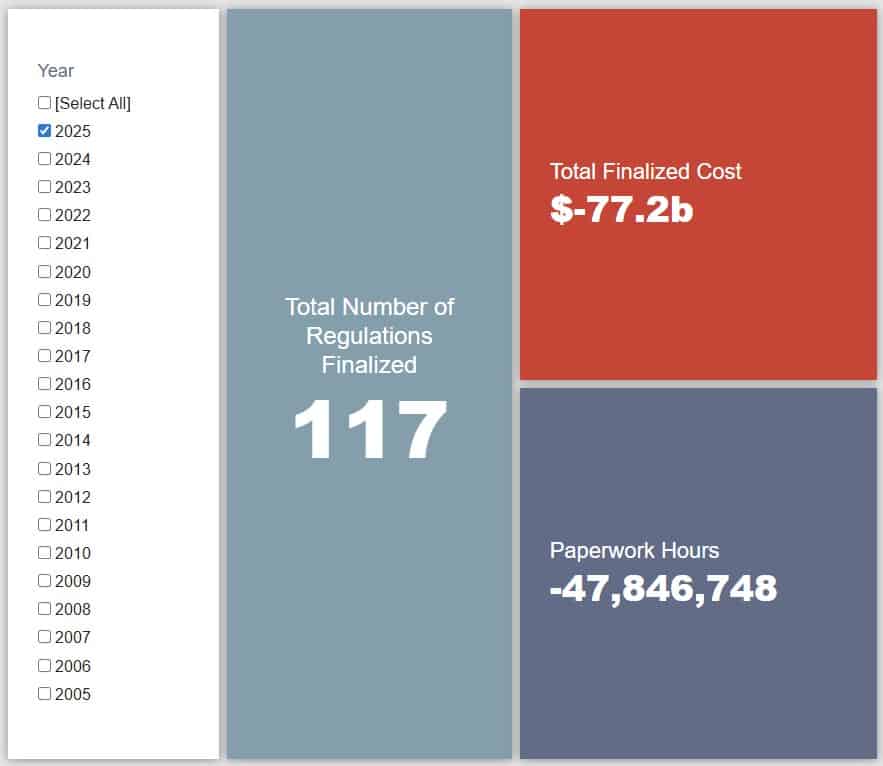
- 2025 Final Rule Costs: -$77.2 billion
- 2025 Proposed Rule Costs: -$626 billion
NOTABLE REGULATORY ACTIONS
As mentioned above, the most consequential action of the week was the EPA proposed rule on “Reconsideration of 2009 Endangerment Finding and Greenhouse Gas Vehicle Standards.” The proposal, released last Wednesday and then quickly published in the Federal Register by Friday, seeks “to rescind the Endangerment Finding and all resulting GHG emission standards for new motor vehicles and engines, including the light-duty, medium-duty, and heavy-duty vehicle and engine standards for model years (MY) 2012 to 2027 and beyond.”
The endangerment finding in question is the 2009 document that provides the legal basis for EPA to regulate GHG emissions under the Clean Air Act. The American Action Forum (AAF) in March reviewed the implications of rescinding the endangerment finding here. Assuming this rule becomes final and survives additional legal scrutiny, the effects of the endangerment finding’s repeal would be broad and profound, albeit difficult to quantify in many respects.
As for the GHG standards portion of this rulemaking, however, EPA was able to conduct a preliminary analysis of economic impacts resulting from those provisions. While the proposal seeks to rescind relevant standards going all the way back to 2010 rulemakings, most of the rules since then have already been implemented. The items this proposed rule focuses on in its analysis are the most recent rounds of these standards for light-and-medium-duty and heavy-duty vehicles, respectively, that combined for nearly $900 billion in total “vehicle technology” costs (the expected “rise in the average purchase price for consumers”).
EPA includes a series of alternative cost-benefit estimates in the rule’s Regulatory Impact Analysis (RIA). For the purposes of RegRodeo measurement, AAF is recording the estimate for Vehicle Technology savings of $800 billion (found in Table A-2 of the RIA). This estimate largely utilizes the same methodology as EPA used for its 2024 rule estimates but also factors in the implications of repealing certain clean energy tax credits under the reconciliation package, as well as the end of California’s state-level emission standards due to the passage of a series of Congressional Review Act (CRA) resolutions. The one main incongruity between these estimates is the discount rate, with the 2024 rules using a 2-percent rate under the Biden Administration’s short-lived adjustment to regulatory analysis procedures. Nevertheless, the respective estimates are within the same order of magnitude.
Since this rulemaking is still in the proposed rule stage – and likely faces a long and winding road to finalization – these savings will not yet officially count toward the administration’s regulatory budget under Executive Order 14192. Another EPA rule issued last week, however, will provide the agency with a sizeable savings estimate to add to its deregulatory tally. The aptly titled rule on “Extension of Deadlines in Standards of Performance for New, Reconstructed, and Modified Sources and Emissions Guidelines for Existing Sources: Oil and Natural Gas Sector Climate Review Final Rule” delays the full implementation of another 2024 final rule. The agency expects such extensions to yield roughly $1.4 billion in regulatory relief for covered entities.
TRACKING TRUMP 2.0
With various trade policy developments drawing the bulk of the administration’s attention last week, there was virtually nothing new in terms of broader regulatory policy pronouncements from the White House. The only real CRA development of the week was another set of resolutions introduced by a Democratic senator against a Trump Administration rule. Senator Sheldon Whitehouse (D-RI) added on to the cohort of resolutions he introduced the week prior by filing resolutions on the following Trump Administration actions:
- “Estate Tax Closing Letter User Fee Update”
- “National Volatile Organic Compound Emission Standards for Aerosol Coatings: Interim Final Rule”
- “Pipeline Safety: Editorial Change To Reflect the Name Change of the Gulf of Mexico to the Gulf of America”
Be sure to check the AAF CRA tracker for a full survey of activity under the law during the first part of 2025. As of today, members of the 119th Congress have introduced CRA resolutions of disapproval addressing 57 rulemakings across the Biden and Trump Administrations that collectively involve $138 billion in compliance costs. Of these, 16 have been passed into law, repealing a series of Biden Administration rules that had a combined $3 billion in associated compliance costs – roughly 2 percent of that potential $138 billion total. While the main window of CRA action has largely passed, there are still outstanding resolutions that could move legislatively. AAF will continue to monitor and update such developments as appropriate.
TOTAL BURDENS
Since January 1, the federal government has published $703.2 billion in total regulatory net cost savings (with $77.2 billion in cost savings from finalized rules) and 85.5 million hours of net annual paperwork cuts (with 47.8 million hours coming from final rules).