Week in Regulation
December 12, 2022
Energy and Environment Rules Fuel Busy Week
In yet another busy week of rulemaking, regulations regarding energy and environmental issues took center stage. There were 18 rulemakings with some measurable economic impact. Proposed rules from the Environmental Protection Agency (EPA) and Department of Energy (DOE) provided the main highlights of the week. Across all rulemakings, agencies published $13.3 billion in total costs and added 5.8 million annual paperwork burden hours.
REGULATORY TOPLINES
- Proposed Rules: 49
- Final Rules: 61
- 2022 Total Pages: 75,879
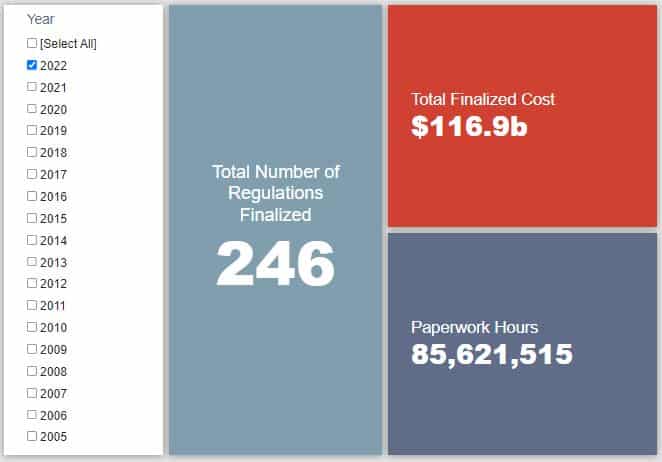
- 2022 Final Rule Costs: $116.9 billion
- 2022 Proposed Rule Costs: $152.8 billion
NOTABLE REGULATORY ACTIONS
The most consequential rulemaking of the week was a proposed rule from EPA regarding “Standards of Performance for New, Reconstructed, and Modified Sources and Emissions Guidelines for Existing Sources: Oil and Natural Gas Sector Climate Review.” The action technically represents a “supplemental notice of proposed rulemaking” that builds off of a November 2021 proposal. This current supplemental proposal would establish more stringent standards and cover a wider scope of operations than the November 2021 iteration. To put into perspective how much more expansive this version is, EPA estimates the current action to bring $12 billion in total costs – roughly twice that of the $6.3 billion estimated in the November 2021 action.
The second most notable rulemaking of the week was DOE’s proposed rule regarding “Energy Conservation Program: Energy Conservation Standards for Circulator Pumps.” This current proposal builds upon a 2016 rule that established broad efficiency standards for “pumps” generally. This action focuses its attention on the sub-category of devices designated as “circulator pumps.” DOE estimates that this new standard could bring roughly $950 million in total “Incremental Product Costs” for such pumps.
TRACKING THE ADMINISTRATIONS
As we have already seen from executive orders and memos, the Biden Administration will surely provide plenty of contrasts with the Trump Administration on the regulatory front. And while there is a general expectation that the current administration will seek to broadly restore Obama-esque regulatory actions, there will also be areas where it charts its own course. Since the AAF RegRodeo data extend back to 2005, it is possible to provide weekly updates on how the top-level trends of President Biden’s regulatory record track with those of his two most recent predecessors. The following table provides the cumulative totals of final rules containing some quantified economic impact from each administration through this point in their respective terms.
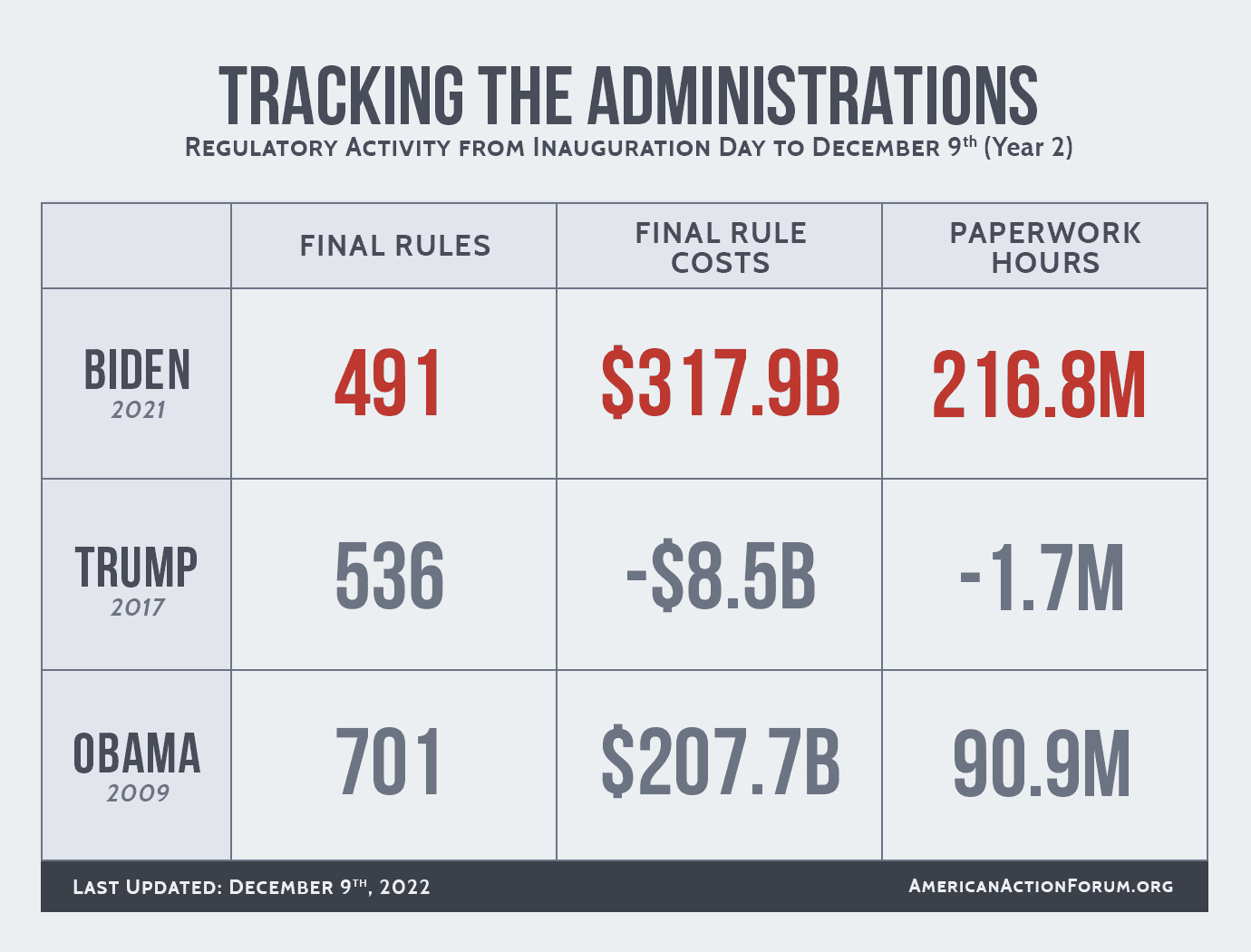
While the most significant actions of the week fell into the proposed rule column, there was some modest movement in the Biden Administration’s final rule totals. Biden-era costs and paperwork rose by $569.5 million and nearly 171,000 hours, respectively. The thematic trend of environmental issues also continued. An EPA rule focusing on oil and gas operations “on Indian country lands within the Uintah and Ouray Indian Reservation (also referred to as the U&O Reservation)” provided the bulk of those increases. The most notable movement across either of the other administrations came from the Obama years with a $222.5 million cost bump. An EPA rule on “Water Quality Standards for the State of Florida’s Lakes” was the main driver of that trend.
THIS WEEK’S REGULATORY PICTURE
This week, the Transportation Security Administration (TSA) delays – again – enforcement of the REAL ID program.

On December 5, TSA announced that it would issue new regulations to extend the enforcement deadline of the REAL ID program by two years, to May 7, 2025. The move marks the latest delay of full enforcement of the program, which was initially slated to begin in 2011.
The REAL ID program was created by the REAL ID Act, a 2005 law that established minimum standards for state-issued identification cards in the wake of the September 11, 2001, terrorist attacks. Among the requirements included in the legislation were physical security features to prevent tampering, counterfeiting, or duplication and common machine-readable technology. Once full enforcement begins, persons will need compliant identification cards to enter federal buildings and board federally regulated commercial aircraft.
A final rule implementing the program was published in early 2008 and granted states a compliance deadline of May 2011 if they could demonstrate progress toward implementation. Since that time, states have run into myriad problems implementing the program, including costs. Last year, TSA estimated that only about 43 percent of current identification cards held by the public were compliant.
The COVID-19 pandemic has added a further complication in getting cards in the hands of those with outdated identification, and is the main driver of the latest extension, according to TSA.
TOTAL BURDENS
Since January 1, the federal government has published $269.8 billion in total net costs (with $116.9 billion in new costs from finalized rules) and 174.9 million hours of net annual paperwork burden increases (with 85.6 million hours in increases from final rules).