Week in Regulation
June 15, 2026
One DOJ Rule and Not Much Else
Coming off of the frenetic week that preceded it, this past week was much more muted. There was a grand total of five rulemakings that had some kind of measurable economic impact. Of these, only one really stood out. A Department of Justice (DOJ) rule implementing aspects of a 2022 law regarding the prescription and dispensing of certain controlled substances could bring billions of dollars in costs as well as apparently sizable, yet non-quantified, “societal cost savings.” Overall, federal agencies published roughly $2.7 billion in total costs and added 1,053 paperwork burden hours.
REGULATORY TOPLINES
- Proposed Rules This Week: 19
- Final Rules This Week: 65
- 2026 Total Pages: 35,804
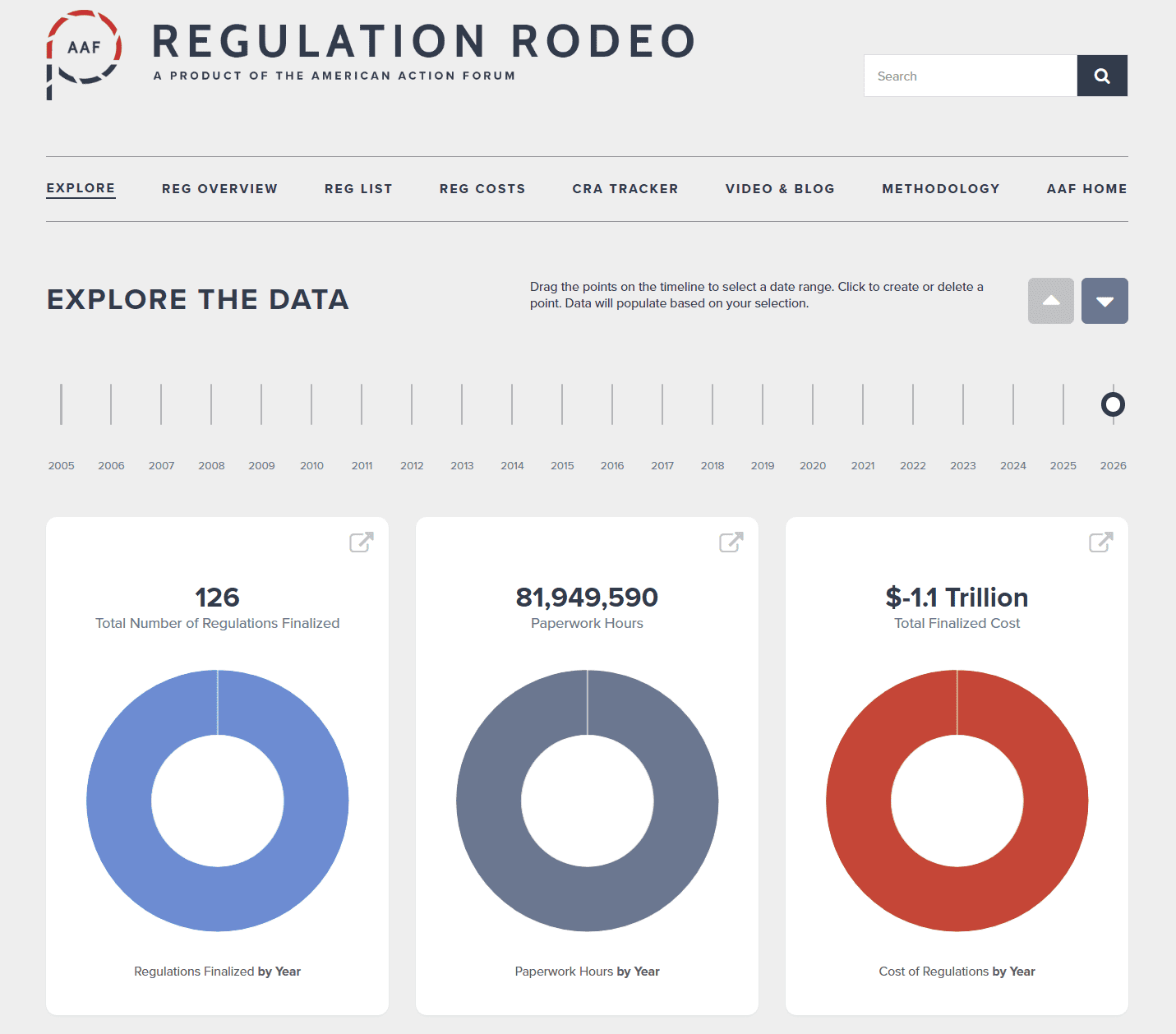
- 2026 Final Rule Costs: -$1.1 trillion
- 2026 Proposed Rule Costs: $64.8 billion
NOTABLE REGULATORY ACTIONS
The most significant rulemaking of the week was the DOJ rule regarding “Implementation of the Substance Use-Disorder Prevention That Promotes Opioid Recovery and Treatment for Patients and Communities [SUPPORT] Act of 2018: Dispensing and Administering Controlled Substances for Medication-Assisted Treatment.” The rule builds off an interim final rule promulgated in 2020 that implemented aspects of the SUPPORT Act. In the intervening years – more specifically December 2022 – the Restoring Hope for Mental Health and Well-Being Act was passed into law and “removed many of the statutory provisions of the SUPPORT Act.” Per the agency: “This final rule adopts the provisions of the interim final rule that are still applicable as final, with minor changes. In addition, this final rule implements the related provisions of the Restoring Hope for Mental Health and Well-Being Act of 2022.”
The main, quantifiable aspects of the new rule are the new training and certification requirements to become a “qualified practitioner.” DOJ estimates that the costs of these new requirements could add up to $2.7 billion over a 10-year horizon (when discounted at a 7-percent rate). The agency also notes that the changes in question will increase “the number of practitioners who will be authorized to dispense narcotic drugs in schedules III, IV, and V for maintenance or detoxification treatment,” and “anticipates the increase in the number of patients receiving treatment authorized by this final rule will generate a substantial benefit in the form of societal cost savings.” DOJ is unable to quantify the level of impact of this dynamic but seemingly expects the effects to be extensive enough that they warrant designating this rule as a “deregulatory” action under Executive Order (EO) 14192.
TRACKING TRUMP 2.0
In assessing 2026 rulemakings that include an EO 14192 determination, there have been 48 “deregulatory” rules with combined total savings of $1.1 trillion against nine “regulatory” rules that involve roughly $45.7 billion in costs. Adding that to the total agencies produced during 2025 (at least from rules that had a clear “regulatory” or “deregulatory” designation), the Trump Administration has enacted $1.2 trillion in total cost reductions thus far under EO 14192. Rules for which agencies have claimed one of the EO’s exemptions have accounted for an additional $7.6 billion in costs so far in 2026.
CONGRESSIONAL REVIEW ACT (CRA)
The AAF CRA tracker provides a full survey of activity under the law thus far into this term. As of today, members of the 119th Congress have introduced CRA resolutions of disapproval addressing 137 “rules” across the Biden and Trump Administrations that collectively involve $173.6 billion in estimated compliance costs. Of these, 23 have been passed into law, repealing a series of Biden Administration rules that had a combined $3 billion in associated compliance costs. The Trump Administration estimates that the repeal of this rule yields an additional $936 million in savings. While the main window of CRA action has largely passed, there are still outstanding resolutions that could move legislatively. AAF will continue to monitor and update such developments as appropriate.
TOTAL BURDENS
Since the start of 2026, the federal government has published $986.8 billion in total regulatory net cost savings (with $1.1 trillion in reductions from finalized rules) and 106.9 million hours of net annual paperwork increases (with 81.9 million hours coming from final rules).