Week in Regulation
June 29, 2026
Proposed SNAP Cost-shift Overshadows Other Rulemakings
This past week was a fairly lively one in the pages of the Federal Register. There was a grand total of 17 rulemakings that carried some kind of quantifiable economic impact. Some of these – such as a proposed rule from the Consumer Product Safety Commission (CPSC) on new battery standards or a Nuclear Regulatory Commission (NRC) proposal to update facility security requirements – brought sizable direct regulatory costs or savings, respectively. The rulemaking that brought the largest economic effect, however, was the proposed rule from the Department of Agriculture (USDA) implementing a significant shift in the cost burden of the Supplemental Nutrition Assistance Program (SNAP) as directed by the “One Big Beautiful Bill Act.” Overall, federal agencies published roughly $17.6 billion in total costs but cut 1.3 million paperwork burden hours.
REGULATORY TOPLINES
- Proposed Rules This Week: 55
- Final Rules This Week: 88
- 2026 Total Pages: 38,917
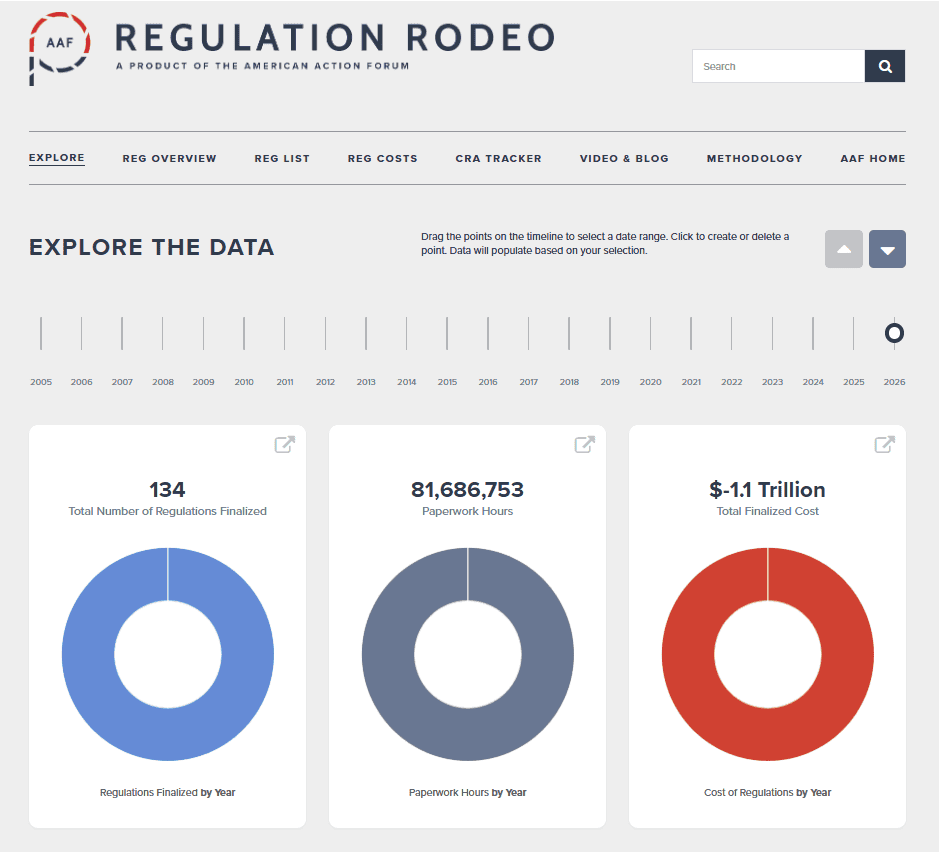
- 2026 Final Rule Costs: -$1.1 trillion
- 2026 Proposed Rule Costs: $82.3 billion
NOTABLE REGULATORY ACTIONS
The most consequential rulemaking of the week was the USDA proposal regarding “Supplemental Nutrition Assistance Program: Changes in Federal-State Administrative Cost Sharing.” As the rulemaking’s summary succinctly states:
In response to Section 10106 of Public Law 119-21, the One Big Beautiful Bill Act of 2025, this proposed rule would amend the Supplemental Nutrition Assistance Program (SNAP) regulations to codify the reduction of the amount of the Federal government’s share of annual SNAP State administrative costs from 50 percent to 25 percent, effective beginning in fiscal year 2027.
The agency estimates that “State administrative spending to implement this proposed rule…[will increase costs by] $16.9 billion over FY 2027 to FY 2031, or an annual average of $3.4 billion,” and also notes in the relevant section how it is a federal spending mandate that triggers the Unfunded Mandates Reform Act. While the American Action Forum’s (AAF) RegRodeo project does not track rules undertaking fiscal actions that are purely federal in nature, when such actions implicate state or local governments in this manner they represent federal regulatory impositions (and thus recordable costs) on those entities.
In terms of rulemakings that had a more direct regulatory or deregulatory impact on relevant parties, there were a couple of rather substantial items. CPSC proposed a new “Safety Standard for Lithium-Ion Batteries Used in Micromobility Products and Electrical Systems of Micromobility Products Containing Such Batteries.” The commission estimates that these new standards will involve $147 million in annual compliance costs (or roughly $1.8 billion total when extrapolated over the 30-year analytic window). On the deregulatory side of the ledger, NRC proposed a rule on “Modernizing Security Requirements.” The proposal seeks to make a series of updates to the regulatory code that “are intended to reduce regulatory burden, where appropriate, while continuing to provide reasonable assurance that safety and security will be adequately maintained at NRC-licensed facilities.” The commission expects such changes to yield $557 million in total cost savings for affected facilities.
TRACKING TRUMP 2.0
In assessing 2026 rulemakings that include an Executive Order (EO) 14192 determination, there have been 50 “deregulatory” rules with combined total savings of $1.1 trillion against 10 “regulatory” rules that involve roughly $45.7 billion in costs. Adding that to the total agencies produced during 2025 (at least from rules that had a clear “regulatory” or “deregulatory” designation), the Trump Administration has enacted $1.2 trillion in total cost reductions thus far under EO 14192. Rules for which agencies have claimed one of the EO’s exemptions have accounted for an additional $7.6 billion in costs so far in 2026.
CONGRESSIONAL REVIEW ACT (CRA)
The AAF CRA tracker provides a full survey of activity under the law thus far into this term. As of today, members of the 119th Congress have introduced CRA resolutions of disapproval addressing 138 “rules” across the Biden and Trump Administrations that collectively involve $176 billion in estimated compliance costs. Of these, 23 have been passed into law, repealing a series of Biden Administration rules that had a combined $3 billion in associated compliance costs. The Trump Administration estimates that the repeal of this rule yields an additional $936 million in savings. While the main window of CRA action has largely passed, there are still outstanding resolutions that could move legislatively. AAF will continue to monitor and update such developments as appropriate.
TOTAL BURDENS
Since the start of 2026, the federal government has published $969.6 billion in total regulatory net cost savings (with $1.1 trillion in reductions from finalized rules) and 105.6 million hours of net annual paperwork increases (with 81.7 million hours coming from final rules).