Week in Regulation
May 19, 2025
“Energy” in the Executive
It was yet another sparse week in terms of rules that had clearly quantified economic impacts with only four rulemakings containing such estimates. The most active agency of the week was far and away the Department of Energy (DOE) with dozens of rulemakings hitting the pages of the Federal Register last Friday. Despite that conspicuous flurry of activity, none of the rules included measurable economic estimates in their analyses. Perhaps the main development of the week was the curtain closing on Senate Republicans’ ability to sidestep the filibuster for Congressional Review Act (CRA) resolutions of disapproval on late-breaking Biden-era regulations. Across all rulemakings, agencies published $6.1 million in total costs and cut 47 paperwork burden hours.
REGULATORY TOPLINES
- Proposed Rules: 61
- Final Rules: 59
- 2025 Total Pages: 21,263
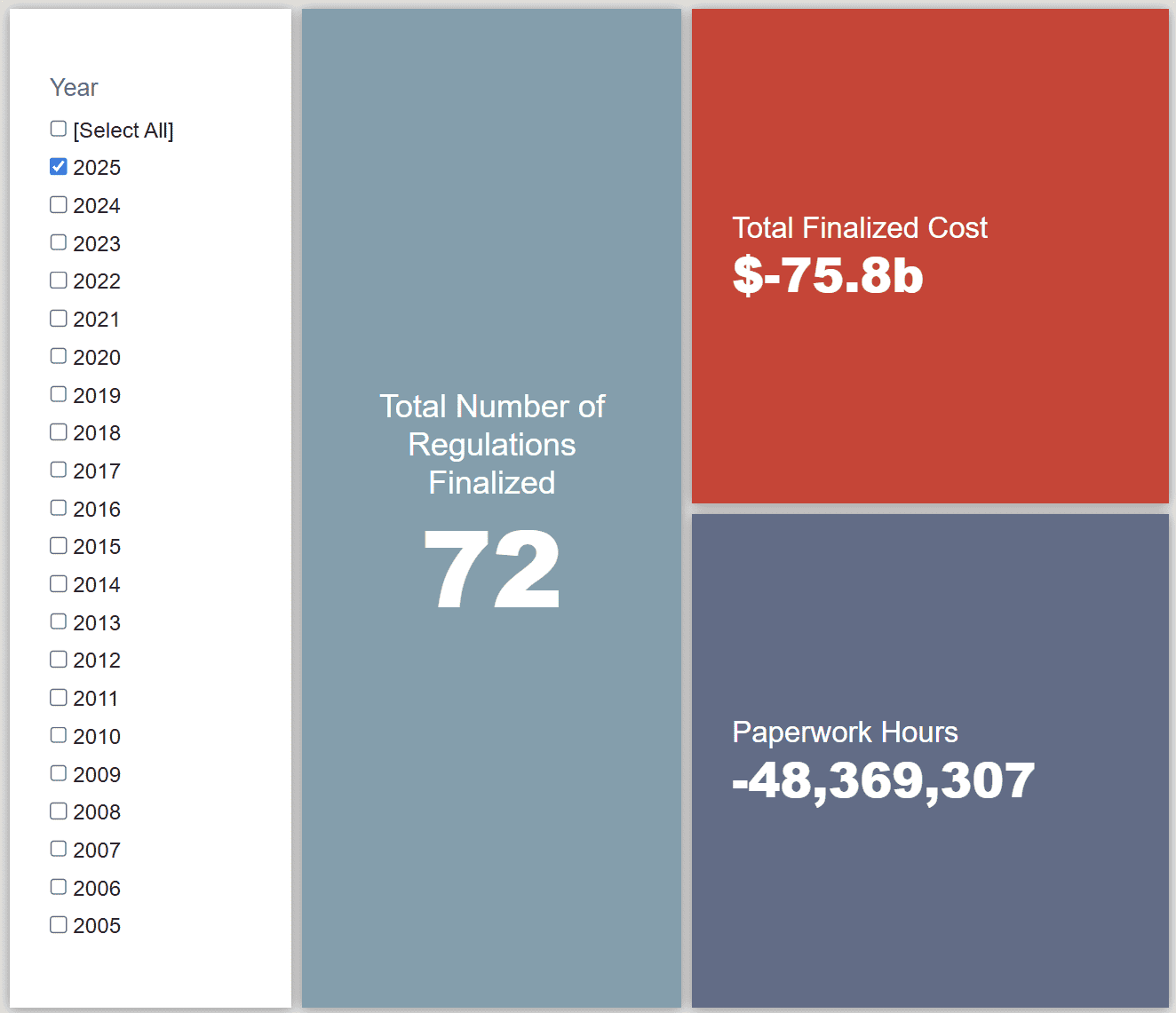
- 2025 Final Rule Costs: -$75.8 billion
- 2025 Proposed Rule Costs: $181.3 billion
NOTABLE REGULATORY ACTIONS
To demonstrate how marginal of a week it was in terms of rulemakings with some substantial economic impact, consider that the most “significant” rulemaking was an airworthiness directive with roughly $4.6 million in total costs. Enough said.
Turning back to the deluge of DOE actions, the 43 rulemakings hitting the books last Friday represent a large majority of the actions the agency announced earlier in the week. While the agency press release on the matter claimed that, “Once finalized, these actions will save the American people an estimated $11 billion,” none of the rulemakings published contained quantified estimates in the respective portions where one finds cost-benefit analyses.
Part of this is due to the actions addressing such items as regulatory code that has been obsolete for decades now and/or issues on which one may be surprised to find DOE has any sort of regulatory purview to begin with, such as transgender athletes. Even in instances where DOE is seeking to change policies that had a substantial economic impact, such as this proposed recission of efficiency standards for external power supplies from 2014, the exercise of discerning the economic effects of overturning now-longstanding standards is more complicated than simply declaring the negative value of the originally estimated costs.
The rulemakings DOE promulgated here are either in the proposed stage – and thus must still go through the full notice-and-comment process – or have been designated as “direct final rules.” Those in the latter category, however, carry the following conditional status: “If significant adverse comments are received, notice will be published in the Federal Register before the effective date either withdrawing the rule or issuing a new final rule which responds to significant adverse comments.” As such, it will take some time to determine which actions officially become actual policy. Nevertheless, the sheer volume of rulemakings from DOE is remarkable and likely puts the agency in position to, if nothing else, achieve the rule-counting aspect of Executive Order 14192’s “10-out-for-every-1-in” edict.
TRACKING TRUMP 2.0
Especially with the president being abroad for most of this past week, there was not much in terms of broad regulatory policy announcements from the White House. The most consequential development of the week for the Trump Administration’s regulatory agenda thus far into this term came as the window closed for repealing Biden-era regulations – outside of a handful of notable exceptions – with a simple majority vote in the Senate under the CRA. Going forward, the administration will need to implement its deregulatory actions via the full rulemaking process.
As the American Action Forum (AAF) projected last week, the final day for expedited consideration in the Senate for CRA resolutions of disapproval on Biden Administration rules came and went last Thursday. As significant as this occurrence was, one could hardly tell it upon looking at the Senate’s schedule – devoted almost entirely to confirmation votes – this past week. There are still three Senate-passed resolutions that await action in the House where the filibuster issue is, of course, moot. In fact, the House appears set to take up two of them this week. Furthermore, the Senate appears likely to take up the relatively novel resolutions addressing the Environmental Protection Agency waiver determinations for California’s emissions standards soon.
Assuming all six of these still-operable resolutions floating out there make their way to President Trump’s desk for his signature, they will join 11 others that either have or shortly will become law. That will bring the 2025 Republican “trifecta” CRA totals to 17 Biden-era rules, with roughly $3 billion total associated costs, which are now repealed. By way of comparison, the initial 2017 tranche of CRA resolutions repealed 14 Obama-era rules with $3.7 billion in total associated costs. This is a rather surprising result, considering how, in light of Trump’s election last fall, one would have expected this incoming administration and Congress to be far more aggressive on the CRA front than their predecessors.
Be sure to follow the AAF CRA tracker. As of today, members of the 119th Congress have introduced CRA resolutions of disapproval addressing 43 Biden-era rules that collectively involve $137.5 billion in compliance costs. Given the passage of the look-back window discussed above, it is highly unlikely any more resolutions of disapproval will be introduced this term. Since there are still outstanding resolutions that could move legislatively, however, AAF will continue to monitor and update such developments as appropriate.
TOTAL BURDENS
Since January 1, the federal government has published $105.5 billion in total net costs (with $75.8 billion in cost savings from finalized rules) and 69.5 million hours of net annual paperwork cuts (with 48.4 million hours coming from final rules).