Week in Regulation
May 12, 2025
Not Much Rulemaking to Kick Off May, But Plenty Else
The first full week of May was a relatively desolate one on the regulatory front. There was a grand total of two rulemakings – both in the proposed rule stage – in the pages of the Federal Register last week. Neither was of any great consequence. There was, however, a substantial amount of Congressional Review Act (CRA) news as the window for simple majority votes in the Senate on Biden-era rules nears its endgame. Across all rulemakings, agencies published $11.3 million in total costs and added 1,016 paperwork burden hours.
REGULATORY TOPLINES
- Proposed Rules: 22
- Final Rules: 47
- 2025 Total Pages: 20,033
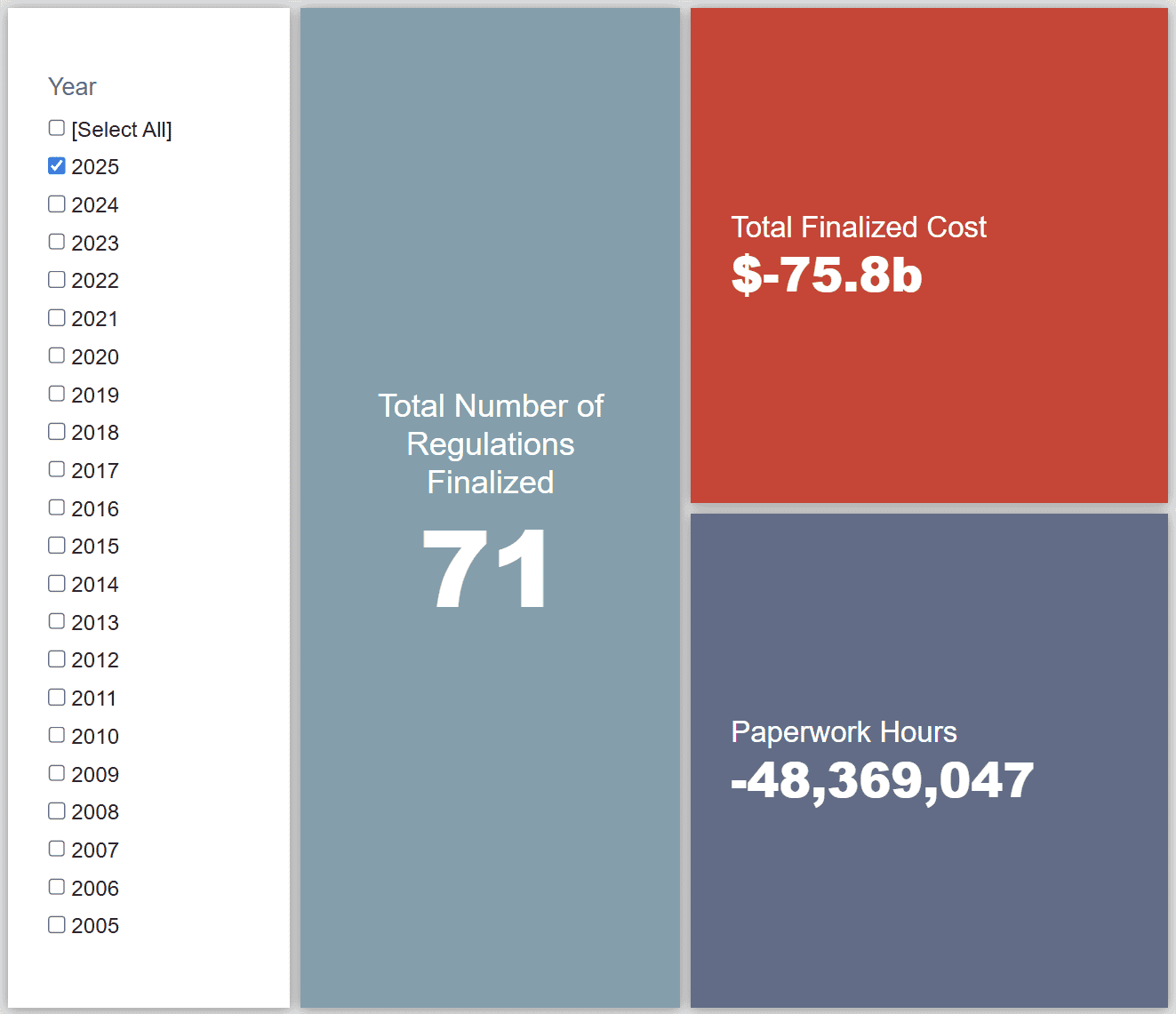
- 2025 Final Rule Costs: -$75.8 billion
- 2025 Proposed Rule Costs: $181.3 billion
NOTABLE REGULATORY ACTIONS
As discussed above, it was a remarkably quiet week in terms of rulemaking activity. The most significant item of the week was a proposed rule from the Federal Communications Commission (FCC) regarding “Wireless E911 Location Accuracy Requirements.” As the title suggests, the proposal seeks “to strengthen wireless 911 location accuracy rules and to put more actionable location information in the hands of Public Safety Answering Points (PSAPs) and first responders.” FCC estimates that this will involve $10.9 million in total costs to achieve such objectives.
TRACKING TRUMP 2.0
While agency actions were relatively muted, there was plenty happening in terms of the Trump Administration’s broader regulatory agenda – punctuated by a rather busy Friday afternoon. Perhaps most notably, the president finally signed a half-dozen CRA resolutions of disapproval into law. This now means nine Biden-era rules, with roughly $2.9 billion in associated costs, have been officially repealed via the CRA this term. These numbers, however, still lag behind the totals achieved during the opening salvo of the first Trump term. As discussed further below, the opportunity for this Republican “trifecta” to match or exceed such marks is quickly waning.
Beyond these CRA signatures, the president also found time this past Friday to issue a series of orders and memoranda concerning regulatory issues that varied in issue area and significance. The most consequential item was the executive order (EO) regarding “Fighting Overcriminalization in Federal Regulations.” At its core, the EO represents this White House’s effort to effectuate certain principles of past mens rea reform proposals administratively. While it may take some time and legal wrangling for the impacts of this EO to become apparent, it could represent yet another profound shift from this administration on the posture of federal regulatory enforcement. As with other aspects of the Trump Administration’s agenda, however, this one specifies that “[N]othing in this order shall apply to the enforcement of the immigration laws or regulations promulgated to implement such laws, nor shall it apply to the enforcement of laws or regulations related to national security or defense.”
The other late-breaking items from last week are not as sweeping but are still interesting in their own unique ways. Building from his EO regarding showerheads from last month, President Trump issued a presidential memorandum entitled “Rescission of Useless Water Pressure Standards.” The memo directs the Department of Energy “to rescind – or, as appropriate, amend to revert to the standards required by statute – the regulations” on water conservation and efficiency for a host of product categories including: “‘automatic clothes washer,’ ‘clothes washer,’ ‘dishwasher,’ ‘faucet,’ ‘other clothes washer,’ ‘semi-automatic clothes washer,’ ‘urinal,’ and ‘water closet.’”
Keeping with the “efficiency” theme – albeit in an entirely different context – the president also issued an EO on “Increasing Efficiency at the Office of the Federal Register.” Finding that inefficiencies in the Federal Register publication process “inhibit my Administration’s deregulatory agenda and waste taxpayer money,” the president directs the Archivist of the United States[1] to essentially conduct an audit of any Federal Register publication delays as well as assess how to update the printing cost structure involved.
Another notable regulatory policy document emanating from the White House earlier last week was the president’s EO on “Regulatory Relief to Promote Domestic Production of Critical Medicines.” The EO directs various agencies – from expected ones such as the Food and Drug Administration to some less-obvious ones such as the Army Corps of Engineers – to assess and update their relevant regulatory policies “to facilitate the restoration of a robust domestic pharmaceutical manufacturing base.” The latest edition of the American Action Forum’s (AAF) “Weekly Checkup” dives into the EO’s implications here.
Over on Capitol Hill, the Senate had an active week of CRA votes, passing the following resolutions of disapproval:
- J Res 61 (Passed 55-45)
- J. Res 13 (Passed 52-47)
- J. Res 7 (Passed 50-38)
- J Res 60 (Passed 50-43)
With H.J. Res 60 and 61 – addressing a Department of Interior rule on motor vehicles in Glen Canyon National Recreation Area and an Environmental Protection Agency rule on emissions standards for rubber manufacturing plants, respectively – advancing through the upper chamber, they now join 11 such resolutions that have fully passed through the 119th Congress. The other two resolutions, which focus on an FCC rule regarding “Addressing the Homework Gap Through the E-Rate Program” and a Department of Treasury rule on back mergers, now stand poised for potential consideration on the House side. Since the House does not have the filibuster, that chamber can vote on such resolutions at its leisure.
The Senate, though, is now down to its final countdown for most[2] filibuster-proof CRA votes on Biden-era rulemakings. AAF previously estimated that this window would close today, May 12th. An updated assessment, based upon the actual number of “session days” in April and the Senate’s projected schedule for this week, now points to this Thursday (the 15th) as the end-date for expedited CRA votes in the Senate.
Be sure to follow the AAF CRA tracker. As of today, members of the 119th Congress have introduced CRA resolutions of disapproval addressing 43 Biden-era rules that collectively involve $137.5 billion in compliance costs. AAF will continue to update this tracker as additional resolutions are introduced and receive votes on the floors of each chamber.
TOTAL BURDENS
Since January 1, the federal government has published $105.5 billion in total net costs (with $75.8 billion in cost savings from finalized rules) and 69.5 million hours of net annual paperwork cuts (with 48.4 million hours coming from final rules).