Week in Regulation
December 8, 2025
Enter Dereg December
The opening week of December was relatively sparse in terms of the number of rulemaking actions, with only six that contained some kind of quantifiable economic effect. What it lacked in volume, however, it more than made up for in impact with some of the most significant deregulatory items of the year. Rules from the Department of Health and Human Services (HHS) and Transportation (DOT) brought total estimated cost reductions in the tens and hundreds of billions of dollars, respectively. Across all rulemakings, federal agencies published roughly $274.5 billion in total cost savings and cut 676,334 million paperwork burden hours.
REGULATORY TOPLINES
- Proposed Rules: 25
- Final Rules: 43
- 2025 Total Pages: 56,527
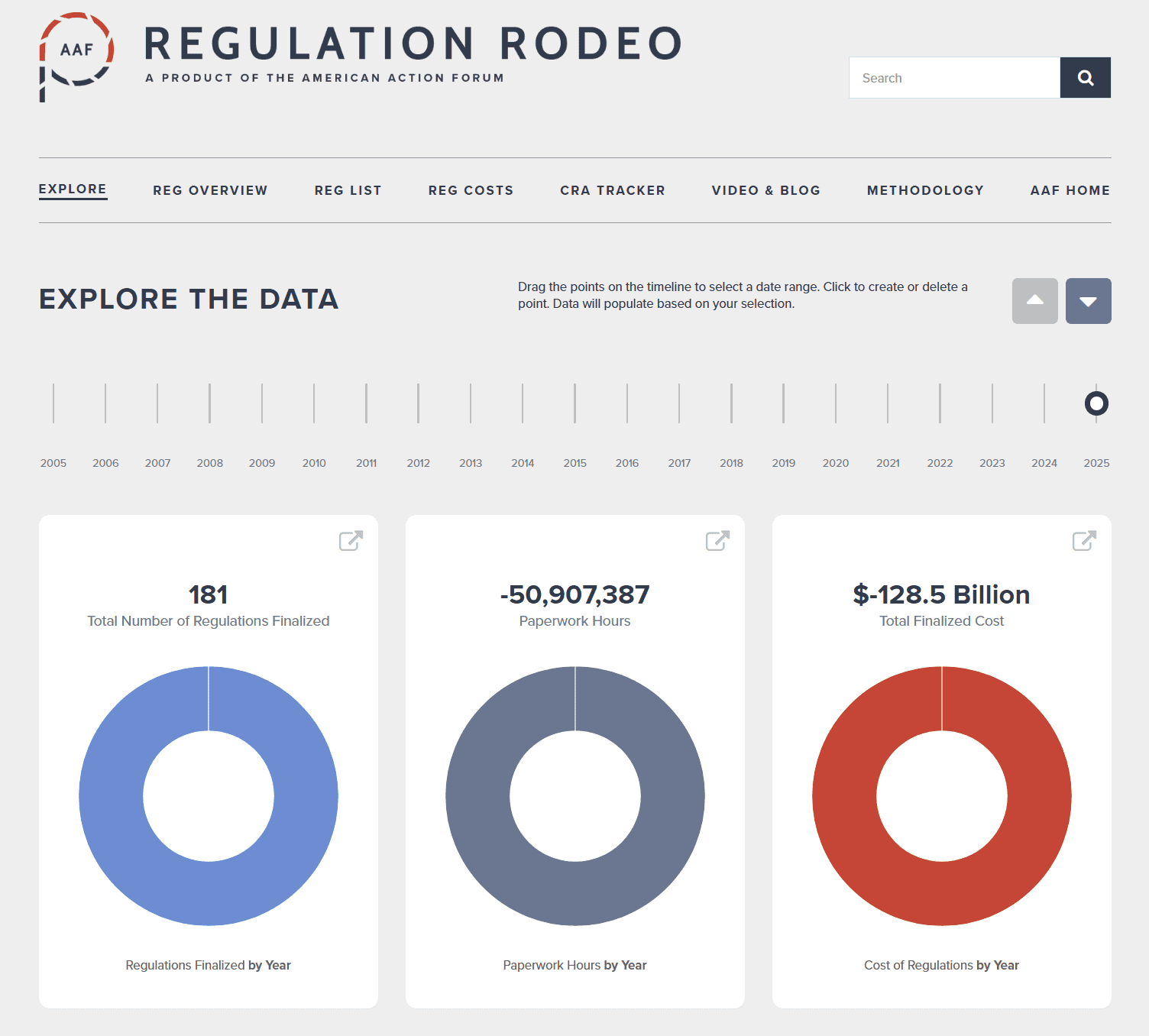
- 2025 Final Rule Costs: -$128.5 billion
- 2025 Proposed Rule Costs: -$847.6 billion
*IMPORTANT ANNOUNCEMENT*
The American Action Forum (AAF) is proud to announce a revamped version of our Regulation Rodeo (or RegRodeo) project. For those unfamiliar with it, AAF’s RegRodeo database houses information on federal regulations going back to 2005. Launched in 2015, RegRodeo tracks every proposed and final rule published in the Federal Register that includes a quantified economic impact or paperwork burden estimate. This version makes the following improvements to the site:
- Clearer graphics and layout;
- An updated, more intuitive user interface;
- Enhanced ability to share findings across social media platforms;
- The opportunity to export selected sets of regulatory cost/savings data; and
- Direct links to additional AAF material on regulatory policy matters such as the Congressional Review Act (CRA).
NOTABLE REGULATORY ACTIONS
The most consequential rulemaking of the week was the DOT proposed rule on “The Safer Affordable Fuel-Efficient (SAFE) Vehicles Rule III for Model Years [MY] 2022 to 2031 Passenger Cars and Light Trucks.” This proposal represents the Trump Administration’s latest salvo regarding the Corporate Average Fuel Economy (CAFE) program, markedly reducing the rate at which MY-over-MY fuel efficiency targets increase. DOT estimates that this would yield total cost reductions of $219.5 billion dollars through 2050 (or $18.3 billion on an annualized basis). Much as with the Biden-era set of CAFE standards it seeks to replace, it represents a substantial rulemaking that is nevertheless dwarfed by associated Environmental Protection Agency vehicle standards.
As noted in this current rulemaking, this shift in the overall standards for affected MYs comes on the heels of the provision in last summer’s One Big Beautiful Bill Act (OBBBA) legislation that zeroed out the civil penalties levied against manufacturers that are out of compliance with relevant CAFE standards. This provision would seem to essentially neuter the effective enforcement of any level of standards, thereby throwing the projected manufacturer decisions – and the resulting economic effects – into doubt. Yet in its analysis DOT expects that, based upon previous manufacturer statements, affected entities will continue to follow the relevant standards to remain in legal compliance.
The other major rulemaking of the week was the HHS interim final rule on “Medicare and Medicaid Programs; Repeal of Minimum Staffing Standards for Long-Term Care Facilities.” As the title plainly suggests, the rulemaking would repeal the standards set by the Biden Administration in May 2024. HHS is implementing the rule directly as an interim final rule under the auspices of (another) OBBBA provision that restricts the agency from “implementing, administering, or enforcing the minimum staffing standards…until after September 30, 2034.” The agency estimates that this will result in $55.1 billion in total cost savings for affected facilities over a 10-year window. As HHS itself notes, this savings total exceeds the net-cost total of the original Biden-era rule by a sizable margin. This divergence is due to:
- A shift in the analytical window, with the Biden rule examining a 2024–2033 window vs. this current window that assumes an additional $6.6 billion in projected economic impacts in 2034; and
- Adjusting “all estimates to 2024 dollars” whereas the Biden rule used 2021 dollars in its calculations.
TRACKING TRUMP 2.0
The main non-rulemaking regulatory policy news of the week was the Senate passing another CRA resolution of disapproval. The upper chamber passed H.J. Res 131 by a 49-45 vote this past Thursday. The resolution would repeal another Biden-era Department of Interior oil and gas leasing determination. It now joins the recently passed H.J. Res 130 at the White House for President Trump’s expected signature.
The AAF CRA tracker provides a full survey of activity under the law thus far in 2025. As of today, members of the 119th Congress have introduced CRA resolutions of disapproval addressing 69 rulemakings across the Biden and Trump Administrations that collectively involve $138 billion in compliance costs. Of these, 16 have been passed into law, repealing a series of Biden Administration rules that had a combined $3 billion in associated compliance costs – roughly 2 percent of that potential $138 billion total. While the main window of CRA action has largely passed, there are still outstanding resolutions that could move legislatively. AAF will continue to monitor and update such developments as appropriate.
TOTAL BURDENS
Since January 1, the federal government has published $976.1 billion in total regulatory net cost savings (with $128.5 billion in cost savings from finalized rules) and 75.1 million hours of net annual paperwork cuts (with 50.9 million hours coming from final rules).