Week in Regulation
October 14, 2025
Shutdown Swoon
As the latest federal government shutdown now approaches two weeks, agency rulemaking activity has all but dried up. While a handful of documents graced the pages of the Federal Register each day this past week, there were no appreciable changes in regulatory costs or paperwork burdens. In a rather ironic twist – given the seeming legislative intractability over relevant fiscal matters – the main regulatory policy news of the week came from the halls of Congress with a series of interesting Congressional Review Act (CRA) developments.
REGULATORY TOPLINES
- Proposed Rules: 0
- Final Rules: 5
- 2025 Total Pages: 48,134
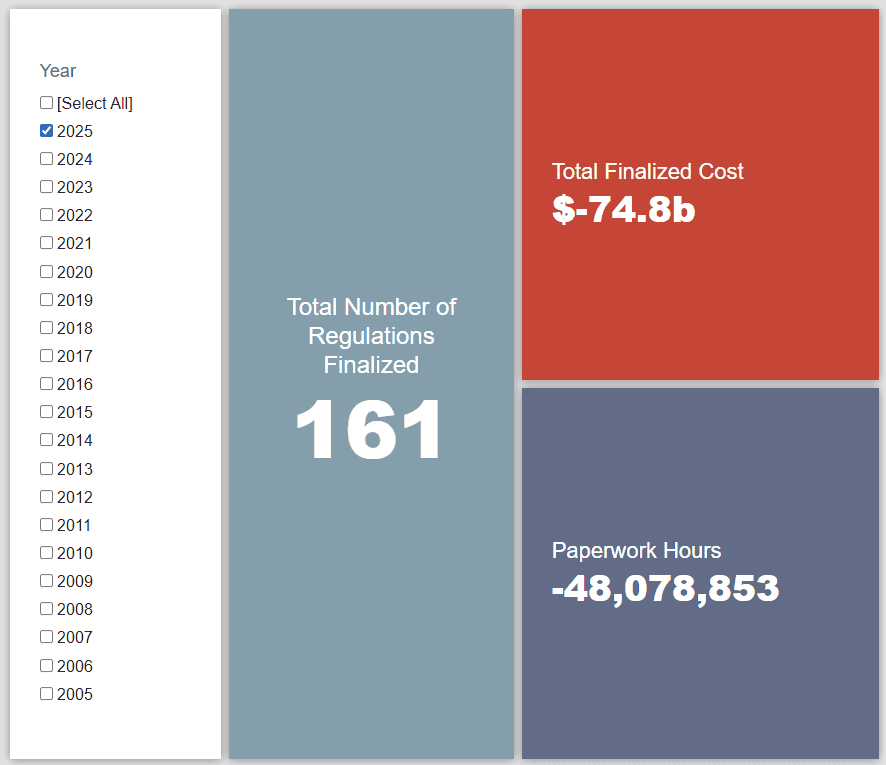
- 2025 Final Rule Costs: -$74.8 billion
- 2025 Proposed Rule Costs: -$628 billion
NOTABLE REGULATORY ACTIONS
Again, there were no rulemakings that contained meaningful economic impacts.
TRACKING TRUMP 2.0
The most significant news of the week from a regulatory perspective came in a series of Senate votes on some relatively unique CRA resolutions of disapproval. The upper chamber advanced a trio of resolutions previously passed by the House that seek to repeal a set of Department of Interior (DOI) “Resource Management Plan” (RMP) determinations made under the Biden Administration. The resolutions now head to President Trump’s desk for his expected signature. Additionally, members of the Wyoming congressional delegation introduced a pair of resolutions in each chamber seeking to repeal a similar kind of determination in their state.
The use of the CRA in these instances is notable for multiple reasons. These RMP determinations do not resemble more typical rulemaking documents and their issuance dates would generally put them beyond the CRA’s “look-back” window. What makes them live items under the Act, however, is a subsequent Government Accountability Office determination finding them to be “rules” for the purposes of the CRA. This illustrates how broad the definition of a “rule” can be under the Act. Some legal wrangling is likely to follow, but for now, the parameters established by these determinations are set to be voided out. Furthermore – perhaps even more so than with traditional rulemakings – there is the open question of whether a future administration’s DOI can issue like-minded RMPs under the CRA’s “substantially similar” provision as well.
The American Action Forum (AAF) CRA tracker provides a full survey of activity under the law thus far in 2025. As of today, members of the 119th Congress have introduced CRA resolutions of disapproval addressing 65 rulemakings across the Biden and Trump Administrations that collectively involve $138 billion in compliance costs. Of these, 16 have been passed into law, repealing a series of Biden Administration rules that had a combined $3 billion in associated compliance costs – roughly 2 percent of that potential $138 billion total. While the main window of CRA action has largely passed, there are still outstanding resolutions that could move legislatively. AAF will continue to monitor and update such developments as appropriate.
TOTAL BURDENS
Since January 1, the federal government has published $702.8 billion in total regulatory net cost savings (with $74.8 billion in cost savings from finalized rules) and 69.6 million hours of net annual paperwork cuts (with 48.1 million hours coming from final rules).