Week in Regulation
September 22, 2025
EPA Proposes Cutting Out Greenhouse Gas Reports
This past week was a fairly active one in the Federal Register with a dozen rulemakings that had some kind of measurable economic impact gracing its pages. Most of these actions, however, were relatively muted. The one exception to this trend was a proposed rule from the Environmental Protection Agency (EPA) that seeks to roll back the greenhouse gas reports that entities across various sectors currently must file. Across all rulemakings, agencies published roughly $2 billion in total cost savings and cut 2.4 million paperwork burden hours.
REGULATORY TOPLINES
- Proposed Rules: 21
- Final Rules: 62
- 2025 Total Pages: 45,217
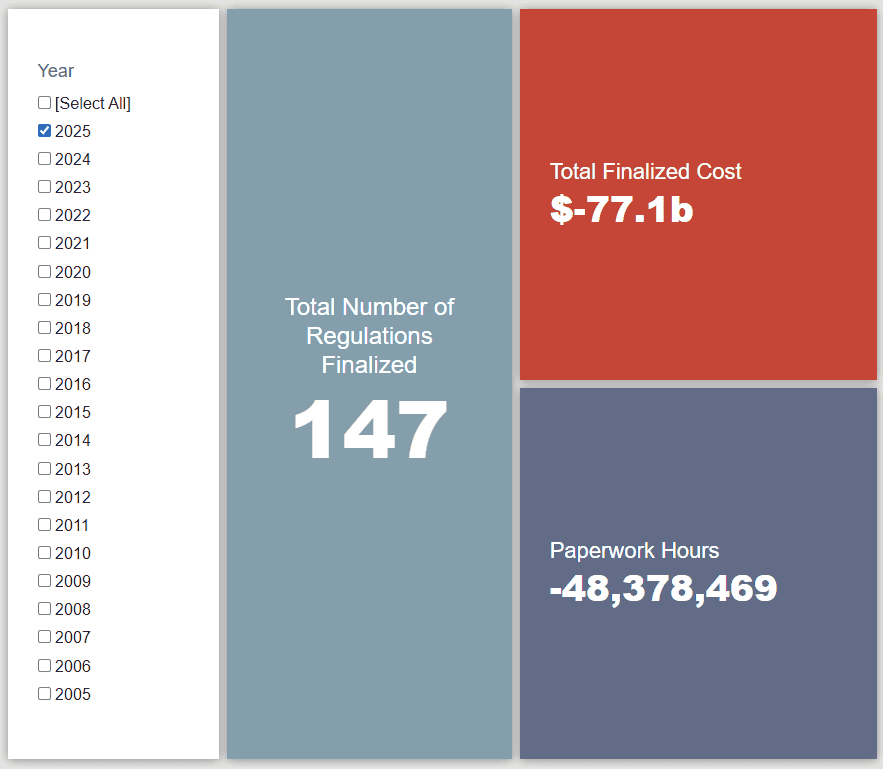
- 2025 Final Rule Costs: -$77.1 billion
- 2025 Proposed Rule Costs: -$626.6 billion
NOTABLE REGULATORY ACTIONS
The most consequential rulemaking of the week – by a wide margin – was the EPA proposal on “Reconsideration of the Greenhouse Gas Reporting Program.” The proposed rules specifically seeks:
To amend the Greenhouse Gas Reporting Program (GHGRP) to remove program obligations for most source categories, including the distribution segment of the petroleum and natural gas systems source category (subpart W—Petroleum and Natural Gas Systems), and suspend program obligations for the remaining subpart W segments until reporting year 2034.
The agency estimates that eliminating these reporting requirements will cut 2.6 million hours of paperwork and $303 million in associated costs each year from 2025 through 2033. When discounted out under a 7-percent rate across a 10-year horizon, EPA finds that the total net present value comes out to roughly $2 billion in cost reductions.
TRACKING TRUMP 2.0
There wasn’t much in the way of major regulatory policy announcements from the White House, but there were some interesting developments on the Congressional Review Act (CRA) front. First, on Tuesday, the Senate voted down the motion to proceed on S.J. Res 60, a resolution introduced by Senator Sheldon Whitehouse (D-RI) seeking to repeal a Trump Administration rule. This marked the first formal legislative action on a CRA resolution introduced by a Democratic lawmaker this term.
There was also another batch of CRA resolutions introduced across both chambers and parties. H.J. Res 123 was yet another resolution of disapproval introduced by a Democratic representative directly addressing a Trump-era rule. There were, however, some others with more unique circumstances. H.J. Res 125 (and its Senate companion S.J. Res 82) would repeal a March 2025 Trump-era rule that originally seemed as though it might fall outside the purview of CRA consideration. The Government Accountability Office (GAO) determined that the Act did apply, however. GAO’s determination also factored into the introduction of H.J. Res 124/S.J. Res 80, a pair of resolutions addressing a Department of Interior “Record of Decision” (ROD) from 2022. Despite a years-long gap since the ROD came down and the fact that it was not a typical rulemaking document, a more recent review by GAO led to the determination that “it meets the definition of a rule under APA [Administrative Procedure Act] and no CRA exception applies.”
The American Action Forum (AAF) CRA tracker provides a full survey of activity under the law thus far in 2025. As of today, members of the 119th Congress have introduced CRA resolutions of disapproval addressing 61 rulemakings across the Biden and Trump Administrations that collectively involve $138 billion in compliance costs. Of these, 16 have been passed into law, repealing a series of Biden Administration rules that had a combined $3 billion in associated compliance costs – roughly 2 percent of that potential $138 billion total. While the main window of CRA action has largely passed, there are still outstanding resolutions that could move legislatively. AAF will continue to monitor and update such developments as appropriate.
TOTAL BURDENS
Since January 1, the federal government has published $703.8 billion in total regulatory net cost savings (with $77.1 billion in cost savings from finalized rules) and 71.7 million hours of net annual paperwork cuts (with 48.4 million hours coming from final rules).