Week in Regulation
November 25, 2024
EPA Stands Out During Another Active Week
This past week in regulation largely continued the trend established in the weeks prior. One must go back nearly a month to find a week of regulatory activity that did not reach the billion-dollar cost threshold. All told, there were a dozen rulemakings with some kind of quantified economic effect. The Environmental Protection Agency (EPA) had the most substantial impact with a pair of significant rules. The Federal Aviation Administration (FAA) also got in on the action, though. Across all rulemakings, agencies published $10.2 billion in total costs and added 3.9 million annual paperwork burden hours.
REGULATORY TOPLINES
- Proposed Rules: 27
- Final Rules: 66
- 2024 Total Pages: 92,674
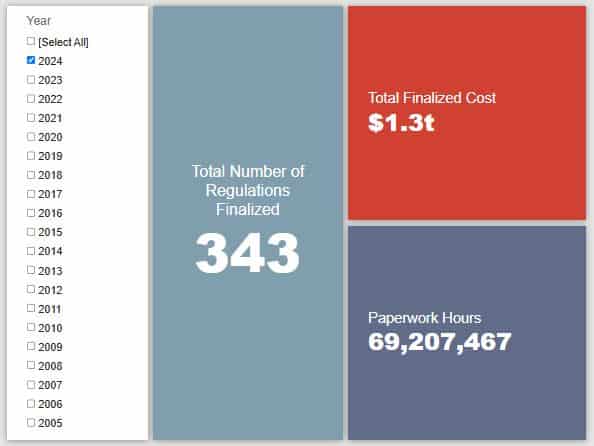
- 2024 Final Rule Costs: $1.34 trillion
- 2024 Proposed Rule Costs: $127.7 billion
NOTABLE REGULATORY ACTIONS
The main rulemaking flow of the week came from the EPA with two rules regarding “Decabromodiphenyl Ether and Phenol, Isopropylated Phosphate (3:1); Revision to the Regulation of Persistent, Bioaccumulative, and Toxic Chemicals Under the Toxic Substances Control Act (TSCA)” and “Waste Emissions Charge for Petroleum and Natural Gas Systems: Procedures for Facilitating Compliance, Including Netting and Exemptions.” The former updates the agency’s standards regarding the titular chemicals in response to recent public input. EPA estimates that the annual costs involved will be roughly $390 million (or $8.7 billion in present value across the 30-year analytical window). The latter establishes the compliance framework for the so-called “methane fee” under the Inflation Reduction Act. The agency expects that rule to involve $460 million in total costs.
The other notable rulemaking of the week comes in the form of FAA’s rule regarding “Integration of Powered-Lift: Pilot Certification and Operations; Miscellaneous Amendments Related to Rotorcraft and Airplanes.” In particular, the rule:
Adopts permanent amendments and a Special Federal Aviation Regulation (SFAR) for a period of ten years to: facilitate the certification of powered-lift pilots, clarify operating rules applicable to operations involving a powered-lift, and finalize other amendments which are necessary to integrate powered-lift into the National Airspace System (NAS).
These actions are meant to fill in the “safety gaps” for “advanced air mobility (AAM) operations” that may not currently fit the regulatory parameters set for more traditional aircraft. FAA expects the main costs to “include incremental costs for individuals to hold an airman’s certificate with a type rating for the powered-lift flown, costs for the minimum fuel reserve requirement, and costs for the provision of dual-control aircraft and full flight simulators for training.” While it provides a modest range of outcomes, the agency estimates that these costs will add up to roughly $914 million over a 10-year horizon.
TRACKING THE ADMINISTRATIONS
As we have already seen from executive orders and memos, the Biden Administration has provided plenty of contrasts with the Trump Administration on the regulatory front. And while there have been areas where the current administration has sought to broadly restore Obama-esque regulatory actions, there are also areas where it has charted its own course. Since the AAF RegRodeo data extend back to 2005, it is possible to provide weekly updates on how the top-level trends of President Biden’s regulatory record track with those of his two most recent predecessors. The following table provides the cumulative totals of final rules containing some quantified economic impact from each administration through this point in their respective terms.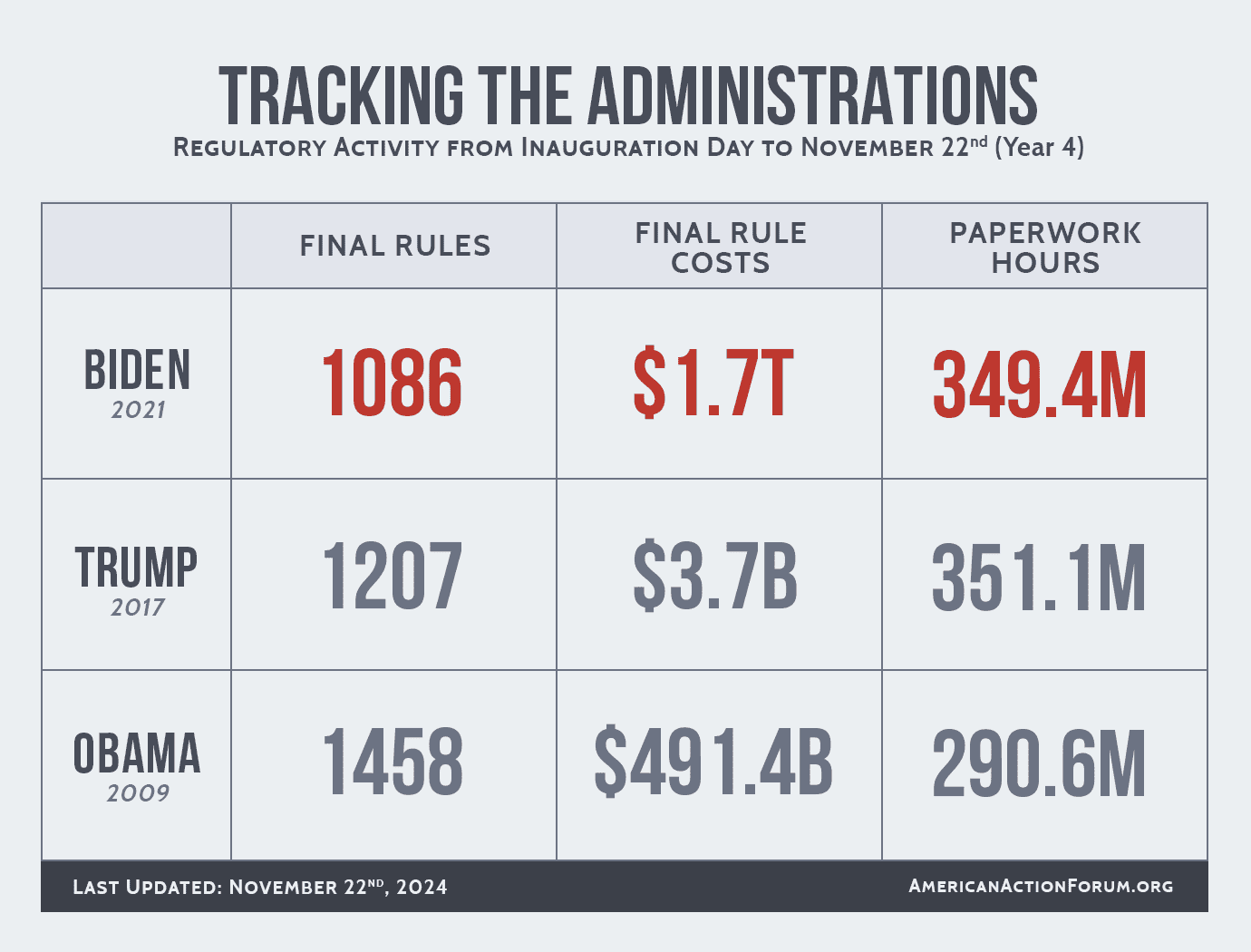 The rulemakings discussed above combined to represent a $10.1-billion increase the Biden final rule cost total. On top of those, a Consumer Financial Protection Bureau rule contributed an additional 2.8 million hours to the administration’s paperwork total. As for the other administrations covered here, the main action – once again – came from the Trump Administration. Thanks primarily to a 2020 Securities and Exchange Commission rule, the Trump-era costs and paperwork totals rose by $2.4 billion and 1.2 million hours, respectively.
As the Biden Administration concludes, AAF will continue this analytical section for the remainder of its term to provide a complete historical record of its agency activity and how it stacked up against the full first terms of the other included administrations – even if the rulemakings finalized in these waning months may be subject to recission under the incoming administration and Congress. As noted during the campaign, there is little reason to believe this Trump Administration’s regulatory policy will be directionally different from that of its first term. Yet given that President-elect Trump now stands to join Grover Cleveland as the only president thus far to have a second non-consecutive term, the exact nature and format of this section may undergo some changes once that second term begins. Stay tuned.
TOTAL BURDENS
Since January 1, the federal government has published $1.47 trillion in total net costs (with $1.34 trillion in new costs from finalized rules) and 143 million hours of net annual paperwork burden increases (with 69.2 million hours coming from final rules).