Week in Regulation
December 2, 2024
HHS Serves the Main Dishes
Despite the Thanksgiving-shortened workweek, agencies continued the recent trend of steady – if not earth-shattering – regulatory activity. This past week saw nine rulemakings that contained some kind of quantified economic impacts. Most of these, however, were rather understated. The main agency of the week was the Department of Health and Human Services (HHS), which had two significant rules come down the line. Across all rulemakings, agencies published $4.7 billion in total costs and added 148,253 annual paperwork burden hours.
REGULATORY TOPLINES
- Proposed Rules: 37
- Final Rules: 57
- 2024 Total Pages: 94,962
- 2024 Final Rule Costs: $1.35 trillion
- 2024 Proposed Rule Costs: $127.8 billion
NOTABLE REGULATORY ACTIONS
The most consequential rules of the week came from HHS, first in a rule regarding “Hospital Outpatient Prospective Payment and Ambulatory Surgical Center Payment Systems” (and other items) and second in a rule on “Organ Procurement and Transplantation: Implementation of the HIV Organ Policy Equity (HOPE) Act.” The former is yet another annual rulemaking setting certain parameters for Medicare and Medicaid funding levels that also includes a series of other policy changes. The 683-page rule’s “summary” gives a sense of its wide-ranging scope: HHS estimates that the costs to affected providers come out to $430 million on an annualized basis (or roughly $3.9 billion total over the 10-year analytical period).
As for the latter rule, if it looks oddly familiar, that’s because its proposed version hit the Federal Register a little over two months ago. The rule makes a series of updates to organ transplants standards for individuals with human immunodeficiency virus (HIV) under the 2013 HOPE Act. Even with only a 30-day comment period, the proposed-to-final turnaround on this rule is still somewhat remarkable. Considering, however, that there was only one oppositional comment out of the 56 submitted, perhaps it is not terribly surprising. HHS estimates that there will be some additional costs to affected entities under these new standards – approximately $83 million per year (or $745 million over a 10-year horizon).
TRACKING THE ADMINISTRATIONS
As we have already seen from executive orders and memos, the Biden Administration has provided plenty of contrasts with the Trump Administration on the regulatory front. And while there have been areas where the current administration has sought to broadly restore Obama-esque regulatory actions, there are also areas where it has charted its own course. Since the AAF RegRodeo data extend back to 2005, it is possible to provide weekly updates on how the top-level trends of President Biden’s regulatory record track with those of his two most recent predecessors. The following table provides the cumulative totals of final rules containing some quantified economic impact from each administration through this point in their respective terms.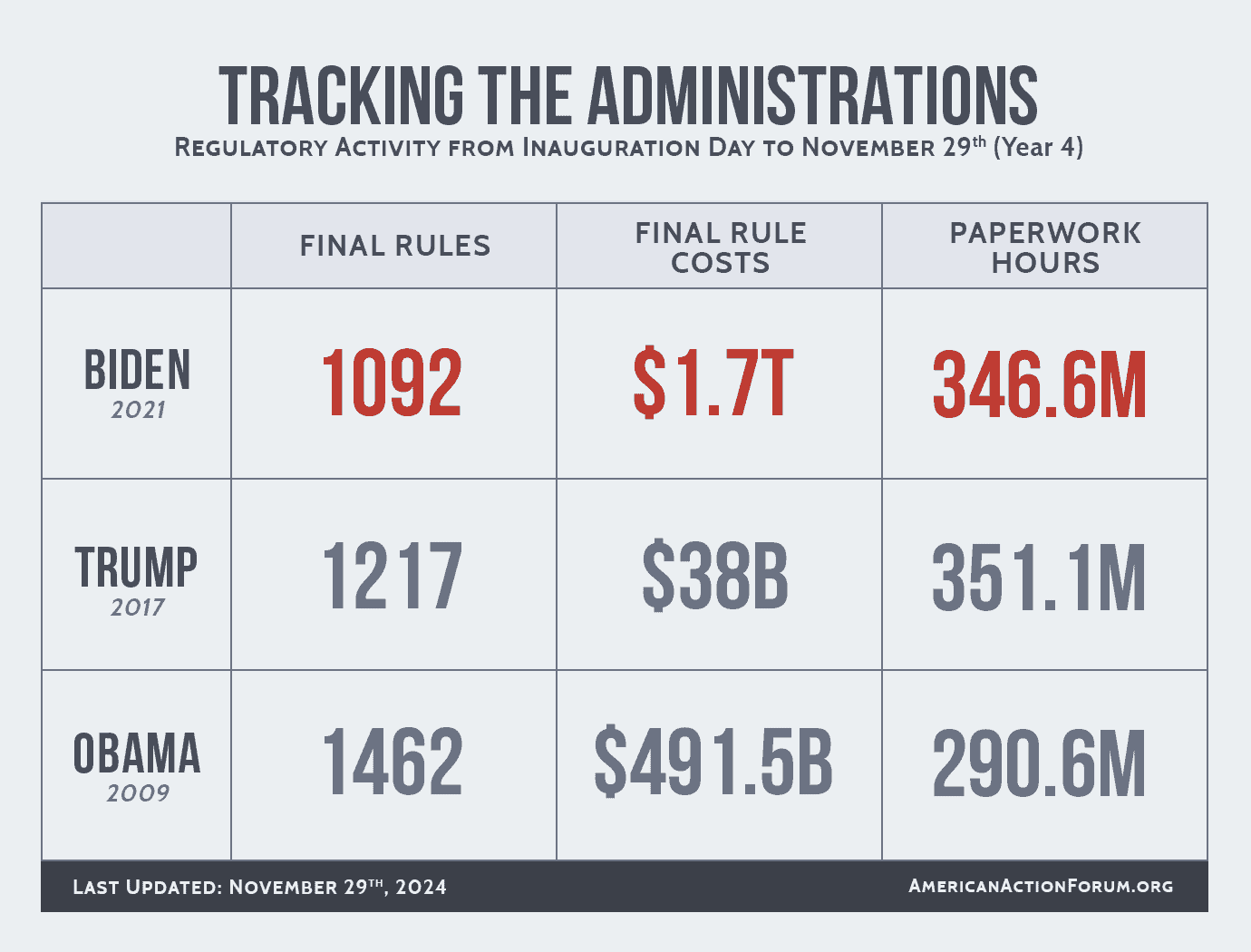 With virtually all of this week’s rulemakings of any consequence coming on the final rule side, the Biden Administration totals rose by the levels noted above. The HHS rules discussed earlier were the primary contributors to this trend. As for the other two administrations covered here, there were only minimal shifts. The most significant action across either was the Trump-era HHS rule establishing the “Most Favored Nation (MFN) Model” that brought roughly $175 million in costs.
As the Biden Administration concludes, AAF will continue this analytical section for the remainder of its term to provide a complete historical record of its agency activity and how it stacked up against the full first terms of the other included administrations – even if the rulemakings finalized in these waning months may be subject to recission under the incoming administration and Congress. As noted during the campaign, there is little reason to believe this Trump Administration’s regulatory policy will be directionally different from that of its first term. Yet given that President-elect Trump now stands to join Grover Cleveland as the only president thus far to have a second non-consecutive term, the exact nature and format of this section may undergo some changes once that second term begins. Stay tuned.
TOTAL BURDENS
Since January 1, the federal government has published $1.47 trillion in total net costs (with $1.35 trillion in new costs from finalized rules) and 143.1 million hours of net annual paperwork burden increases (with 69.4 million hours coming from final rules).