Week in Regulation
August 10, 2026
Cost Reductions Start Flowing Again
Last week was a lively one in the pages of the Federal Register, with 20 rulemakings that had some kind of measurable economic impact. After a one-week, cost-adding blip, agencies returned to a primarily cost-cutting posture. The main items of the week in this regard were proposed rules from the Departments of Health & Human Services (HHS) and Interior (DOI) that focused on the Head Start program and offshore drilling in the Arctic, respectively. Overall, federal agencies published roughly $5.2 billion in total cost savings but added 161,410 paperwork burden hours.
REGULATORY TOPLINES
- Proposed Rules This Week: 36
- Final Rules This Week: 83
- 2026 Total Pages: 51,269
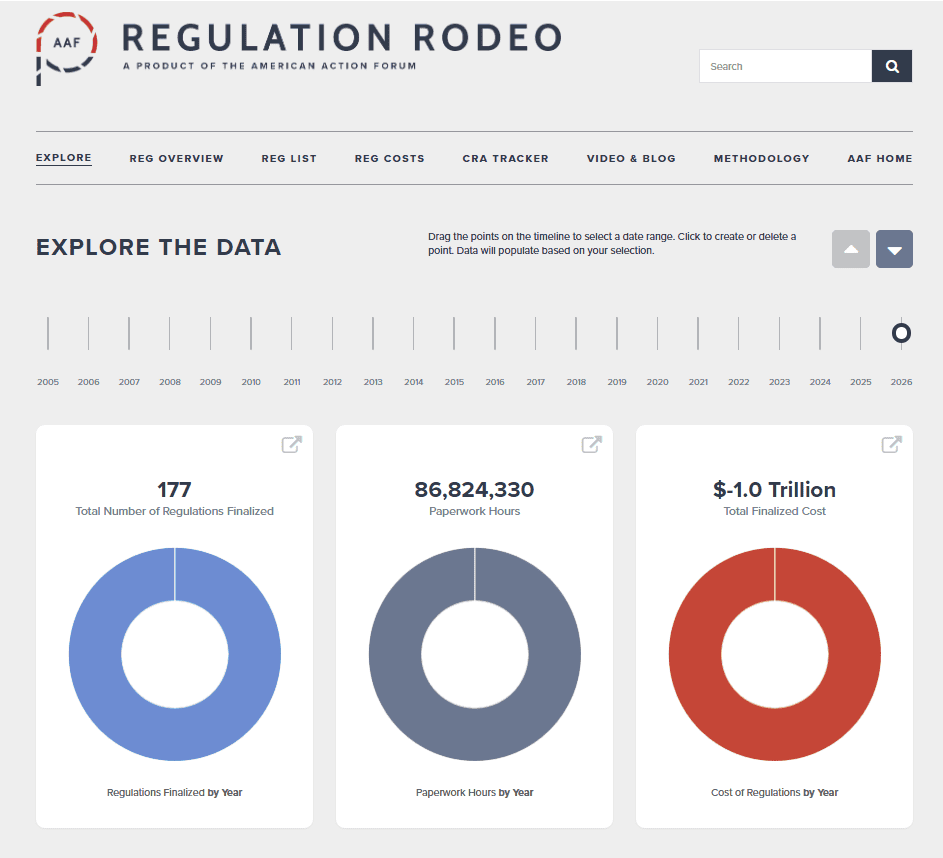
- 2026 Final Rule Costs: -$1 trillion
- 2026 Proposed Rule Costs: $46.6 billion
NOTABLE REGULATORY ACTIONS
The most consequential rulemaking of the week was the proposed rule from HHS titled “Reducing Federal Burden for Head Start Programs.” The proposal seeks to:
Significantly reduce Federal bureaucratic burden on programs; defer to State policies wherever possible; return substantial local control to Head Start agencies delivering the services and to parents as the primary caregivers and decision-makers for their children; reduce unnecessary duplication of Head Start regulations with Federal statute and other regulations; and emphasize the critical role of health, nutrition, and physical exercise for young children.
The agency expects these wide-ranging changes to result in “quantified reductions in regulatory compliance costs and program expenditures.” HHS estimates annualized net-cost reductions of $814 million at a 7-percent discount rate (or roughly $3.3 billion across the 5-year analytic window).
The other significant action of the week was the DOI proposed rule regarding “Oil and Gas and Sulfur Operations on the Outer Continental Shelf-Revisions to the Requirements for Exploratory Drilling on the Arctic Outer Continental Shelf [OCS].” Specifically, the rulemaking:
Would modify existing Arctic OCS blowout preventer (BOP) real-time monitoring requirements and add new provisions to BSEE’s [Bureau of Safety and Environmental Enforcement] regulations pertaining to requirements for crane operations on artificial islands, suspensions of operations (SOO), and suspensions of production (SOP). This proposed rule would also revise certain parts of the Exploration Plan (EP) and Development and Production Plan (DPP) regulations implemented by BOEM [Bureau of Ocean Energy Management].
For its preliminary cost-benefit analysis, the agency includes two scenarios. The first one – the “Full Arctic OCS Case” – “assumes that lease sales in both the Beaufort Sea and Chukchi Sea, currently scheduled in the 11th National OCS Oil and Gas Leasing Proposed Program in 2026-2030, will result in industry interest in both of these planning areas.” The alternative scenario, or the “Limited Arctic Case,” operates under the assumption that commercial interest in developing these operations will focus primarily on the Beaufort Sea area. In the accompanying Regulatory Impact Analysis, DOI estimates that the total cost savings for affected entities could range from nearly $1.6 billion under the “Limited” scenario to roughly $1.8 billion under the “Full” scenario.
TRACKING TRUMP 2.0
In assessing 2026 rulemakings that include an EO 14192 determination, there have been 66 “deregulatory” rules with combined total savings of $1.1 trillion against 13 “regulatory” rules that involve roughly $45.9 billion in costs. Adding that to the total agencies produced during 2025 (at least from rules that had a clear “regulatory” or “deregulatory” designation), the Trump Administration has enacted $1.2 trillion in total cost reductions thus far under EO 14192. Rules for which agencies have claimed one of the EO’s exemptions have accounted for an additional $10.7 billion in costs so far in 2026.
CONGRESSIONAL REVIEW ACT (CRA)
The AAF CRA tracker provides a full survey of activity under the law thus far into this term. As of today, members of the 119th Congress have introduced CRA resolutions of disapproval addressing 138 “rules” across the Biden and Trump Administrations that collectively involve $176 billion in estimated compliance costs. Of these, 23 have been passed into law, repealing a series of Biden Administration rules that had a combined $3 billion in associated compliance costs. The Trump Administration estimates that the repeal of this rule yields an additional $936 million in savings. While the main window of CRA action has largely passed, there are still outstanding resolutions that could move legislatively. AAF will continue to monitor and update such developments as appropriate.
TOTAL BURDENS
Since the start of 2026, the federal government has published $1 trillion in total regulatory net cost savings (with $1.05 trillion in reductions from finalized rules) and 101.5 million hours of net annual paperwork increases (with 86.8 million hours coming from final rules).