Week in Regulation
July 27, 2026
Cost Cuts Keep Churning
The trend continues. For the fourth consecutive week, federal agency rulemakings have landed on the net-cost-reducing side of the ledger. While this past week’s haul was relatively modest in number – with only eight rulemakings containing some kind of quantified economic analysis – there were multiple actions that left a mark. Proposed rules from the Department of Labor (DOL) and Securities and Exchange Commission (SEC) seek to cut costs by allowing affected parties to deliver certain disclosures electronically rather than via a paper-based format. Additionally, the Department of Homeland Security (DHS) finalized its rescission of the Biden-era Public Charge rule. Overall, federal agencies published roughly $4.9 billion in total cost savings and cut 4.9 million paperwork burden hours.
REGULATORY TOPLINES
- Proposed Rules This Week: 46
- Final Rules This Week: 66
- 2026 Total Pages: 46,746
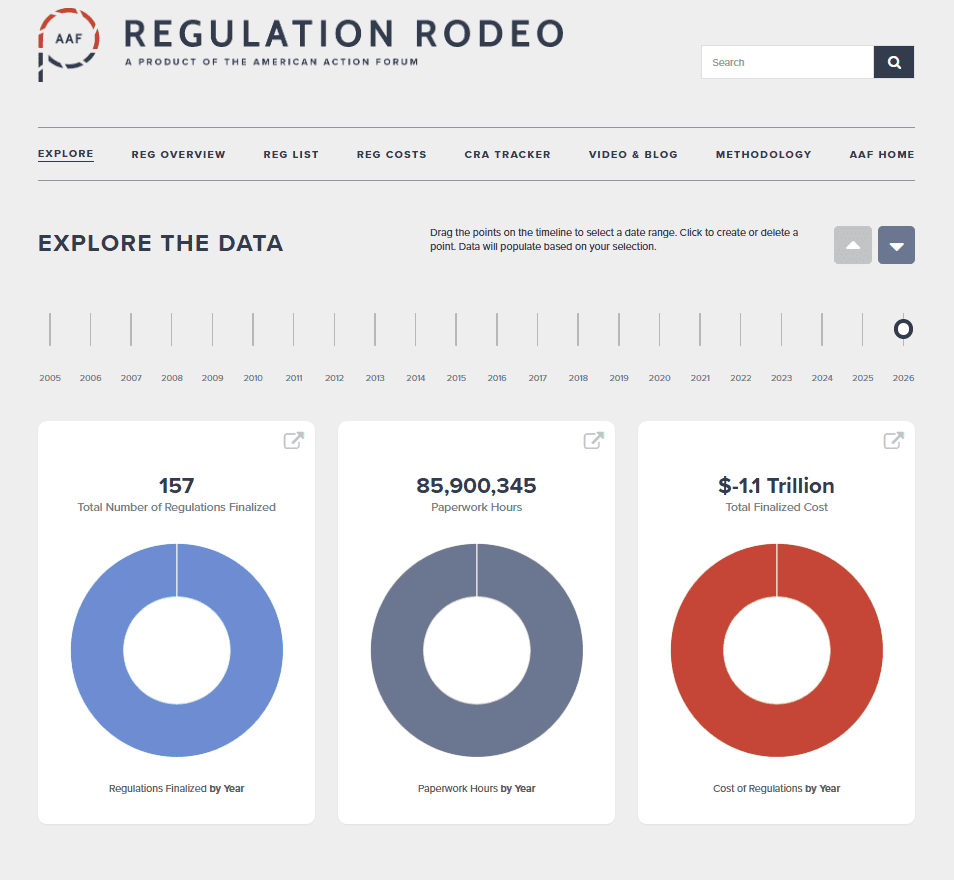
- 2026 Final Rule Costs: -$1.1 trillion
- 2026 Proposed Rule Costs: $51.7 billion
NOTABLE REGULATORY ACTIONS
The most significant cost-reducing actions of the week came from different agencies but were remarkably similar in terms of their general purpose. DOL had a proposed rule on “Electronic Disclosure by Group Health Plans Under ERISA [Employee Retirement Income Security Act],” while SEC had one on “Electronic Delivery of Information Under the Federal Securities Laws.” The former “sets forth a new, additional safe harbor for group health plan administrators to use electronic media (e.g., email or web portal) to furnish documents and information to participants and beneficiaries of plans subject to the Employee Retirement Income Security Act of 1974 (ERISA).” DOL estimates that such a change could yield $392 million in annualized savings (or nearly $2.8 billion when extrapolated over a 10-year horizon). The latter proposal from SEC would make the “use of electronic delivery (‘e-delivery’)” the default mode of transmission for relevant documents as opposed to the current system where document recipients need to actively opt into such an arrangement. SEC estimates that this shift from paper-based delivery to e-delivery will result in $155 million in net annual savings (or $1.1 billion total over a 10-year period).
The other rulemaking of great consequence this past week was the final rule from DHS on “Public Charge Ground of Inadmissibility.” Specifically, DHS “is rescinding the 2022 public charge ground of inadmissibility regulations (“2022 Final Rule”),” and the framework that rule established for determining an individual’s “public charge” status during immigration proceedings. This is the latest salvo in the winding saga of administrative actions on the matter. Beyond a nominal consideration of the per-entity “regulatory familiarization” costs, DHS’s cost-benefit analysis only really addresses the qualitative cost aspects of the rule. Given the magnitude of the rule’s changes to transfer payments, however, the downstream effects the agency identifies in its qualitative discussion of costs are likely to be substantial.
TRACKING TRUMP 2.0
In assessing 2026 rulemakings that include an Executive Order (EO) 14192 determination, there have been 57 “deregulatory” rules with combined total savings of $1.1 trillion against 10 “regulatory” rules that involve roughly $45.7 billion in costs. Adding that to the total agencies produced during 2025 (at least from rules that had a clear “regulatory” or “deregulatory” designation), the Trump Administration has enacted $1.2 trillion in total cost reductions thus far under EO 14192. Rules for which agencies have claimed one of the EO’s exemptions have accounted for an additional $10.7 billion in costs so far in 2026.
CONGRESSIONAL REVIEW ACT (CRA)
The AAF CRA tracker provides a full survey of activity under the law thus far into this term. As of today, members of the 119th Congress have introduced CRA resolutions of disapproval addressing 138 “rules” across the Biden and Trump Administrations that collectively involve $176 billion in estimated compliance costs. Of these, 23 have been passed into law, repealing a series of Biden Administration rules that had a combined $3 billion in associated compliance costs. The Trump Administration estimates that the repeal of this rule yields an additional $936 million in savings. While the main window of CRA action has largely passed, there are still outstanding resolutions that could move legislatively. AAF will continue to monitor and update such developments as appropriate.
TOTAL BURDENS
Since the start of 2026, the federal government has published $1 trillion in total regulatory net cost savings (with $1.1 trillion in reductions from finalized rules) and 100.5 million hours of net annual paperwork increases (with 85.9 million hours coming from final rules).