Week in Regulation
December 15, 2025
Not Much in Rulemaking, But Plenty Else
Coming off of a fairly remarkable week before it, this past week was something of a dud – at least on the rulemaking side. There were seven actions with some kind of quantified economic effects, but most of them were relatively routine airworthiness directive rules. There were, however, some broader, significant regulatory policy items that popped up along the way. Across all rulemakings, federal agencies published roughly $58.2 million in total costs and no change in paperwork burden hours.
REGULATORY TOPLINES
- Proposed Rules: 33
- Final Rules: 77
- 2025 Total Pages: 57,734
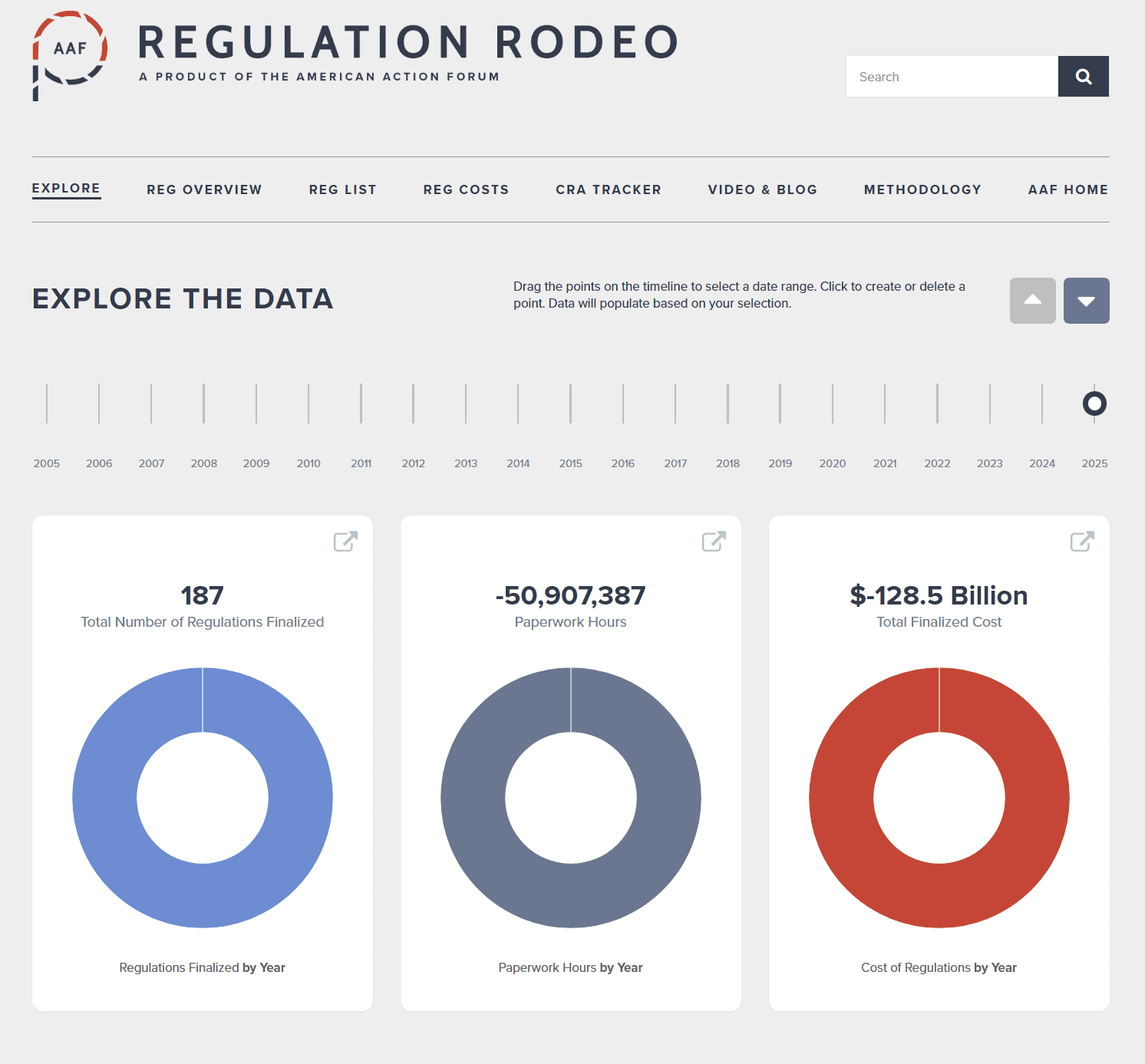
- 2025 Final Rule Costs: -$128.5 billion
- 2025 Proposed Rule Costs: -$847.6 billion
NOTABLE REGULATORY ACTIONS
As mentioned above, the rulemaking haul largely consisted of airworthiness directives. The only rule with quantified impacts that fell outside that cohort was a Federal Communications Commission rule regarding “Wireless Emergency Alerts and the Emergency Alert System” that involves roughly $42 million in total costs.
TRACKING TRUMP 2.0
Perhaps the most high-profile regulatory policy news of the week was President Trump signing an executive order (EO) on “Ensuring a National Policy Framework for Artificial Intelligence [AI].” As the title suggests, the EO seeks to pre-empt state-level AI regulatory regimes and establish a national one instead. (The American Action Forum (AAF) has previously explored the implications of a national AI regulatory framework versus a state-level “patchwork” here.) The actual efficacy of the EO – by the very nature of it being an EO – remains to be seen. The order largely directs certain agencies to take specific actions against states that attempt to formulate their own program, such as the Department of Commerce withholding “Broadband Equity Access and Deployment (BEAD) Program” funds from non-compliant states. Establishing a truly national framework is likely the purview of a more fully realized legislative package.
The other item with some regulatory policy nexus that captured public attention this past week was a Department of Homeland Security (DHS) notice on “Agency Information Collection Activities; Revision; Arrival and Departure Record (Form I-94) and Electronic System for Travel Authorization.” Information collection notices are generally quite mundane documents announcing that an agency plans to update the terms and estimated paperwork burdens of certain forms and soliciting public comment on such changes. This one caught some attention for some of its very particular new requirements, such as applicants needing to upload a “selfie” in addition to their passport photo and “provide their social media from the last 5 years.” In terms of estimated hours, the changes come out to roughly 639,000 additional hours as compared to the most recently estimated total. While this additional burden is not massive, it mirrors efforts by DHS across a recent trio of such updates for immigration documentation more broadly that the agency itself estimates would collectively bring an additional 23.2 million hours of paperwork each year (with nearly $1.1 billion in associated costs, per the respective supporting statements).
There was also some notable Congressional Review Act (CRA) news. Last Thursday, President Trump finally signed into law a series of CRA resolutions of disapproval that had percolated through Congress in recent weeks. The resolutions repealed a series of Biden-era Department of Interior administrative determinations. (AAF previously discussed the unique nature of these pieces of legislation here.) In CRA news running against the Trump Administration, Senator Jacky Rosen (D-NV) introduced a resolution seeking to repeal a recent DHS rule regarding “Removal of the Automatic Extension of Employment Authorization Documents.”
The AAF CRA tracker provides a full survey of activity under the law thus far in 2025. As of today, members of the 119th Congress have introduced CRA resolutions of disapproval addressing 70 rulemakings across the Biden and Trump Administrations that collectively involve $138 billion in compliance costs. Of these, 21 have been passed into law, repealing a series of Biden Administration rules that had a combined $3 billion in associated compliance costs – roughly 2 percent of that potential $138 billion total. While the main window of CRA action has largely passed, there are still outstanding resolutions that could move legislatively. AAF will continue to monitor and update such developments as appropriate.
TOTAL BURDENS
Since January 1, the federal government has published $976 billion in total regulatory net cost savings (with $128.5 billion in cost savings from finalized rules) and 75.1 million hours of net annual paperwork cuts (with 50.9 million hours coming from final rules).