Week in Regulation
June 1, 2026
Some Savings and A Glimmer of Sunsetting
This past week was a modestly busy one in the pages of the Federal Register. There were ultimately 14 rulemakings that contained some kind of quantified economic effects. Of these, a handful – from the Environmental Protection Agency (EPA) and Securities & Exchange Commission (SEC) – were well into the hundred-million-dollar range of total impacts. Additionally, a Department of Energy (DOE) rulemaking applying “sunset” clauses to various regulatory provisions provided another example of the current administration instituting some deeper regulatory reform practices. Overall, federal agencies published roughly $2.3 billion in total cost savings but added 15,332 paperwork burden hours.
REGULATORY TOPLINES
- Proposed Rules This Week: 37
- Final Rules This Week: 63
- 2026 Total Pages: 32,250
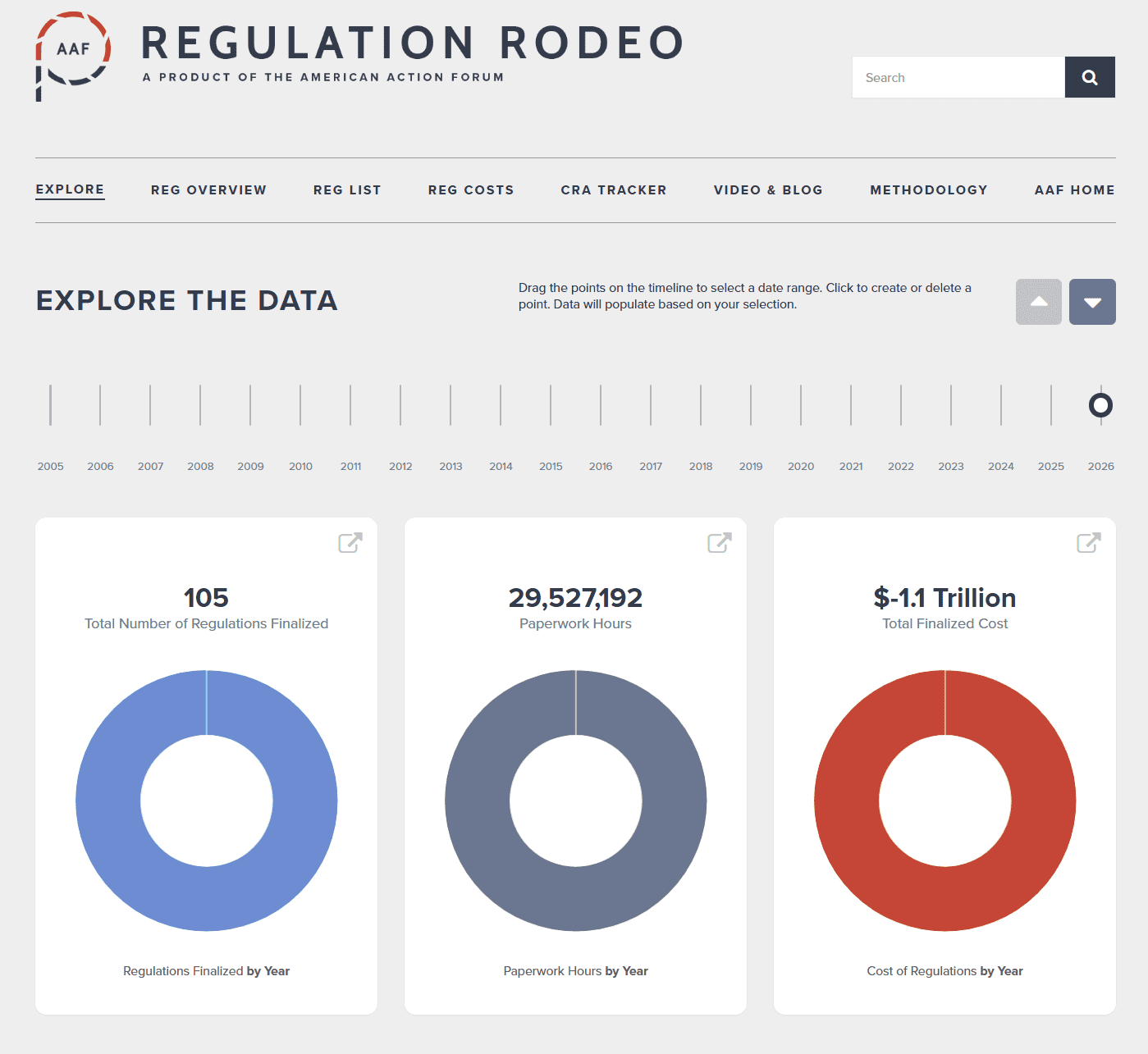
- 2026 Final Rule Costs: -$1.1 trillion
- 2026 Proposed Rule Costs: $87.9 billion
NOTABLE REGULATORY ACTIONS
The agency with the most significant rulemakings of the week was EPA with its pair of measures – one final, one proposed – making changes to Biden-era rules on hydrofluorocarbons. The proposed rule is the more expansive of the two actions and establishes “an exemption for road and intermodal container transport refrigeration units (TRUs) from the leak repair requirements established under the American Innovation and Manufacturing (AIM) Act.” EPA estimates that this will yield roughly $1 billion in total savings when discounted at a 7-percent rate over a 25-year window. The final rule makes various regulatory amendments in response to “significant issues raised in administrative petitions and input received from regulated industry and other interested parties with respect to regulatory provisions promulgated in the Code of Federal Regulations (CFR) pursuant to the AIM Act subsection (i).” EPA calculates that such changes will provide $653 million in net present value cost savings over a 25-year period.
The other agency that logged a sizable cost-cutting rulemaking was SEC with its proposed rule on “Registered Offering Reform.” Specifically:
The proposed amendments would amend certain of our Securities Act rules and forms to provide issuers with greater flexibility to determine the timing and structure of their registered offerings and reduce the costs of conducting a registered offering by, among other things, simplifying and modernizing the applicable rules and forms.
The proposal follows a recent trend of SEC rulemakings seeking to make substantial amendments to how and when various companies need to report relevant data to the commission. For this one, SEC estimates that the changes will yield roughly $712 million in total net savings for affected entities.
TRACKING TRUMP 2.0
In assessing 2026 rulemakings that include an Executive (EO) 14192 determination, there have been 39 “deregulatory” rules with combined total savings of $1.1 trillion against six “regulatory” rules that involve roughly $41.8 billion in costs. Adding that to the total agencies produced during 2025 (at least from rules that had a clear “regulatory” or “deregulatory” designation), the Trump Administration has enacted $1.2 trillion in total cost reductions thus far under EO 14192. Rules for which agencies have claimed one of the EO’s exemptions have accounted for an additional $2.9 billion in costs so far in 2026.
Beyond the regulatory budget aspect of the administration’s deregulatory agenda, there was also movement in terms of instituting “sunset” provisions into the regulatory code – this time from DOE. The American Action Forum (AAF) has previously written on the nascent sunsetting efforts undertaken by the Department of Health & Human Services at the tail-end of the first Trump term. In this instance, under the auspices of EO 14270, DOE has published both a direct final rule and accompanying proposed rule that would attach sunset clauses to various portions of the Code of Federal Regulations (CFR) under the agency’s purview. With DOE deeming these clauses to be “non-controversial regulatory amendments,” the direct final rule takes effect July 13, 2026. As DOE notes, however:
If significant adverse comments are received by June 29, 2026, a timely withdrawal of this rule will be published in the Federal Register and DOE will address the comments received in a subsequent final rule as a response to the companion proposed rule published in this issue of the Federal Register, or take other action as appropriate.
For context, this past winter, the Nuclear Regulatory Commission (NRC) underwent a similar rulemaking process. After a review of the comments received, NRC scrapped only one aspect from its direct final rule. Stay tuned for which sections of the CFR do or do not avoid “significant adverse comments” for this DOE version.
CONGRESSIONAL REVIEW ACT (CRA)
The AAF CRA tracker provides a full survey of activity under the law thus far into this term. As of today, members of the 119th Congress have introduced CRA resolutions of disapproval addressing 136 “rules” across the Biden and Trump Administrations that collectively involve $173.6 billion in estimated compliance costs. Of these, 23 have been passed into law, repealing a series of Biden Administration rules that had a combined $3 billion in associated compliance costs. The Trump Administration estimates that the repeal of this rule yields an additional $936 million in savings. While the main window of CRA action has largely passed, there are still outstanding resolutions that could move legislatively. AAF will continue to monitor and update such developments as appropriate.
TOTAL BURDENS
Since the start of 2026, the federal government has published $974.5 billion in total regulatory net cost savings (with $1.1 trillion in reductions from finalized rules) and 56.4 million hours of net annual paperwork increases (with 29.5 million hours coming from final rules).