Week in Regulation
April 20, 2026
Another Steady Savings Clip With a Side of CRA News
This past week was hardly a blockbuster in terms of rulemaking activity, but did carry over a similar trend from the week before it. Across eight rulemakings from last week that contained some kind of measurable economic impact, there were some actions that brought effects in the billions of dollars. Proposed rules from the Environmental Protection Agency (EPA) and the Internal Revenue Service (IRS) were the main items of the bunch. Overall, federal agencies published roughly $4.2 billion in total cost savings and cut 1.5 million paperwork burden hours.
REGULATORY TOPLINES
- Proposed Rules This Week: 29
- Final Rules This Week: 49
- 2026 Total Pages: 20,821
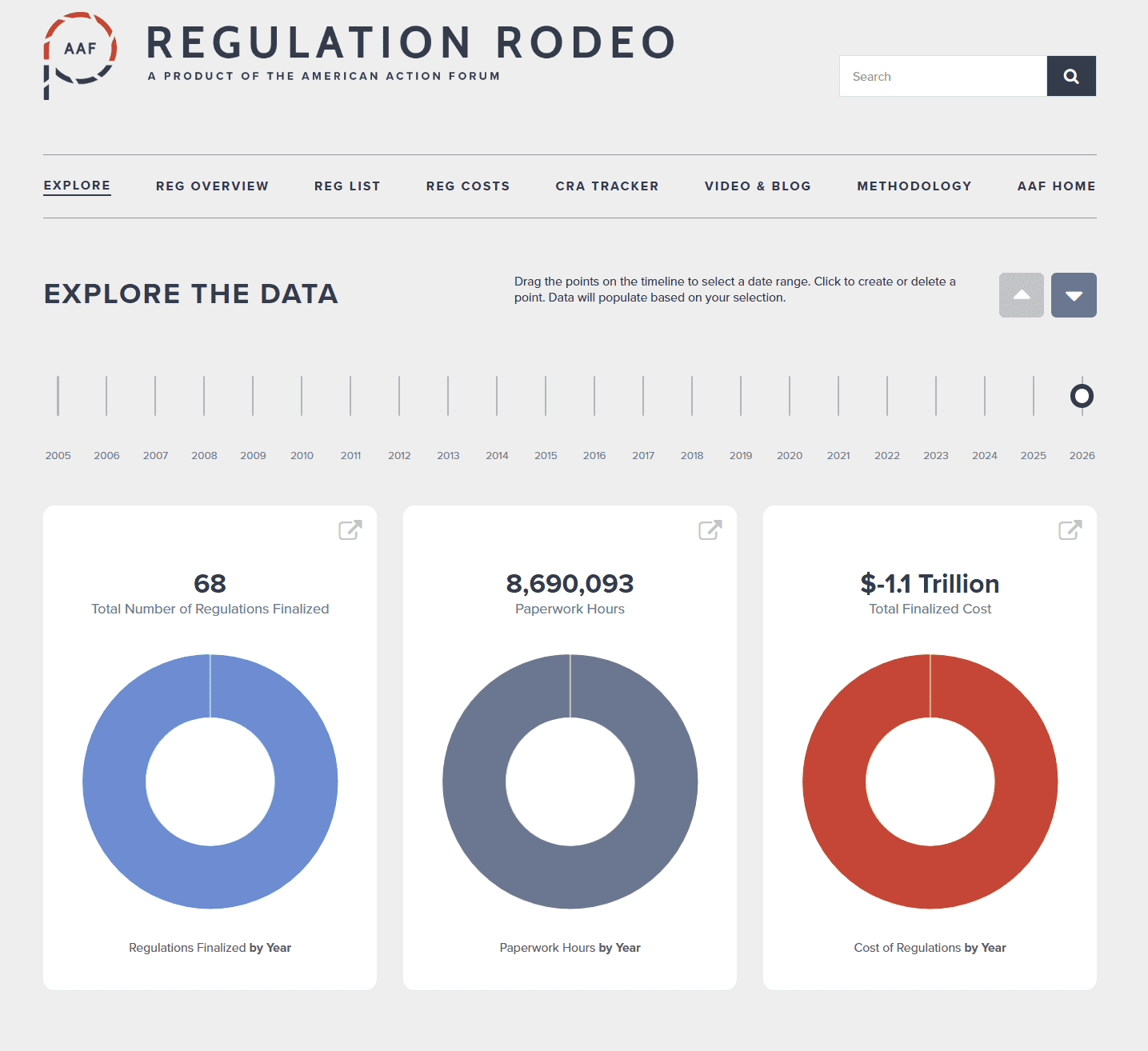
- 2026 Final Rule Costs: -$1.1 trillion
- 2026 Proposed Rule Costs: $127.7 billion
NOTABLE REGULATORY ACTIONS
The most consequential rulemaking of the week was the proposed rule from EPA on “Hazardous and Solid Waste Management System: Disposal of Coal Combustion Residuals From Electric Utilities; Legacy/CCRMU Amendments.” Specifically, the proposal makes “several revisions to the existing federal CCR regulations, including exempting CCR dewatering structures and modifying the legacy coal combustion residual (CCR) surface impoundment and CCR management unit provisions.” EPA expects these changes to provide between $3.3–$3.7 billion in total cost savings to affected entities (for a mid-point estimate recorded here of $3.5 billion).
The other sizable cost-cutting rulemaking – fittingly during the week of Tax Day – was the IRS proposal titled “Increase in Threshold for Requiring Information Reporting With Respect to Certain Payees; Extension and Modification of Limitation on Wagering Losses.” The rulemaking implements aspects of the reconciliation bill “commonly known as the One, Big, Beautiful Bill Act,” that amended tax provisions on gambling winnings. Beyond the fiscal policy implications, the estimated regulatory impact is nearly $1 billion in lower administrative costs for taxpayers due to nearly 49 million fewer tax forms being filed in 2027.
TRACKING TRUMP 2.0
In assessing 2026 rulemakings that include an Executive Order (EO) 14192 determination, there have been 25 “deregulatory” rules with combined total savings of $1.1 trillion against four “regulatory” rules that involve roughly $41.6 billion in costs. Adding that to the total agencies produced during 2025 (at least from rules that had a clear “regulatory” or “deregulatory” designation), the Trump Administration has enacted $1.2 trillion in total cost reductions thus far under EO 14192. Rules for which agencies have claimed one of the EO’s explicit exemptions have accounted for an additional $508 million in costs so far in 2026.
CONGRESSIONAL REVIEW ACT (CRA)
The main CRA news of the week was the Senate narrowly passing H. J. Res 140, a resolution of disapproval targeting a Biden-era Public Land Order that established a protected area of land in Minnesota. While the order’s non-rulemaking nature and date of publication (January 31, 2023) would seem to place it outside of CRA consideration, the current administration transmitted it Congress under the auspices of the CRA this past January – thus setting it up to matriculate through the Capitol. The resolution has passed both chambers and now heads to the White House for President Trump’s expected signature. With its passage into law, this resolution is expected to open the covered area to greater mining development.
The AAF CRA tracker provides a full survey of activity under the law thus far into this term. As of today, members of the 119th Congress have introduced CRA resolutions of disapproval addressing 130 “rules” across the Biden and Trump Administrations that collectively involve $135.7 billion in estimated compliance costs. Of these, 22 have been passed into law, repealing a series of Biden Administration rules that had a combined $3 billion in associated compliance costs. The Trump Administration estimates that the repeal of this rule yields an additional $936 million in savings. While the main window of CRA action has largely passed, there are still outstanding resolutions that could move legislatively. AAF will continue to monitor and update such developments as appropriate.
TOTAL BURDENS
Since the start of 2026, the federal government has published $931.8 billion in total regulatory net cost savings (with $1.1 trillion in reductions from finalized rules) and 37.6 million hours of net annual paperwork increases (with 8.7 million hours coming from final rules).