Weekly Checkup
May 22, 2026
China’s R&D Rise and the Future of American Discovery
For decades, the United States has relied on a simple but powerful assumption: The world’s next great discovery was more likely to happen here than anywhere else. That assumption rarely relied on luck. It reflected a deep and unusually productive ecosystem of universities, federal laboratories, private capital, intellectual property protections, and global talent. But recently updated data on research and development (R&D) spending, combined with patent trends in pharmaceuticals and biotechnology, should force a reassessment of whether that advantage still exists.
Together, the United States and China account for more than half of global R&D performance. In 2024, though, China is estimated to have surpassed the United States as the world’s largest funder of R&D when measured on an internationally comparable basis, with $1.028 trillion in gross domestic expenditures on R&D compared with $1.009 trillion for the United States. While the nominal amounts don’t represent a vast difference (only about $20 billion), the convergence of R&D expenditures between geopolitical rivals is noteworthy, and the significance of the shift is hard to ignore.

Source: OECD Main Science and Technology Indicators (MSTI database)
The Organisation for Economic Co-operation and Development’s (OECD) gross domestic expenditure on R&D metric includes current and capital spending on R&D performed domestically by resident companies, research institutes, universities, and government laboratories; it includes foreign-funded R&D performed inside the country but excludes domestic funds spent on R&D performed abroad. This is an economy-wide measure, not a health care, life sciences, or pharmaceutical R&D measure alone. That distinction is important, but it does not make the trend less relevant to health care. Rather, it reinforces that health care innovation is one part of a much broader competition over scientific capacity, industrial strength, and future discovery.
R&D spending is not just an input in a national accounts table. It seeds future productivity, medical progress, defense capability, industrial resilience, and economic leadership. The country that invests most aggressively in discovery and development helps determine where the next generation of high-value industries will emerge. That matters for artificial intelligence, quantum computing, advanced manufacturing, biotechnology, semiconductors, clean energy, and the long process of turning basic science into new medicines and medical technologies.
When R&D spending is viewed alongside intellectual property data, the picture sharpens even further on what potential impacts may be. World Intellectual Property Organization (WIPO) data show that of the record 3.7 million patent applications worldwide in 2024, China’s intellectual property office received 1.8 million applications compared to about 600,000 at the U.S. Patent and Trademark Office (USPTO). Patent statistics are not a perfect measure of innovation, but provide an important signal of where firms and researchers believe ideas are worth protecting.
In pharmaceuticals and biotechnology, that signal is especially important. Protected intellectual property is often the bridge between uncertain science and the private investment needed to move a therapy through development, clinical trials, regulatory review, and manufacturing scale-up. While not entirely comparable, WIPO data on pharmaceutical and biotechnology show the narrowing gap between U.S. and Chinese patents granted each year. It is evidence of shifting prioritization and infrastructure that supports scientific leadership: discovery, protection, commercialization, and scale.
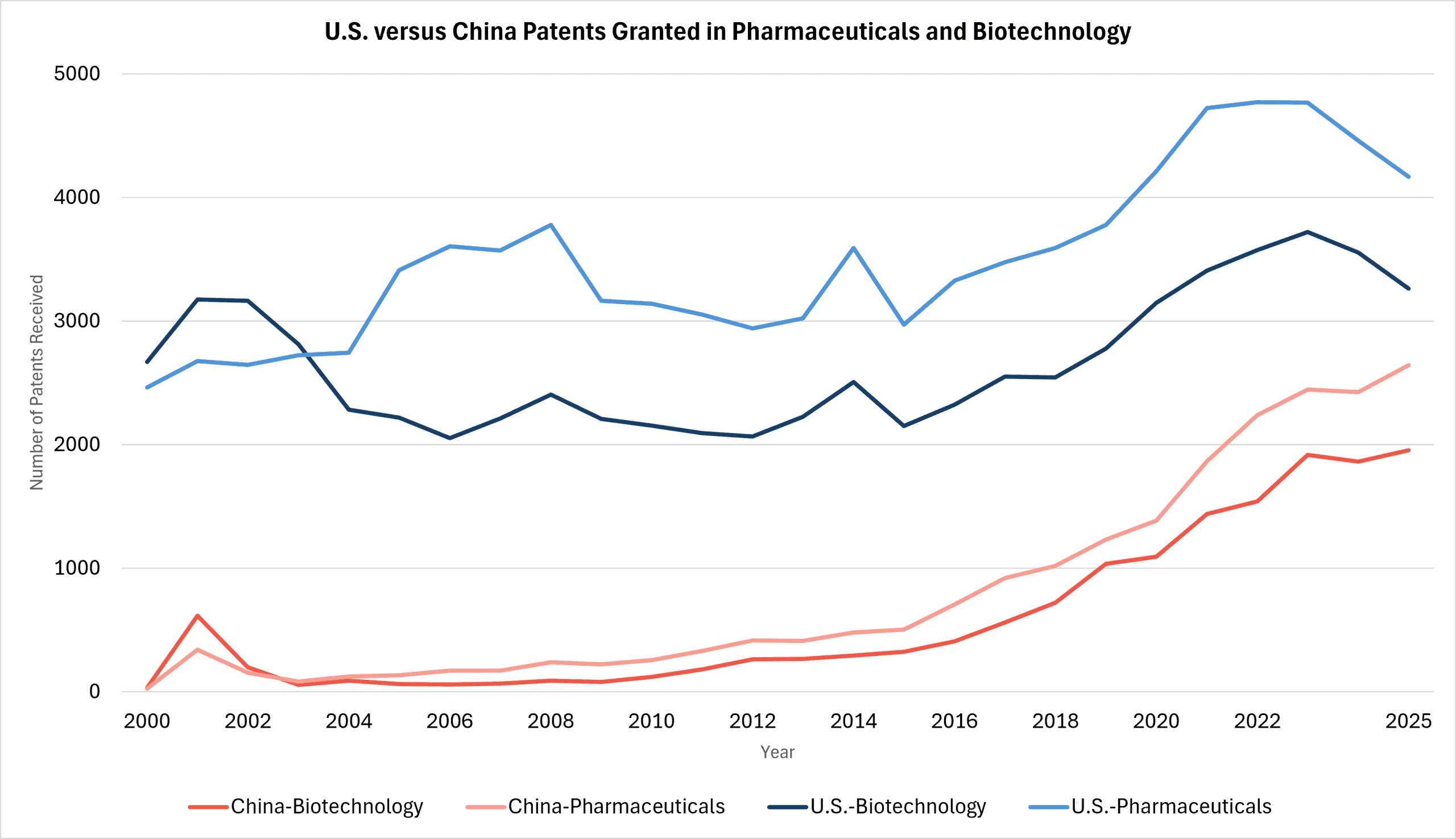
Source: WIPO IP Statistics Data Center
The point is not that every pharmaceutical or biotechnology patent represents a future cure – it does not. The point is that patent data is one measure of where the next generation of commercially relevant scientific claims is accumulating. China is accelerating its claims on novel technologies, while the United States appears to be losing momentum in one of the basic mechanisms by which scientific ideas become protected, investable, and commercially durable innovations. Even if raw patent counts overstate China’s relative innovation position, they point to the scale at which China is building its domestic discovery, development, and intellectual property infrastructure.
The United States still has enormous strengths. Its R&D system remains deeply business-led – accelerating commercialization pathways by linking discovery to markets – with the business sector performing 77 percent and funding 75 percent of U.S. R&D in 2024. U.S. businesses also invested heavily in areas tied to emerging technologies, including nearly $140 billion in biotechnology R&D in 2023. The federal government, meanwhile, remains central to the basic research base, serving as the largest funder of domestic basic research in 2024.
But those strengths are not self-executing. Biomedical discovery depends on a long, fragile continuum: federally supported basic science, university research, venture-backed translation, patent protection, private-sector development, regulatory review, and market uptake. Weakness in any part of that continuum can deter investment elsewhere. A less predictable intellectual property environment, reduced support for basic research, limits on high-skill scientific talent, or policy hostility toward the returns to successful innovation can all weaken the incentives needed to take scientific risk.
The danger is that America’s discovery advantage erodes gradually before it fails visibly. The loss may not first appear as fewer approved drugs next year. It may appear as fewer platform technologies, start-ups, domestically controlled manufacturing capabilities, and first-in-class therapies, and more dependence on scientific advances developed elsewhere. In health care, that means a thinner pipeline of future treatments and less national dexterity in responding to new diseases, new biological threats, and new therapeutic opportunities.
China surpassing the United States in R&D spending does not mean American scientific leadership is over. Nor do WIPO patent trends prove that China is displacing the United States in biomedical innovation. But taken together, these indicators point in the same direction: The global geography of discovery is shifting. For the United States, the appropriate response is not panic, but seriousness. Discovery compounds over time. So does neglect.