Weekly Checkup
June 6, 2025
HHS FY 2026 Budget in Brief (in Brief)
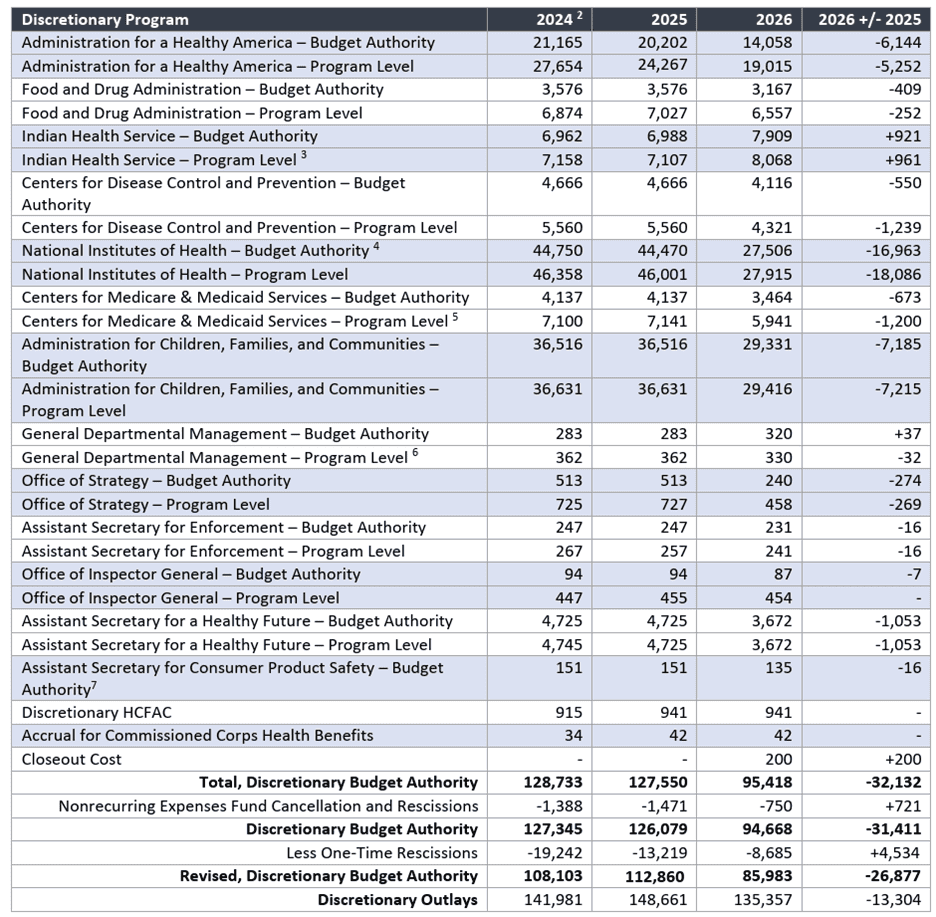
President Trump’s fiscal year (FY) 2026 budget proposal for the Department of Health and Human Services (HHS) outlines a significant restructuring and reduction in discretionary spending, aligning with the administration’s “Make America Healthy Again” (MAHA) initiative. The budget requests $94.7 billion in discretionary funding for HHS, marking a substantial decrease of approximately $31.3 billion from FY 2025 enacted levels. While the aim is to enhance efficiency and address chronic health issues, public health experts and others have raised concerns about the potential impact of the cuts on research, disease prevention, and health services delivery. While these concerns are understandable, it is important to note that it is Congress, not the president, that sets spending levels, and it seems highly unlikely that it would agree to anything close to what the president proposed. Nevertheless, let’s review the president’s budget request for HHS and some of its major provisions.
First, let’s look at a table outlining the president’s proposed funding levels and reorganization structure.
Source: HHS FY2026 Budget in Brief
It is important to understand the difference between each of the lines each agency has listed. Budget authority is the legal authorization from Congress that allows a federal agency to enter into financial obligations that will result in immediate or future outlays, essentially the permission to spend money. The program level represents the total resources available to run a program, including budget authority plus other funding sources, such as user fees (e.g., the Food and Drug Administration drug review fees), reimbursements, and mandatory spending from entitlement laws (e.g., Medicare, Medicaid). Understanding this distinction is crucial when interpreting HHS budget documents. For instance, cuts to budget authority may not fully reflect the impact on services if user fees or other income streams offset reductions. Program levels give a better sense of how much funding an agency uses to operate and deliver services.
| What It Measures | Includes | Used For | |
| Budget Authority | Legal obligation limit set by Congress | Discretionary and some mandatory spending | Congressional control, appropriations |
| Program Level | Total resources used for a program | Budget authority + user fees + other sources | Describing full operational funding |
While I encourage every interested party to read the full budget submission to understand what the Trump Administration’s new HHS might look like, below are some highlights of the funding and restructuring plans:
- National Institutes of Health (NIH): NIH funding would be reduced by nearly $18 billion, from $48.5 billion in FY 2025 to $27.3 billion in FY 2026. The plan would restructure NIH’s 27 institutes into eight, aiming to focus resources on high-impact research areas.
- Centers for Disease Control and Prevention (CDC): The CDC’s budget would decrease from over $9 billion in FY 2025 to approximately $5 billion in FY 2026. The proposal would eliminate the National Center for Chronic Disease Prevention and Health Promotion and transfer certain functions to the newly formed Administration for a Healthy America.
- Food and Drug Administration (FDA): The FDA would see a reduction of nearly $500 million in its budget for FY 2026, with an addition of overarching leadership on food safety but a shift of routine food inspections and other enforcement activities to state agencies.
- Administration for a Healthy America (AHA): The president’s budget would create the AHA to coordinate public health programs focused on chronic disease, primary care, prevention, and behavioral health. The AHA would consolidate functions from Health Resources and Services Administration, Substance Abuse and Mental Health Services Administration, and other public health offices. The AHA would manage $14 billion in discretionary funding and is intended to reduce administrative fragmentation, improve health equity, and streamline service delivery across federal prevention and wellness programs.
- Departmental Management: The president’s budget proposes $513 million in discretionary funding for general department expenditures and HHS’ Office of the Secretary, a reduction from previous years that reflects the department’s broader effort to consolidate administrative functions. The consolidated health information technology and security policy functions would mark a structural shift in how HHS coordinates digital health and data modernization efforts. External affairs, intergovernmental relations, and departmental oversight functions would likely be streamlined under a reorganized executive management structure.
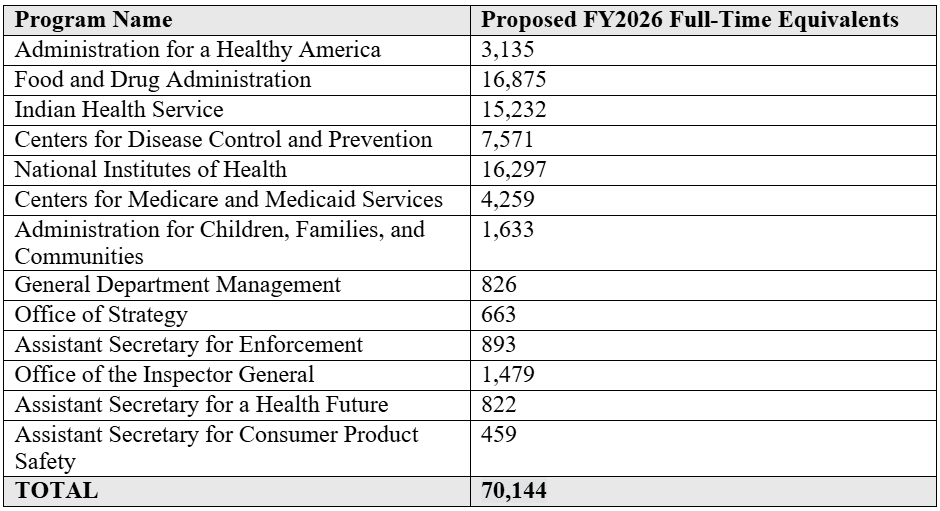
The president’s reorganization plan also includes a significant workforce reduction by proposing the permanent elimination of thousands of full-time positions across HHS in line with program consolidation and reorientation of health priorities, many of which were already announced through earlier reductions-in-force. These include substantial cuts to the FDA, CDC, and general departmental workforces.
Source: HHS FY2026 Budget in Brief, American Action Forum analysis
The president’s FY 2026 HHS budget proposal represents a comprehensive effort to restructure the department, reduce federal spending, and refocus public health priorities. Yet many of these consolidations and reorganizations appear short-sighted, and their implementation could undermine long-term scientific and programmatic reliability. While it is up to Congress to determine funding, it will be interesting to see the extent to which the administration follows through on the enacted appropriations bills.