Weekly Checkup
August 7, 2026
Strengthening 340B Through the Rebate Pilot Program
The Health Resources and Services Administration’s (HRSA) revised 340B Rebate Model Pilot Program – announced last week – is a welcome attempt to modernize a valuable safety-net program without weakening the hospitals, health centers, and clinics that depend on it. It protects the statutory 340B price for hospitals, community health clinics, and other covered entities (CE) while testing whether rebates can provide better transaction-level visibility, reduce duplicate discounts, and coordinate 340B with the Medicare Drug Price Negotiation Program. While a larger, more comprehensive rebate program should be the goal, this pilot is a reasonable effort to make the program more administrable and defensible and generate the appropriate proof points to expand.
The 340B program is essential to assisting CEs with stretching resources and providing care in rural and medically underserved communities. But preserving 340B does not require preserving every administrative convention developed over its three-decade history. A program that reached $100 billion in purchases in 2025 – across more than 15,000 CEs and 49,000 associated sites – needs an accountability mechanism that reflects its present scale and complexity, not the far smaller program Congress created in 1992.
To create a program with broad buy-in, HRSA largely disencumbers CEs by incorporating safeguards that respond directly to their concerns. CEs may continue ordering affected drugs through existing distribution channels rather than constructing an entirely separate purchasing system. They also have at least 45 days after dispensing a drug to submit a claim, while manufacturers generally must pay – or document a denial – within 10 calendar days after receiving complete data. Manufacturers must bear any costs of the IT platform used to submit data. Manufacturers must also provide 90 days’ notice before beginning any rebate program, as well as offer technical assistance, real-time reconciliation reports, and quarterly price files to CEs. There will still be a timing difference between purchase and rebate, and HRSA should monitor liquidity effects closely, particularly for rural hospitals and smaller health centers. But a 10-day payment standard, paired with rapid reconciliation and oversight, is a meaningful protection against protracted delays.
The revised pilot prevents manufacturers from converting transaction verification into an open-ended fishing expedition. HRSA limits submissions to standardized pharmacy and medical claims fields already commonly generated through billing and dispensing. The notice further prohibits manufacturers and technology platforms from collecting, aggregating, sharing, licensing, or otherwise using pilot data for purposes outside the program.
The pilot also prohibits manufacturers from simply denying rebates whenever they suspect diversion, Medicaid duplication, or insufficient purchases. Those concerns must be taken to HRSA or addressed through existing audit and dispute-resolution mechanisms. CEs may resubmit incomplete claims, challenge denials, report problems to HRSA, and ultimately use the 340B administrative dispute resolution process. This preserves the government’s role as program administrator and accountability guarantor rather than creating a piecemeal, company-specific approach.
The revised pilot is appropriately focused on that accountability and program moderation. It applies only to drugs selected for the first two years of Medicare negotiation and only during their applicable pricing periods. Those products represented less than 5.5 percent of 340B sales in 2025, meaning the traditional upfront discount would continue to govern the majority of program purchases. Manufacturers must apply to participate, receive HRSA approval, and operate for at least one year (in aid in certainty and predictability). HRSA can revoke approval if a manufacturer fails to comply with the terms of the program. This is how a pilot should work: Begin with a defined set of transactions, collect evidence, and evaluate performance before contemplating broader changes.
This pilot could not come at a better time, as Congress actively considers differing approaches to rewrite 340B program rules.
The SUSTAIN 340B Act, led by Senator Jerry Moran (R-KS) and the Senate’s bipartisan 340B working group, attempts to offer a reform framework that is both comprehensive and minimally disruptive to current 340B operations. The legislation would codify CEs’ use of contract pharmacies, establish patient and child-site definitions, require financial-assistance policies, strengthen HRSA’s audit authority, prohibit discriminatory reimbursement practices, and create an independent data clearinghouse to identify duplicate discounts. Several of those provisions advance the same basic objectives as HRSA’s pilot: standardized claims information, stronger federal oversight, limits on secondary uses of data, and a more reliable process for reconciling potentially overlapping discounts.
Senator Bill Cassidy’s (R-LA) 340B for Patients Act discussion draft would expressly accommodate upfront discounts, retrospective rebates, and a federally operated claims repository. Its rebate provisions similarly contemplate standardized claims data, payment of undisputed rebates within 10 days, documented denials, and secretarial review. Although the larger bill raises questions that extend well beyond the pilot, that operational overlap suggests the executive and legislative branches are beginning to converge on the need for clearer data, faster adjudication, and stronger federal oversight.
A bipartisan House bill, the SECURE 340B Act, by Representatives Scott Peters (D-CA) and John Joyce (R-PA), proposes pausing manufacturer rebate models for four years while Congress and the Department of Health and Human Services establish standards governing patients, contract pharmacies, data sharing, and transparency. Those are legitimate subjects for legislation, but freezing rebate models before the revised pilot can operate would discard the very evidence Congress needs to legislate well.
Legislation can establish durable rules for data privacy, payment deadlines, appeals, manufacturer accountability, contract pharmacies, and HRSA’s enforcement authority. It can also ensure that any future expansion is contingent on demonstrated performance and does not impose unreasonable liquidity or administrative burdens on covered entities. But lawmakers should not seek empirical answers and simultaneously prevent HRSA from generating them.
The revised model preserves the 340B benefit and tests a new approach on a narrow drug set – a reasonable balance between access and accountability. A stronger 340B program is not one insulated from verification. It is one that can prove its value, protect its participants, and withstand scrutiny. HRSA’s revised rebate pilot offers a careful path toward that goal.
Chart Review: Competing Explanations for Decreased Affordable Care Act Enrollment
Evan McLaughlin, Health Policy Intern
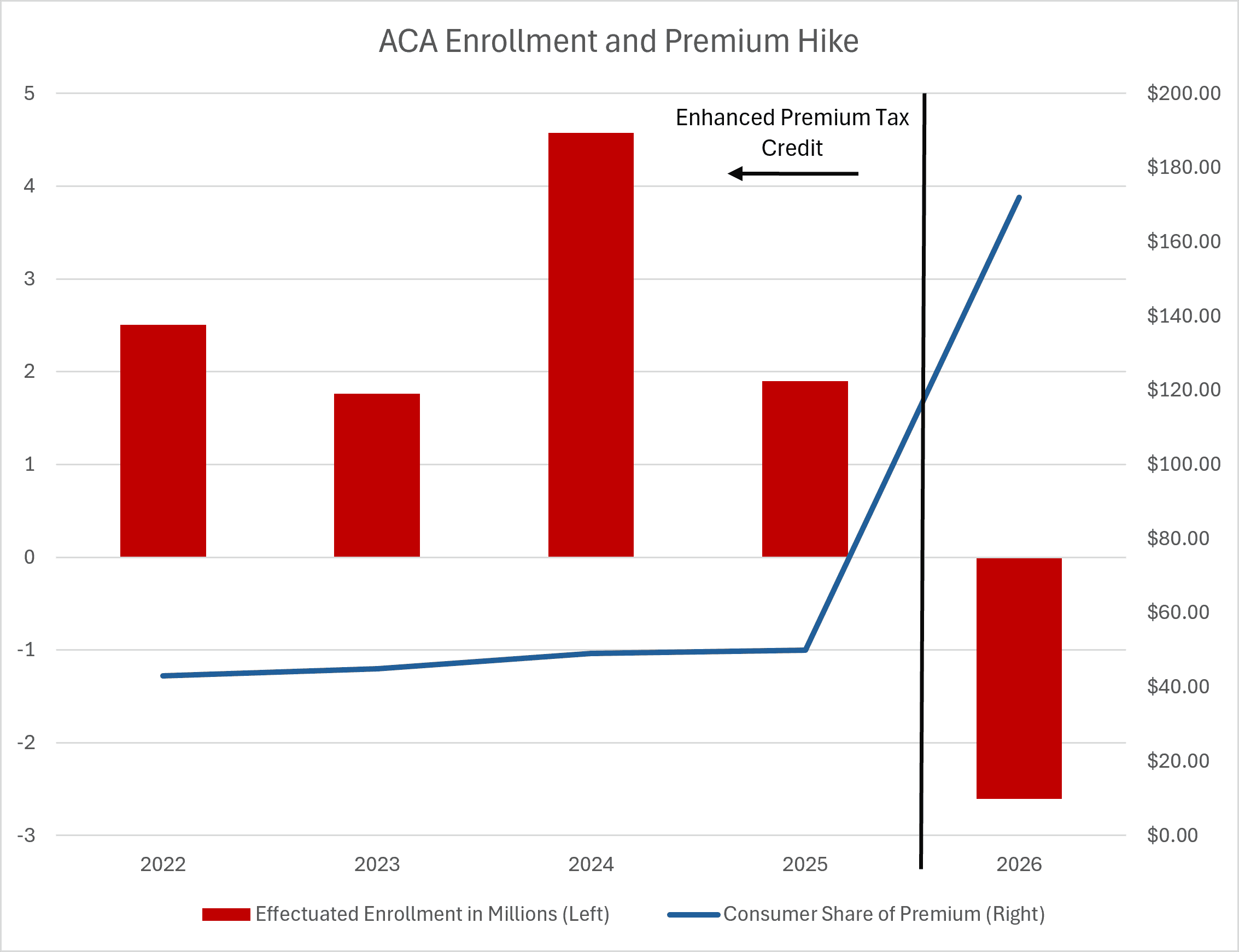
Enrollment in the Affordable Care Act (ACA) exchanges dropped by a whopping 2.6 million in 2026, and two factors likely explain what’s driving most of this disenrollment: premium increases and fraud prevention. A recent KFF study found that national average out-of-pocket premiums for a benchmark 40-year-old ACA policy enrollee increased from $50 in 2025 to $172 in 2026 – a 244-percent increase from the year before; a separate KFF brief reported ACA insurers are proposing a median premium increase of 15 percent in 2027 – a second consecutive year of double-digit hikes.
The Trump Administration attributes the bulk of disenrollment to stricter eligibility verification and targeted fraud-control measures designed to purge improper enrollees. Department of Health and Human Services officials argue that the increase in enrollment from 2021–2025 was a result of Biden-era policies including reduced eligibility verification and increased tax subsides – the enhanced premium tax credits. They claim these policies expanded incentives for companies to improperly enroll people in zero-dollar premium plans without providing mandatory income documentation. That said, many policy experts say that ACA fraud is exaggerated and point to the increase in ACA premiums following the expiration of tax credits on December 31, 2025, as the primary driver of disenrollment. These expanded subsidies capped premiums at 8.5 percent of household income and made zero-dollar premium plans widely available.
Ultimately, the ACA’s enrollment shift demonstrates that policies designed to increase access are likely to be unstable in the long-term if their financial incentives are not properly thought out. Reliance on government subsidies left the ACA marketplace vulnerable to increased fraud exposure while doing nothing to lower the true long-term cost of health care. Once subsidies expired, consumers faced a drastic increase in their share of premiums – and many left the program.