









Insight
October 23, 2026
Heating Oil Price Surge: DOE Announces Emergency Reserve Release
Executive Summary
- As U.S. average residential heating oil prices surged 74 percent year-over-year to $6.19 per gallon in mid-October 2026, the Department of Energy (DOE) announced it will loan up to one third of the Northeast Home Heating Oil Reserve to private fuel companies to mitigate high fuel costs.
- High fuel prices will disproportionately impact the Northeast, especially Maine, as 80 percent of U.S. households that heat with oil reside in the region; this price surge is driven by the Middle East energy shock, the global diesel market disruption, and severe pipeline infrastructure constraints in the region.
- DOE’s emergency release is unlikely to deliver meaningful consumer price relief, as the authorized volume represents only a fraction of winter demand, and ongoing global oil market disruptions continue to put upward pressure on prices.
Introduction
The Department of Energy (DOE) announced it will loan to private fuel companies up to about 315,000 barrels of ultra-low sulfur distillate fuel oil (heating oil or diesel) – about one third of total reserve stock – from the Northeast Home Heating Oil Reserve (NEHHOR). The transfer of the fuel is scheduled to be completed by November 13, 2026, from three storage sites in South Portland, Maine, Boston, Massachusetts, and New Haven, Connecticut.
The plan is structured as an “exchange” initiative, which means that borrowing companies are required to return the same volume of heating oil to the NEHHOR, plus pay a premium by the 2027–2028 winter season.
According to DOE, the goal of the emergency release is to “mitigate heightened home heating oil costs during the upcoming winter” as “a temporary measure to solve a temporary supply disruption” brought on by several factors, including the Middle East energy shock, the global diesel market disruption, and severe pipeline infrastructure constraints in the region. Notably, the NEHHOR reserves have only been released once previously – in 2012, as an emergency response to Hurricane Sandy.
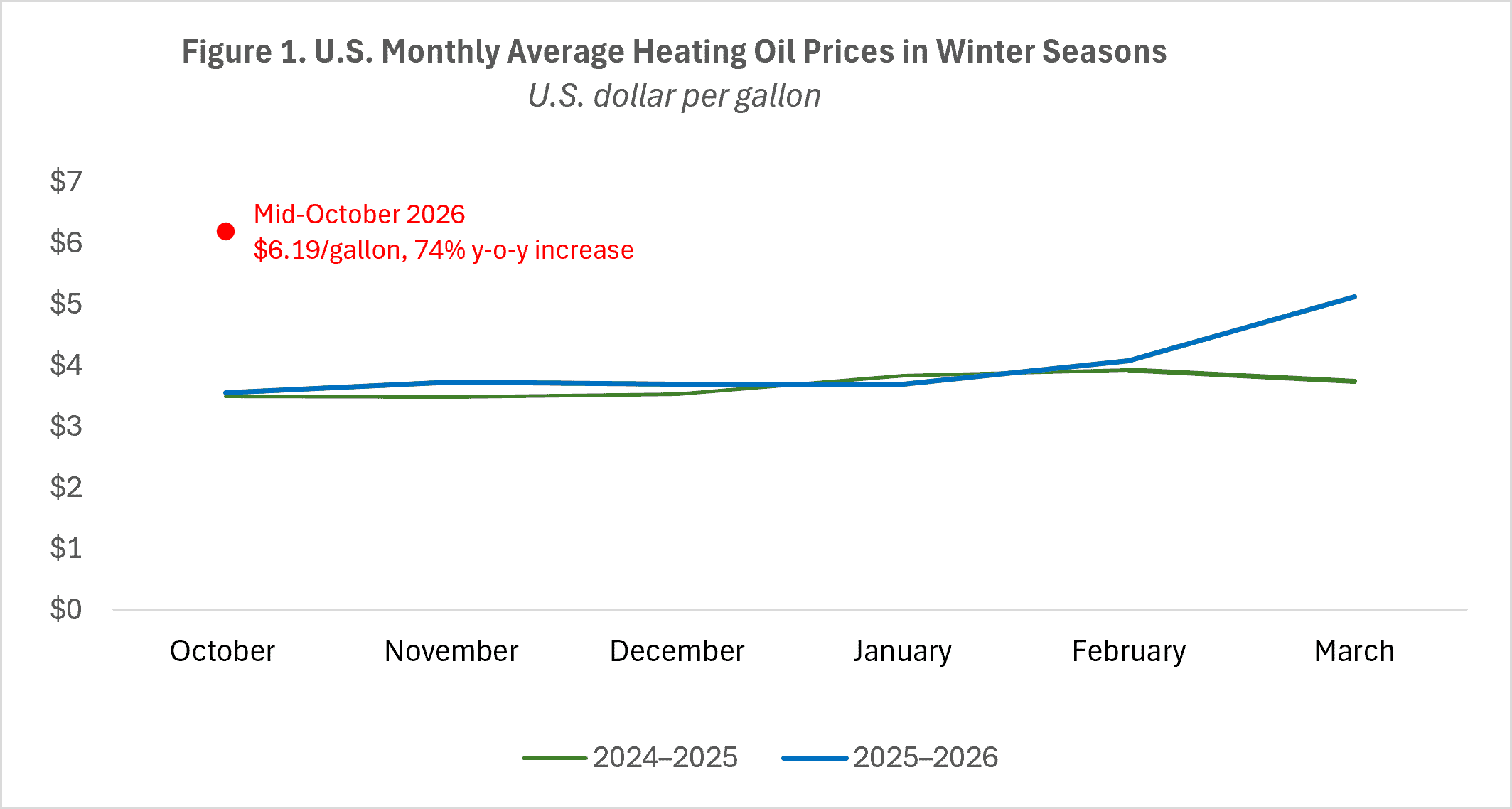
U.S. average monthly heating oil prices jumped to $6.19 per gallon in mid-October 2026, a 74-percent increase from $3.56 per gallon in October 2025. The record-high heating oil prices will disproportionately impact the Northeast, especially Maine, as 80 percent of U.S. households that use heating oil as their main fuel for space heating are in the region. DOE’s emergency release of the heating oil stock is unlikely to bring meaningful price relief in the Northeast, as the authorized volume represents only a fraction of winter demand, and ongoing global oil market disruptions continue to put upward pressure on prices.
Soaring Heating Oil Prices
As shown in Figure 1, U.S. average residential monthly heating oil prices jumped to $6.19 per gallon in mid-October 2026, a 74-percent increase from $3.56 per gallon in October 2025. The Energy Information Administration (EIA) estimated that the 2026–2027 winter season will see a 21-percent increase in heating oil expenditures compared to the previous winter.
The record-high heating oil prices will disproportionally hit the Northeast, especially Maine – in which about 50 percent of all residential households rely on heating oil for winter heating – followed by other New England states such as New Hampshire (37 percent), Vermont (36 percent), and Connecticut (35 percent). While only 3 percent of all the U.S. households use heating oil for space heating, more than 80 percent of households that use heating oil as their main fuel are in the Northeast.
EIA estimated that total U.S. heating oil consumption in the residential sector in 2024 was about 78 million barrels, which was equivalent to about 430,000 barrels per day in the winter season. Maine consumed about 4.5 million barrels a year, which was about 25,000 barrels a day.
Source: EIA
Factors That Drive Up Prices
Middle East Energy Shock
The ongoing energy disruption in the Middle East triggered by the February U.S.-Israel attack on Iran has led to significant decreases in global energy supply. American Action Forum’s (AAF) previous insight provides an in-depth analysis of the energy crisis. Although recent oil shipment through the Strait of Hormuz has exceeded the pre-war level, persistent attacks on commercial oil and gas tankers continue to disrupt global energy markets.
Global Diesel Market Disruption
Diesel prices in the United States and globally have hit record-high levels, with U.S. diesel prices sustained above $6 a gallon since September. The U.S. Gulf Coast diesel crack spread (a measure of profit margins) surged past $100 per barrel on September 1, 2026, which was a fivefold jump from the pre-Middle East-conflict baseline of approximately $20 per barrel (more details are available in this American Action Forum insight). Since diesel and heating oil are both middle-distillate fuels, the diesel price surge has spilled over into the heating oil sector.
Infrastructure Constraints
Severe pipeline infrastructure constraints in the Northeast are a major bottleneck to affordable access to heating fuels, including heating oil and much cheaper alternatives such as natural gas (this AAF insight discusses the infrastructure constraints in the region). A combination of cold winter weather and no feasible options to substitute fuels will continue to drive up the heating oil prices.
Implications of the Emergency Reserve Release
DOE’s emergency release of the heating oil stock is unlikely to meaningfully lower prices in the Northeast for three key reasons.
The scheduled 315,000 barrels of release is a drop in the bucket of needed supply—it accounts for less than one day of total U.S. consumption of heating oil in the winter season, and about 12 days of residential consumption in Maine. The total volume of the scheduled reserves release is simply not significant enough to impact fuel prices. Additionally, even if the fuel companies take up the loans, it will take time for emergency stock to reach consumers once private fuel companies receive the deliveries, which further weakens the impact on consumer prices.
The Northeast is connected to the global energy market. While the region imports most of its heating oil from the Gulf Coast, it imports some heating oil from Canada. In 2025, the East Coast imported almost 38 million barrels of distillate fuel oil (heating oil and diesel) from Canada. Unless the underlying geopolitical conflicts and global energy disruption are solved, heating oil prices in the region will continue to be elevated.
Last, the emergency stock deliveries received by local private fuel companies are unlikely to translate into noticeable price decreases in retail fuel for consumers, as fuel companies have to bid for the release and would drive down the final price very close to the market price. Additionally, distribution costs via diesel trucks have also spiked significantly. Finally, fuel companies may also leverage the emergency stocks as inventory buffers to prepare for unexpected cold winter storms.
The Trump Administration should not schedule any further release of the emergency heating oil stock as existing policies, such as the Low Income Home Energy Assistance Program (LIHEAP), is already designed to help alleviate costs for low-income households when there are spikes in energy costs.
