Insight
April 8, 2026
The 2026 State Minimum Wage Increases and Their Potential Costs and Consequences
Executive Summary
- On January 1, 19 states raised their minimum wage; three more states and the District of Columbia are scheduled to increase theirs later this year.
- While these increases will boost pay for some, requiring employers to pay above-market wages can come with unintended consequences, such as job loss, a reduction of benefits, and loss of opportunity for the least skilled and least experienced workers, which is best illustrated in the negative effect on teenage employment.
- This insight lays out this year’s state minimum wage increases and explores their costs and consequences, giving particular attention to how these raises can disproportionately harm lower-skilled workers.
Introduction
At the beginning of every year, a handful of states raise their minimum wages, either automatically to keep up with inflation or because state legislation prompts their increase – and 2026 is no different. This year, 19 states raised their minimum wages on January 1, and three more states and the District of Columbia are scheduled to implement increases later this year.
Advocates of increasing the minimum wage generally argue that doing so would boost workers’ pay, protecting them from exploitation and ensuring a livable wage. While it is true that some workers will receive a pay increase due to a hike in the minimum wage, requiring employers to pay above-market wages can come with unintended consequences, such as job loss and a reduction of benefits. Furthermore, such a policy can disproportionately hurt the least skilled and least experienced workers, which is best illustrated in its negative effect on teenage employment.
This insight lays out the state minimum wage increases for 2026 and explores the costs and consequences of these minimum wage hikes, giving particular attention to how these raises can disproportionately harm the least skilled and least experienced workers.
2026 State Minimum Wages Increases
The federal minimum wage was introduced in 1938 under the Fair Labor Standards Act at a rate of $0.25 per hour. Since then, it has been raised 22 times, most recently in 2009, bringing the federal minimum wage to its current rate of $7.25 per hour. Because the rate has not changed in nearly two decades, state policies often become the vehicle of minimum wage increases across the country. Thirty-four states, territories, and districts currently have minimum wages above the federal threshold.
This year, a total of 22 states increased or will increase their minimum wages—19 states raised theirs on January 1 and three more states and the District of Columbia are scheduled to implement wage increases later this year, as seen in Figure 1 and Figure 2 below. The District of Columbia and Washington State will have the country’s highest minimum wages, at an hourly rate of $18.40 and $17.13, respectively.
Figure 1: State Minimum Wage Increases, effective January 1, 2026
| State | 2025 Minimum Wage | 2026 Minimum Wage | Difference in Dollars | Percentage Increase
|
Legislation or Inflation Adjustment |
| Washington State | $16.66 | $17.13 | $0.47 | 2.8% | Inflation Adjustment |
| Connecticut | $16.35 | $16.94 | $0.59 | 3.6% | Inflation Adjustment |
| California | $16.50 | $16.90 | $0.40 | 2.4% | Inflation Adjustment |
| Hawaii | $14.00 | $16 | $2.00 | 14.3% | Legislation |
| New York | $15.50 | $16 | $0.50 | 3.2% | Legislation |
| Rhode Island | $15.00 | $16 | $1.00 | 6.7% | Legislation |
| New Jersey | $15.49 | $15.92 | $0.43 | 2.8% | Inflation Adjustment |
| Colorado | $14.81 | $15.16 | $0.35 | 2.4% | Inflation Adjustment |
| Arizona | $14.70 | $15.15 | $0.45 | 3.1% | Inflation Adjustment |
| Maine | $14.65 | $15.10 | $0.45 | 3.1% | Inflation Adjustment |
| Missouri | $13.75 | $15 | $1.25 | 9.1% | Legislation |
| Nebraska | $13.50 | $15 | $1.50 | 11.1% | Legislation |
| Vermont | $14.01 | $14.42 | $0.41 | 2.9% | Inflation Adjustment |
| Michigan | $12.48 | $13.73 | $1.25 | 10.0% | Legislation |
| Virginia | $12.41 | $12.77 | $0.36 | 2.9% | Inflation Adjustment |
| South Dakota | $11.50 | $11.85 | $0.35 | 3.0% | Inflation Adjustment |
| Minnesota | $11.13 | $11.41 | $0.28 | 2.5% | Inflation Adjustment |
| Ohio | $10.70 | $11 | $0.30 | 2.8% | Inflation Adjustment |
| Montana | $10.55 | $10.85 | $0.30 | 2.8% | Inflation Adjustment |
Figure 2: State Minimum Wage Increases, effective later in 2026
| State | Previous Period | 2026 Minimum Wage | Difference in Dollars | Percentage Increase | Legislation or Inflation Adjustment | Effective Date |
| Washington, DC | $17.95 | $18.40 | $0.45 | 2.5% | Inflation Adjustment | 7/1/2026 |
| Oregon | $15.05 | TBD based on CPI | TBD based on CPI | TBD based on CPI | Inflation Adjustment | 7/1/2026 |
| Florida | $14.00 | $15.00 | $1.00 | 7.1% | Legislation | 9/30/2026 |
| Alaska | $13.00 | $14.00 | $1.00 | 7.7% | Legislation | 7/1/2026 |
Source: National Employment Law Project, FRED, District of Columbia Department of Employment Services
The states that are increasing their minimum wages in 2026 are, on average, increasing them by about 4.9 percent or $0.69 since last year. In eight of these states, legislation prompts these increases. For the rest, their minimum wages are indexed to keep up with inflation. On average, states that increase their minimum wages via legislation have more substantial increases than those tied to inflation. Where legislation drives these increases, minimum wages are increasing by an average of 8.7 percent or $1.19; where the minimum wage is indexed to inflation, minimum wages are increasing by an average of 2.8 percent or $0.40.
Costs and Consequences of Minimum Wage Hikes
Advocates of increasing the minimum wage generally argue that it is necessary to protect workers from exploitation, reduce poverty, and ensure that workers receive a livable wage. While it is true that raising the minimum wage can indeed boost the pay of some workers, doing so comes with unintended consequences.
The minimum wage is a price control, specifically a price floor. When government policy sets a wage floor above the market clearing price, it creates a situation where the quantity of labor supplied exceeds the quantity demanded, resulting in a labor surplus, also known as unemployment, as seen in Figure 3 below. The higher the minimum wage is set, it would follow, the greater the unemployment effects would be.
Figure 3: A Minimum Wage Set Above the Market-clearing Price 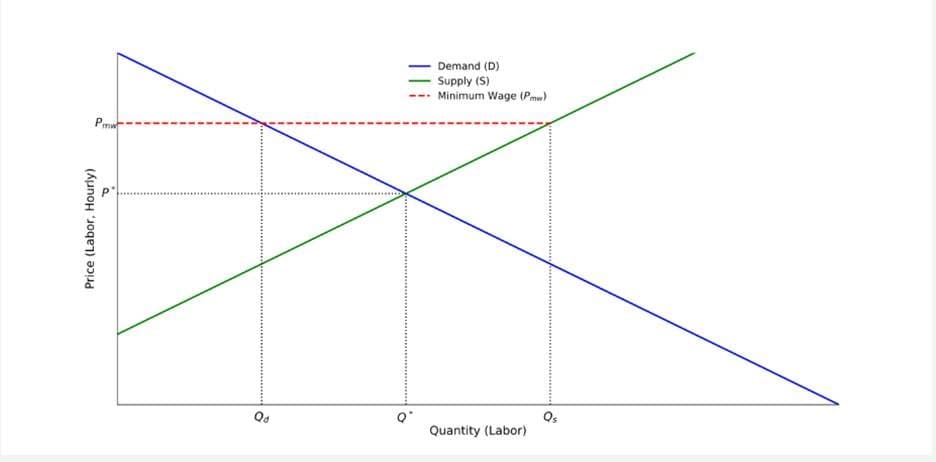 Source: American Institute for Economic Research
While unemployment is one possible consequence of raising the minimum wage, forcing employers to pay higher than the market-clearing wage may cause them to seek other ways to limit overall worker compensation, such as reducing benefits, encouraging automation, or working their employees harder. Furthermore, because these increases primarily affect those workers that would otherwise earn wages below the mandated wage floor, minimum wage hikes have a tendency to simultaneously hurt the least skilled and least experienced workers.
Minimum Wage and Teenage Unemployment
Given that increasing the minimum wage has the potential to price lower-skilled workers out of the job market, examining how different state minimum wage rates impact teenage unemployment can serve as a good illustration on how raising a wage floor affects low-skilled and low-experienced workers.
The Employment Policies Institute recently examined the relationship between teenage unemployment and state minimum wage rates using 2025 data from the U.S. Census Bureau’s Current Population Survey to calculate the 12-month rolling averages for unemployment for individuals ages 16–19 across all states. It found a positive correlation between state minimum wage rates and teenage unemployment, as seen in Figure 4 below.
Figure 4: Relationship Between Teenage Unemployment and State Minimum Wage Rates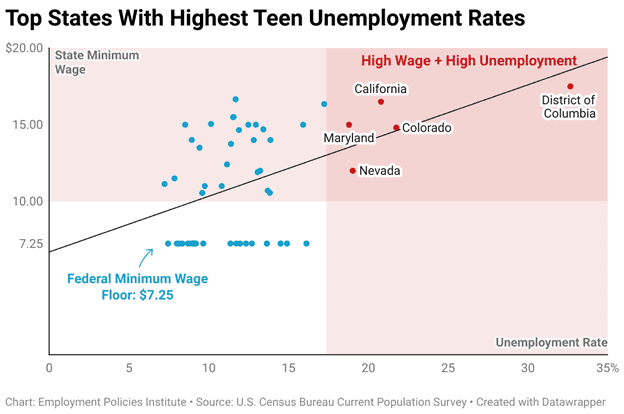
Source: Employment Policies Institute
Although not a causal finding, it is consistent with both economic theory and much research on this topic. For example, economists from the University of California at Irvine reviewed decades of research on the employment effects of the minimum wage, finding that studies that focused on the least-skilled groups, including teenagers, provide overwhelming evidence of stronger disemployment effects for these groups. A 1982 study mentioned in the review found that “time-series studies typically find that a 10 percent increase in the minimum wage reduces teenage employment by one to three percent.” More recently, a 2018 Mercatus Center study found that higher minimum wages were the “predominant factor” in the decline of teenage employment, especially impacting the 16–17-year-old age group, since 2000.
Given that evidence and economic theory suggest a higher minimum wage is associated with higher teenage unemployment, and teenage unemployment can serve as a good proxy for unemployment levels for less skilled and less experienced workers, it would follow that the state minimum wage hikes in 2026 will likely contribute to more disemployment effects among these disadvantaged groups. Further complicating matters, if these workers are priced out of the job market, they not only lose the opportunity to earn an income, albeit a modest one, but they also lose the chance to gain valuable on-the-job training that many entry-level jobs provide, impeding their career growth.
Conclusion
While it is true that increases in the minimum wage will boost pay for some workers, these increases will likely result in unintended consequences that can hurt other workers, particularly the least skilled and least experienced.