








Insight
October 14, 2026
Why Has Teenage Summer Employment Declined?
Executive Summary
- Summer employment among teenagers has substantially declined over the decades, as the employment-to-population ratio among 16- to 19-year-olds during July—generally the month with the highest level of teenage employment—dropped from an average of 55 percent from 1948–1999 to 38.8 percent from 2000–2026, a decline of 16.2 percentage points.
- Data suggest that this drop stems from a declining summer labor force participation rate rather than a growing inability to find work, as the July labor force participation rate among 16- to 19-year-olds fell by 18.3 percentage points between the two periods while the unemployment rate increased only modestly.
- Evidence suggests that an important reason teenagers are participating less in the summer labor market than they did in prior generations is their increased enrollment in summer school—as July school enrollment among 16- to 19-year-olds increased from 10.4–42.1 percent from 1985–2016.
Introduction
Summer employment among teenagers has declined substantially over the decades. The employment-to-population ratio among 16- to 19-year-olds during July—generally the month with the highest level of teenage employment—dropped from an average of 55 percent from 1948–1999 to 38.8 percent from 2000–2026 during the years 1948–1999 to 38.8 percent during the years 2000–2026, representing a decline of 16.2 percentage points between the two periods.
At first glance, it might appear that teenagers are searching for jobs but struggling to find work. Yet Bureau of Labor Statistics (BLS) data suggest that this decline in teenage employment instead stems from teenagers’ lack of participation in the summer job market. The labor force participation rate—the percentage of the population that is either working or actively looking for work—has declined substantially while the unemployment rate—the percent of the labor force that does not have a job but is actively pursuing employment—has not seen any significant increase.
The average labor force participation rate among 16- to 19-year-olds fell by 18.3 percentage points when comparing July averages from 1948–1999 with those from 2000–2026, while the unemployment rate increased only modestly over the same periods. This pattern suggests that the decline in teenage summer employment can be better explained by a declining share of teenagers participating in the labor market than by a substantial increase in teenagers who are actively seeking work but unable to find a job. Changes in teenagers’ activities, circumstances, or incentives may help explain why fewer teenagers are participating in the summer labor market.
Evidence suggests that an important reason for this decreased labor force participation rate is the increase in summer-school enrollment rates for teenagers over the past several decades. Enrollment rates have increased from 10.4 percent in 1985 to 42.1 percent in 2016, a 31.7 percentage point increase, with rates beginning to increase in the 1990s. Furthermore, annualized survey data indicate that the share of teenagers who cite school attendance as their main reason for nonparticipation in the labor market has increased substantially since the turn of the century—from 36.4 percent in 1999 to 54.5 percent in 2022, an 18.1 percentage point increase. Together, these trends suggest that the growing role of education during the summer has likely contributed to the decline in teenage labor force participation, and consequently, the teenage summer employment rate.
Teenage Summer Employment Has Declined Substantially Over the Past Quarter Century
Data from BLS show that teenage summer employment has declined substantially over time, as shown in Figure 1 below. The (not seasonally adjusted) employment-to-population ratio among 16- to 19-year-olds in July was 58.3 percent in 1948 when BLS began collecting such data. The ratio averaged 55 percent through the end of the 20th century, reaching a high of 60.1 percent in 1978. Beginning around the turn of the century, it dropped sharply, reaching its lowest point of 31 percent in 2011 during the immediate aftermath of the Great Recession. Since then, the summer employment-to-population ratio has recovered somewhat, reaching 36.5 percent in 2026, and averaging 38.8 percent since 2000—indicating a 16.2 percentage point fall in the average between the centuries.
Figure 1 Source: BLS
The decline in summer employment among teenagers is particularly noteworthy as compared with those in their early twenties. The July employment-to-population ratio for 20- to 24-year-olds, a relatively close age group, was higher in 2026 than in 1948, while the ratio for 16- to 19-year-olds declined substantially since 1948. The gap between the two age groups has also widened considerably, particularly over the past quarter century.
As shown in Figure 2, in 1948, the employment-to-population ratio for 16- to 19-year-olds in July was 58.3 percent compared with 62.4 percent for 20- to 24-year-olds—a difference of only 4.1 percentage points. By 2026, the ratio for 16- to 19-year-olds had fallen to 36.5 percent, while the ratio for 20- to 24-year-olds had risen to 67.5 percent—creating a much larger 31 percentage point differential between the two age groups. Overall, the difference between the two age groups increased by 26.9 percentage points between 1948 and 2026, with most of the widening resulting from the decline in the employment-to-population ratio among 16- to 19-year-olds.
Figure 2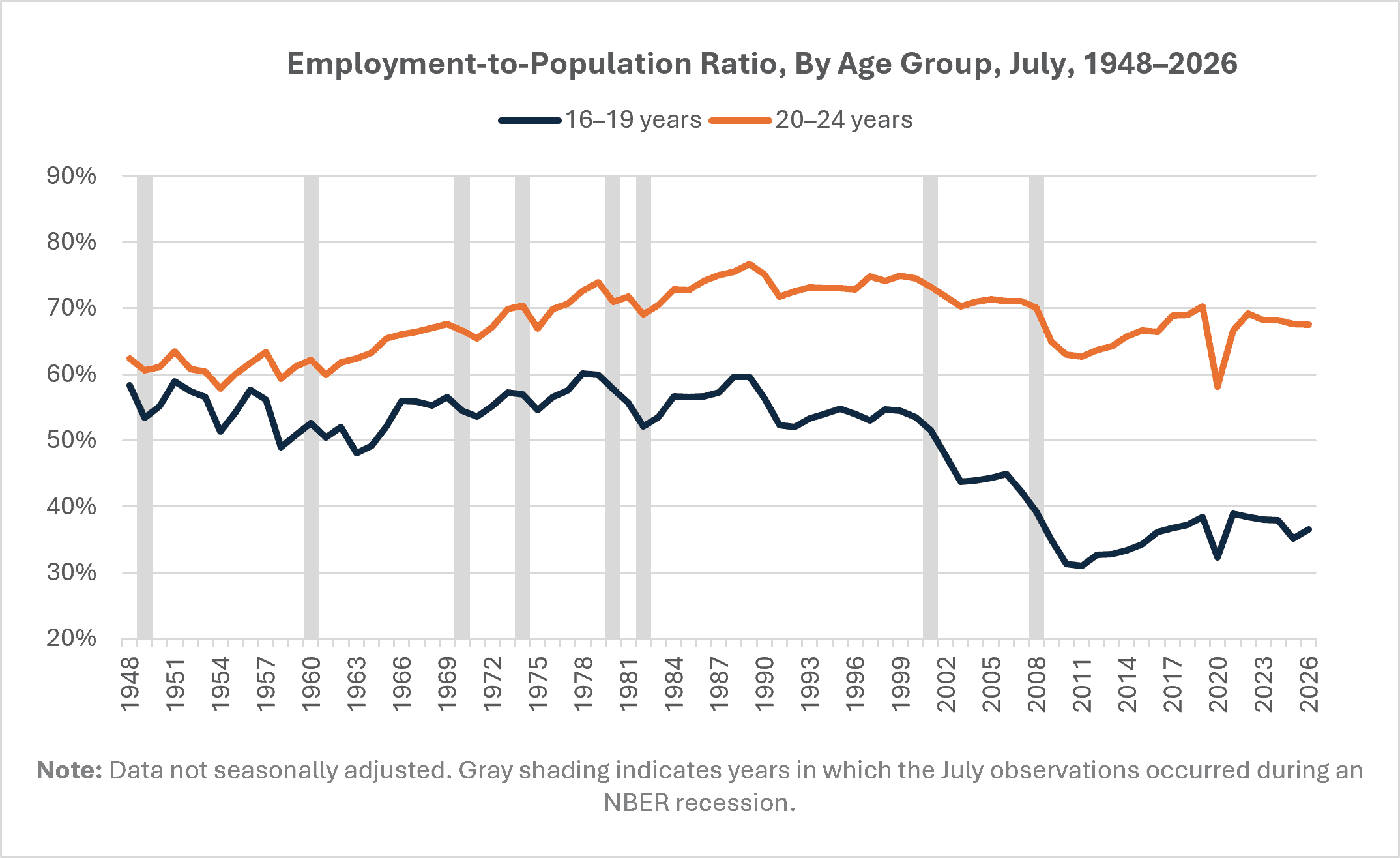 Source: BLS
The widening employment gap between the two age groups suggests there may be factors unique to teenagers that explain the decline in their summer employment. Since the employment-to-population ratio among 16- to 19-year-olds has fallen significantly while remaining comparatively high among 20- to 24-year-olds, the decline cannot be attributed to broad economic factors that reduce employment for young people generally. Rather, it indicates changes in behaviors, incentives, or circumstances of teenagers that have reduced their employment in recent decades.
Teenagers Are Participating Less in the Summer Labor Market, Not Increasingly Struggling to Find Work
In considering the decline in teenage summer employment, one might assume that teenagers are increasingly struggling to find work compared with previous decades. Further labor market data, however, suggest the decline is not primarily explained by an unusual increase in teenage unemployment.
Comparing the labor force participation rate—the percentage of the population that is either working or actively looking for work—among 16- to 19-year-olds with the unemployment rate—the percentage of the labor force that does not have a job but is actively pursuing employment—helps distinguish between these two possibilities. If the decline in teenage summer employment were primarily driven by teenagers struggling to find work, that decline would likely follow—or perhaps be accompanied by—a substantial increase in the unemployment rate. Instead, the much larger decline in the labor force participation rate indicates that an increasing share of teenagers are neither working nor actively seeking employment.
Figure 3 shows that from 1948–2026, the labor force participation rate for 16- to 19-year-olds in July fell substantially, while the unemployment rate did not rise in any remarkable fashion. In 1948, the labor force participation rate for this age group was 65.5 percent and averaged about 65.2 percent through the end of the 20th century, peaking at 71.8 percent in 1978. Since 2000, the average labor force participation rate has dropped to 46.9 percent, representing an 18.3 percentage point decline between the two periods.
The unemployment rate, however, remained largely stable over the same period that the labor force participation rate fell. The unemployment rate since 2000 has averaged 17.3 percent, only about 1.7 percentage points higher than the average of 15.6 percent during the years 1948–1999.
Figure 3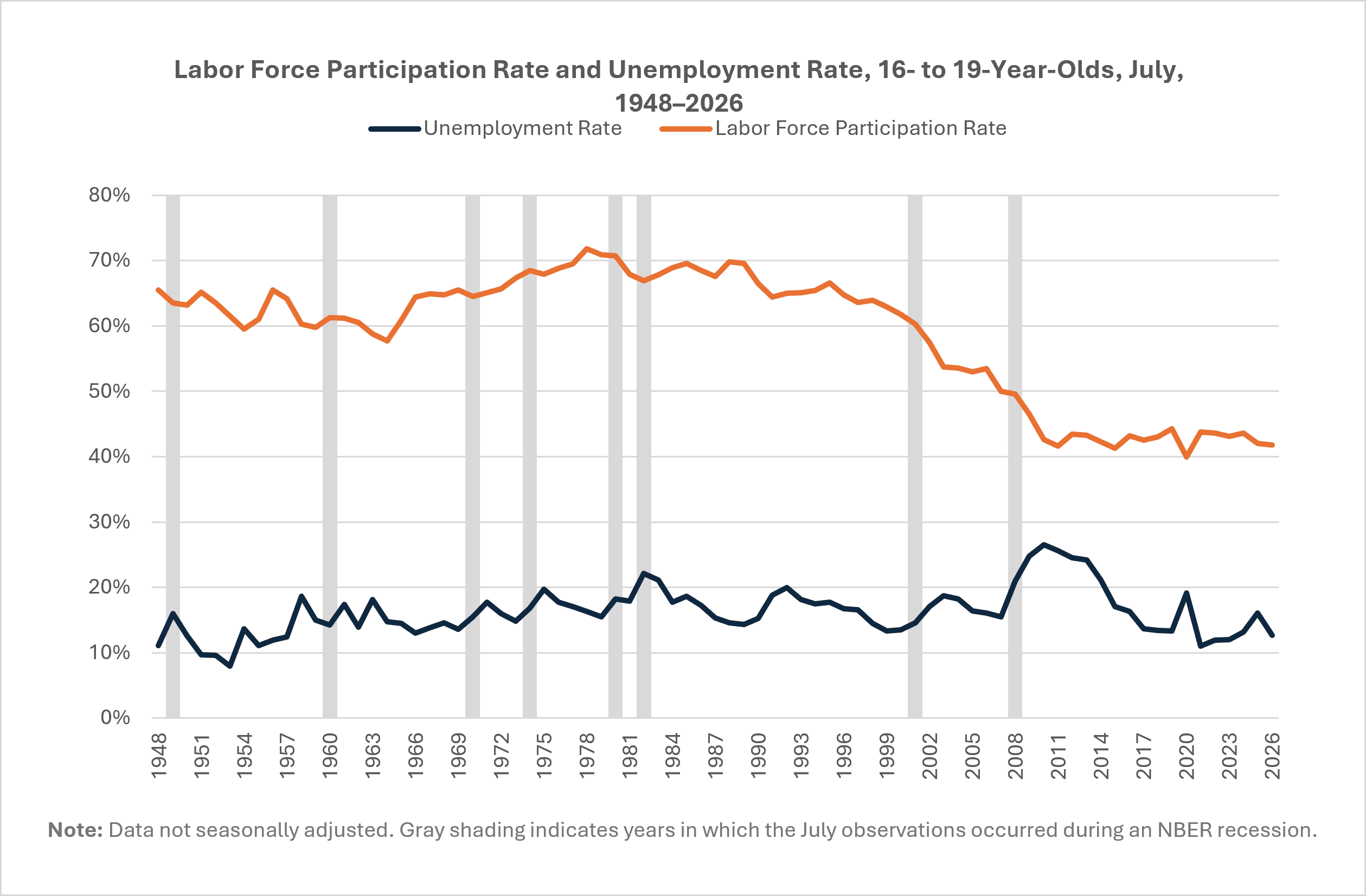 Source: FRED via BLS
Given the substantial decline in the labor force participation rate among 16- to 19-year-olds in July, combined with the absence of a similarly large increase in their unemployment rate, the data suggest that the decline in teenage employment over the past several decades has been driven more by a reduction in labor force participation than an increase in unemployment. In other words, teenagers are affirmatively choosing not to participate in the summer labor market compared to decades prior, rather than substantially more teenagers searching for, but being unable to find work.
Education Has Become a Major Alternative to Summer Employment
With teenagers participating in the summer labor market at lower rates than previous generations, an important question is what is driving this decline. This long-term decline appears to be associated with changes in how teenagers now spend their time during the summer months. Although volunteer work and unpaid internships—neither of which BLS counts as employment—may have increased over time, the growing emphasis on education and academic achievement may have more substantially contributed to the declining labor force participation rates, as more teenagers are enrolled in summer school.
Over the years, high school students have taken increasingly rigorous coursework, while parents have placed greater emphasis on school-related activities and college attendance. Remedial and credit-recovery have also remained an important aspect of summer school. Together, these trends suggest that education and academic achievement have occupied a larger role in teenagers’ lives, potentially increasing the opportunity cost of spending the summer in the labor market.
BLS data show a striking relationship between rising summer-school enrollment and declining summer teenage labor force participation. As shown in Figure 4, the percentage of teenagers enrolled in school in July was 10.4 percent in 1985. Enrollment increased gradually through the late 1980s and early 1990s before rising more rapidly, reaching 42.1 percent by 2016. This represents a total increase of 31.7 percentage points from 1985–2016. During that period, the labor force participation rate for the same age group in July moved in the opposite direction, falling from 69.6 percent in 1985 to 43.2 percent in 2016, a 26.4 percentage point decline.
Figure 4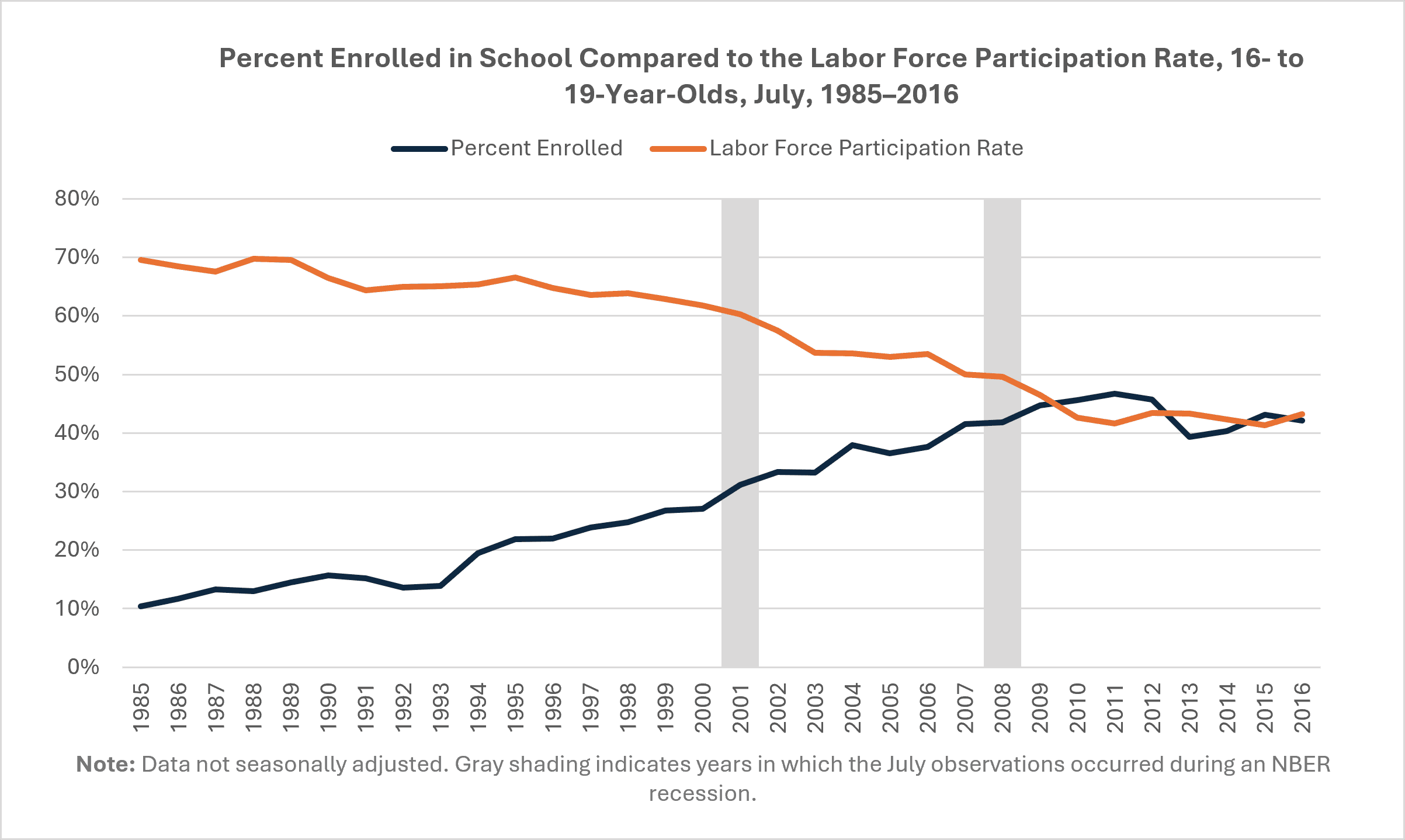 Source: BLS
BLS survey data also indicate that school enrollment has become an increasingly important reason why teenagers are participating in the labor market at lower rates.
Figure 5 shows the labor force nonparticipation rates of 16- to 19-year-olds by reason for not working in 1999 and 2022. According to BLS’ Annual Social and Economic Supplement to the Current Population Survey, in 1999, 40.9 percent of 16- to 19-year-olds were not participating in the labor market. Of those teenagers, 36.4 percent of them cited school enrollment as the main reason for nonparticipation. The remaining 4.5 percent cited reasons including illness or disability, retirement, home responsibilities, and “other reasons.” By 2022, the share of 16- to 19-year-olds outside the labor force had increased to 60.1 percent, while 54.5 percent cited school attendance as their main reason for nonparticipation. The other reasons combined accounted for the remaining 6 percent. Overall, the percentage of teenagers citing school attendance as their main reason for nonparticipation increased by 18.1 percentage points between 1999 and 2022.
Figure 5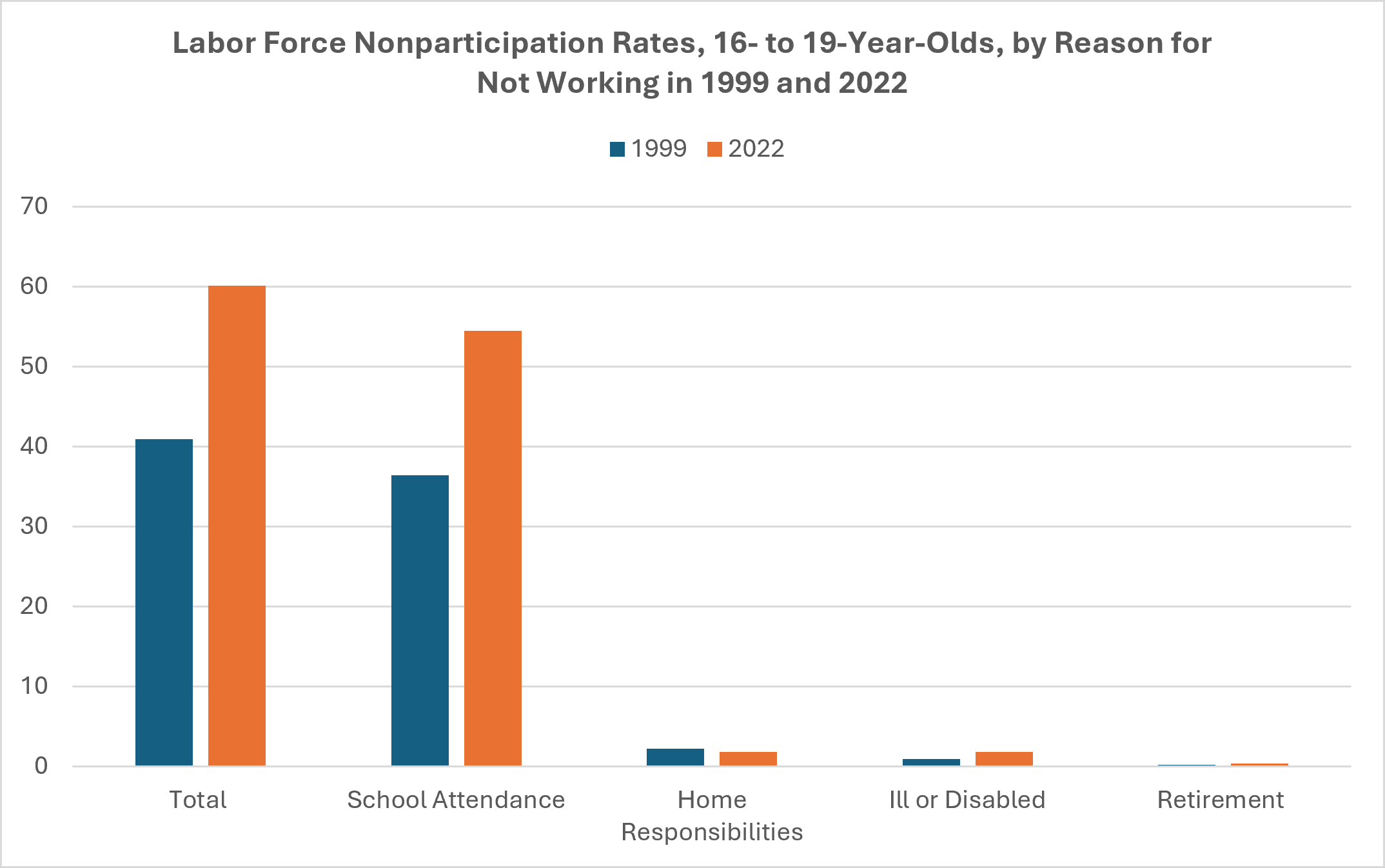 Source: BLS
The increase was particularly pronounced in the first decade of the 21st century, as the share of teenagers citing school attendance as their main reason for nonparticipation increased from 37.3 percent in 2000 to 60.1 percent in 2010, an increase of 22.8 percentage points, as shown in Figure 6.
Figure 6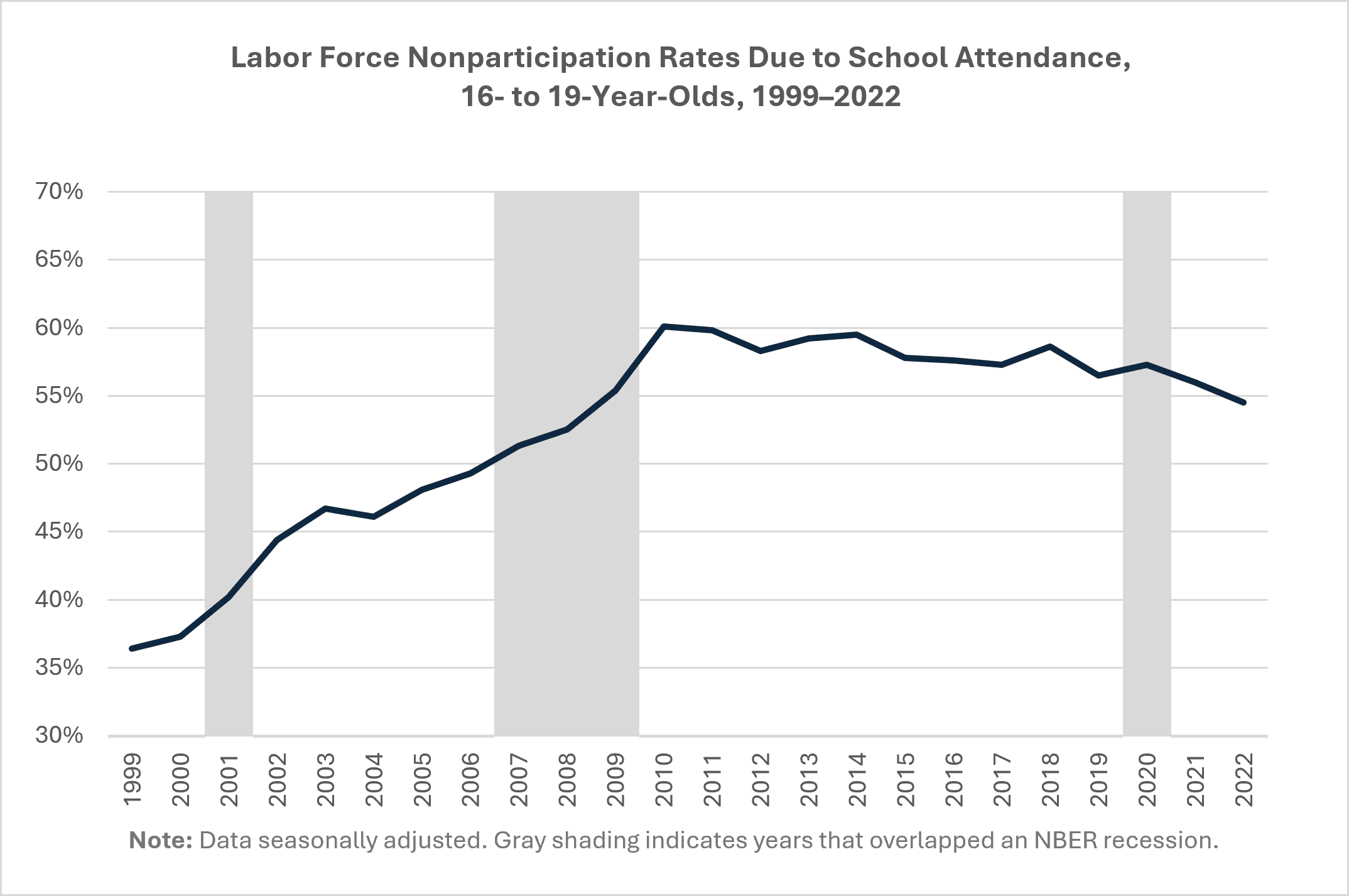 Source: BLS
Notably, this sharp increase around the turn of the century occurred at roughly the same period that the summer labor force participation rates declined. This timing suggests that the growing share of teenagers citing school enrollment as the main reason for nonparticipation during the year may also help explain their declining participation in the summer labor market.
Although these data capture reasons for labor force participation throughout the year rather than specifically during the summer, they nevertheless provide insight into the factors that may contribute to lower summer labor force participation among teenagers. Despite the lack of survey data identifying why teenagers choose not to work specifically during the summer, the substantial increase in summer-school enrollment, combined with the growing share of teenagers who cite school attendance as a reason for nonparticipation, suggests that education has become an increasingly important factor in the decline in teenage summer labor force participation rates.
Conclusion
Teenage summer employment has seen a significant decline in the past several decades, particularly in the past quarter century. Data suggest that the bulk of this decline stems not from an increase in the share of teenagers who are looking for a job but struggling to find one, but rather from a decline in the share of teenagers who are participating in the labor market. Increased summer-school enrollment rates combined with the increased share of 16- to 19-year-olds that cite school attendance as the main reason for nonparticipation in the labor market suggest that summer-school enrollment is a prominent factor in the summer labor force participation decline, and consequently the declining teenage summer employment rate.