The Shipment
September 18, 2025
A Curious Case of Tariff Evasion?
(Not So) Fun Fact: Last weekend, President Trump suggested that all NATO countries should place a tariff of between 50–100 percent on China to pressure the country to help end the war in Ukraine.
Tariff Fraud or Data Flawed?
What’s Happening: On Sunday, The Wall Street Journal (WSJ) reported that domestic appliance manufacturer Whirlpool is claiming its top competitors – Samsung, LG, and GE Appliances – are evading U.S. tariffs. Specifically, Whirlpool is accusing these companies of lowering the reported value of certain imports at U.S. points of entry to reduce the tariff placed on these items. This claim appears to be strengthened by other data showing that while the reported value of these imports has been lowered, the retail prices have not seen a similar drop. To illustrate this, the WSJ highlights three products: garbage disposals from China, gas ranges from Thailand, and front-load washing machines from South Korea. The reviewed import data show the value per unit dropping substantially between January and July: 60 percent for garbage disposals, more than 50 percent for gas ranges, and 90 percent for front-load washing machines. While Whirlpool has expressed its concerns to the Trump Administration, it has not filed a formal complaint. Samsung has declined to comment, LG has stated it is committed to U.S. laws, and GE Appliances has said the claims are inaccurate. An executive at CargoTrans – a logistics company and customs broker – suggested that the imposition of new steel tariffs may have caused a “double-counting” of the quantity of products imported, thereby lowering the estimated per-unit import value. Whirlpool maintains that its competitors “are very large and sophisticated companies that know how to declare their imports.”
Why It Matters: Tariff evasion can take the form of sneaky trade practices such as shipping goods through a third country before arriving in the United States (to reduce a 50-percent tariff to a 10-percent tariff, for instance) or by changing the classification of a product to one with a lower tariff rate. Evasion enters murkier and possibly illegal waters when companies purposely reduce the declared value of an import to pay less to U.S. customs officials, which is what Whirlpool alleges its competitors are doing.
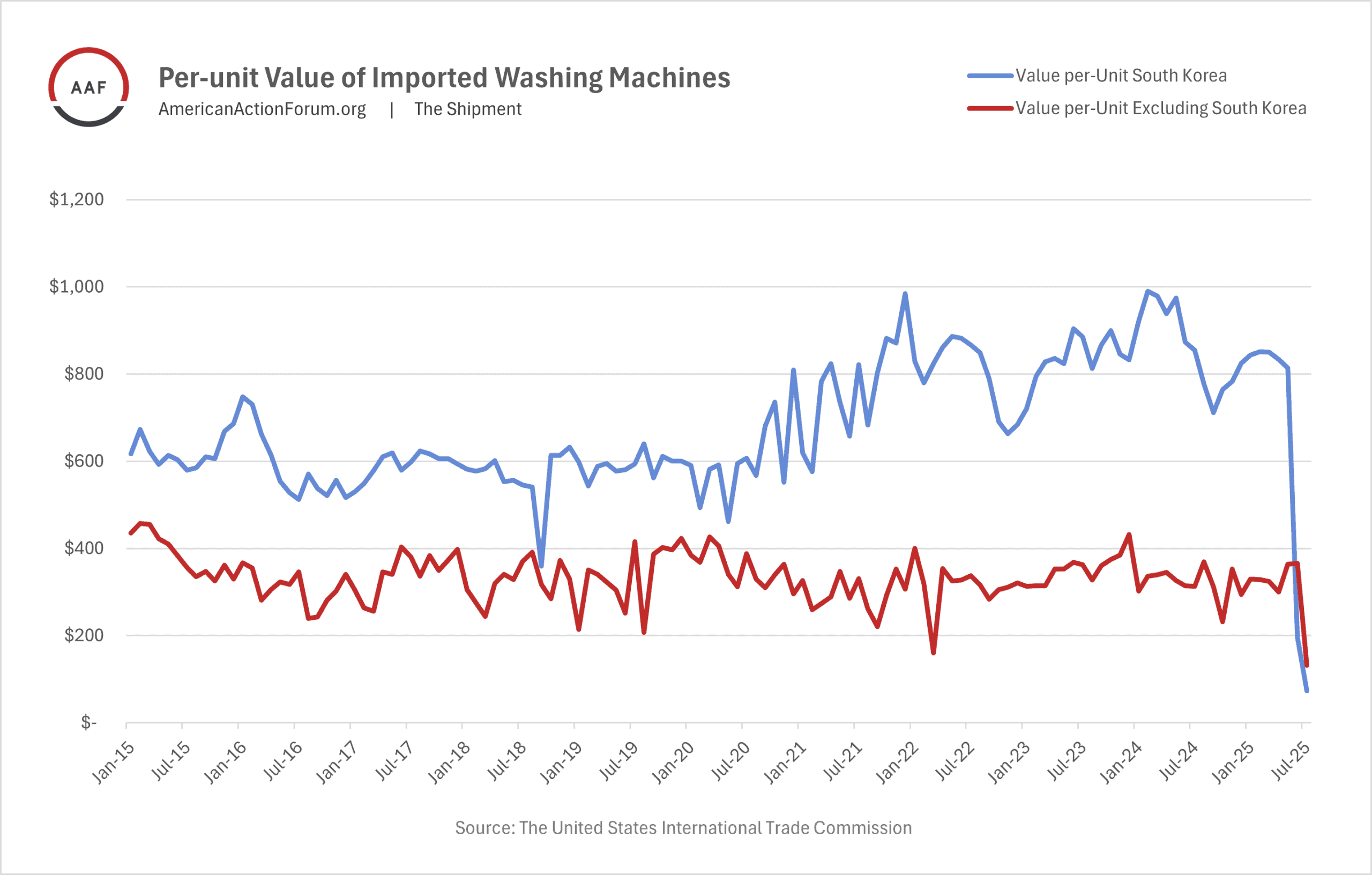
Do Whirlpool’s accusations have merit? To answer that question, the Shipment looked at the reported values of front-load washing machines. The WSJ chart shows that the average per-unit import value of this product from South Korea was around $838 – until it sank to $73 in July. Although the specific product code is not listed in the article, it appears that the washing machine in question corresponds to Harmonized Tariff Schedule code 8450200080, as the Shipment calculated an average per-unit import value of $838.62 between January and May. The per-unit import value dropped significantly, to $196 in June, and $73.45 in July, as displayed in the chart below. Presumably, this information was flagged by Whirlpool as it may indicate that its competitors from South Korea are devaluing their products to pay lower tariff costs.
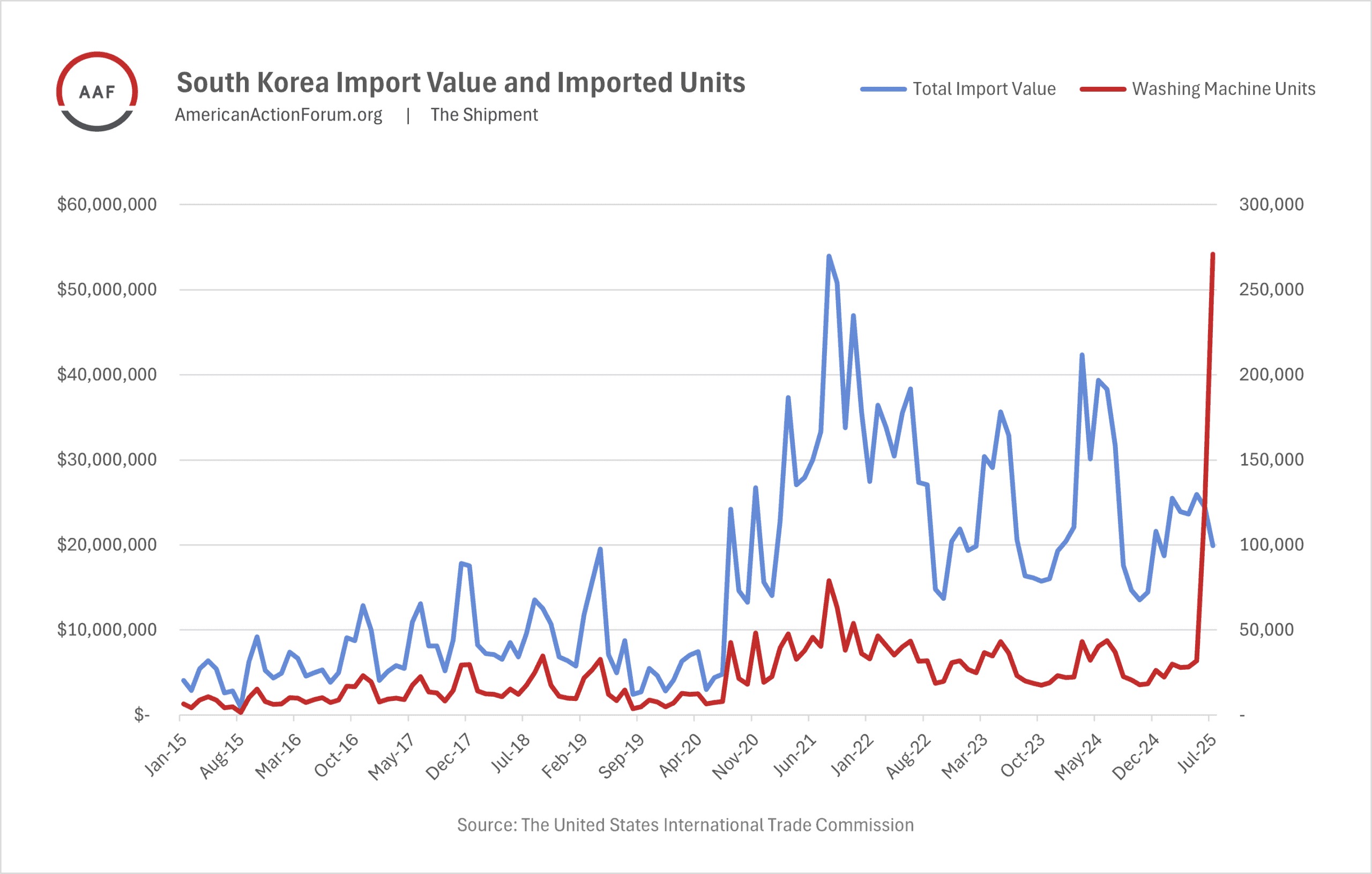
To the Shipment, a few things stick out as rather peculiar. The data show an unprecedented surge in total units imported, which spiked from an average of 28,100 monthly units between January and May to 124,000 in June and 271,000 in July. The reported monthly import value, however, stayed relatively stable as the average was $23.5 million in the first part of the year, $24.4 million in June, and $19.9 million in July. This indicates that the primary reason the value per unit fell is because total units imported skyrocketed rather than total import value decreasing, meaning one of two things. The first option is that companies importing from South Korea purchased 600 percent more washing machine units in July 2025 compared to July 2024, and at the same time undervalued those goods. The second option is that there is a data-entry issue that resulted in an overcounting of the number of imported washing machines. This would artificially lower the calculated per-unit value and may result from the overlap of “Liberation Day” tariffs, steel tariffs, and historical tariffs on appliances, creating a confusing environment in which businesses are filling out multiple forms for separate tariffs.
An additional fact worth noting is that the drop in per-unit value occurred not only in washing machines from South Korea but from nearly every country the United States imported these products. As an example, the per-unit value of front-load washing machines from Canada fell from an average of $31,000 between January and May to $1,128 in July, a 96-percent drop. The reason the unit value was high to begin with is likely due to washing machine imports from Canada being primarily commercial washing machines rather than cheaper household washers, both of which are included in the same product code, according to DataWeb. Despite examples of per-unit value drops outside of South Korea, Whirlpool has not claimed tariff fraud and the WSJ article did not mention these cases.
Looking Ahead: It is not clear at this point whether tariff evasion is taking place or if the true cause is just some sort of data anomaly. As such, it is also unclear whether a case will be filed, or what the results might be of an investigation into appliance manufacturers illegally devaluing their imported products. Notably, per-unit import values are not only dropping in South Korea, but all over the world. If this does turn out to be a data entry concern or an issue with companies filing multiple entry forms for a single unit out of confusion, that might be a more pressing issue for those studying the impact of trade and tariff policy. A widespread issue with trade data would mean policymakers, analysts, and companies are relying on flawed data to make important decisions.