The Shipment
July 31, 2025
The EU Trade Deals and a Whole Lot of Trade News
The European Union Trade Deal: A Tale of Two Fact Sheets
What’s Happening: On July 27, the United States and European Union reached a trade deal, with President Trump and European Commission President Ursula von der Leyen holding a press conference to tout it. The most notable and widely publicized components of the agreement is the EU’s commitment to invest $600 billion in the United States and purchase $750 billion in U.S. energy products by 2028. The U.S. tariff rate on the majority of EU goods is set to be 15 percent while the EU plans on eliminating tariffs on U.S. industrial goods as well as expanding market access for certain U.S. products. Notably, there is currently no formal or legally binding trade agreement signed by either party, with multiple points of contention that still need to be ironed out. According to an EU official, both sides are working on a legal framework, but the content has yet to be confirmed.
Why It Matters: Despite polarized views on the agreement – with some believing it is entirely negative and others thinking it is a historic economic boon – the U.S.-EU trade deal can best be described as a mixed bag for the U.S. economy. The outcome heavily depends on whether real-world actors follow through on the deal and if a legal framework is crafted for implementation. Keeping in mind that the U.S. and EU economies are not centrally planned, let’s assume for the sake of argument that the deal goes through without a hitch. It is generally considered a positive when businesses invest in the United States, as this creates jobs, bolsters GDP growth, and increases government tax revenues. A $600 billion investment is equivalent to about 2 percent of U.S. GDP and would spur downstream economic growth. It is also fair to assume that increasing sales for U.S. companies and opening up the EU market is beneficial to the U.S. economy for similar reasons. At the same time, U.S. consumers and businesses are stuck with a 15-percent tariff on EU imports, which is roughly five times higher than 2024 levels and will raise annual costs by close to $50 billion, according to the Shipment’s calculations. At face value, the deal is a bit of good and a bit of bad.
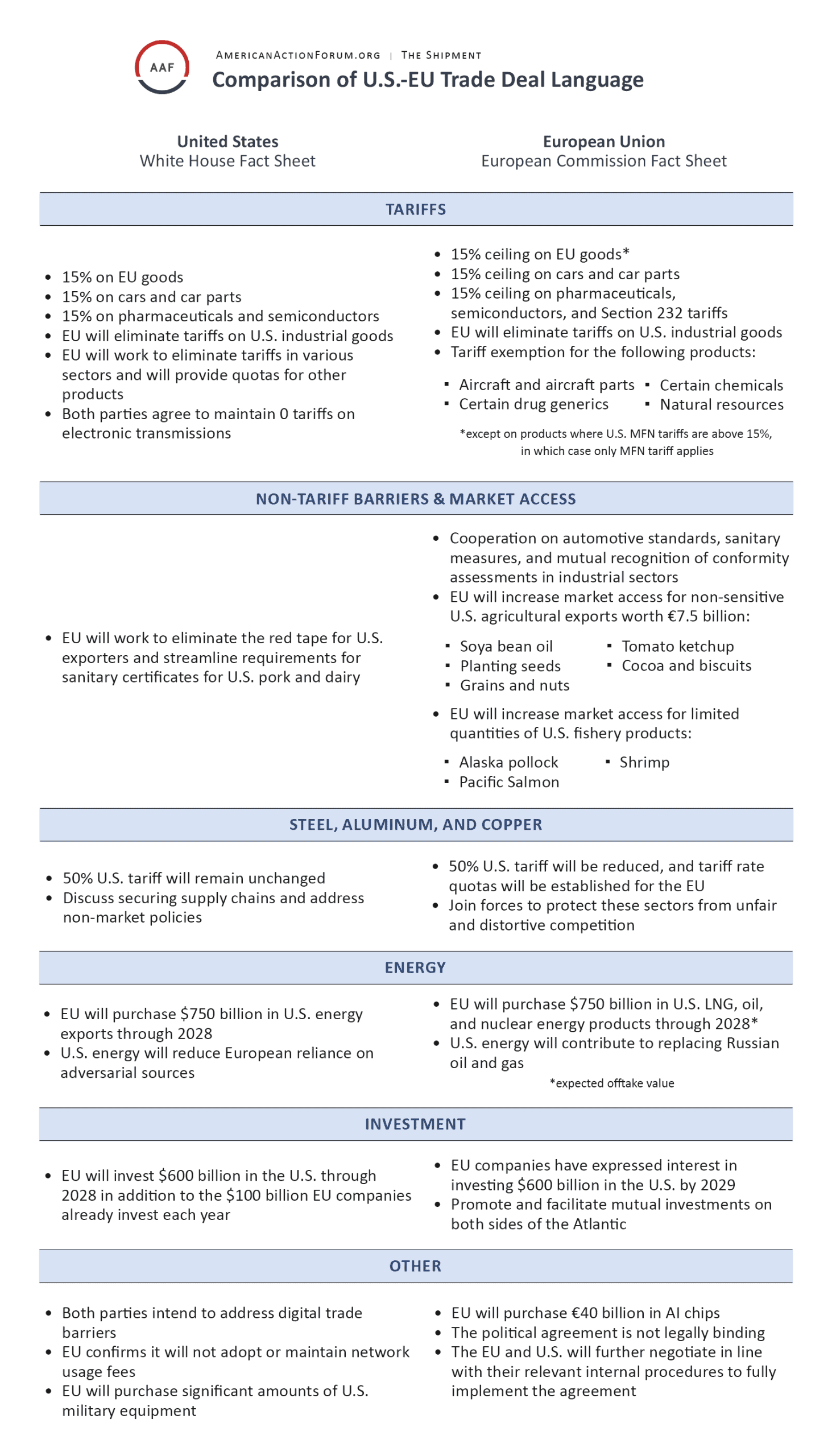
And yet, because the U.S. and EU economies are not centrally planned, and because there is, as mentioned earlier, no formal framework, it is unlikely the deal will live up to the hype and headlines. First, and arguably most important, the White House fact sheet is noticeably different than the fact sheet published by the European Commission. The most dramatic difference is that the United States does not plan on lowering its 50-percent tariffs on steel, aluminum, and copper, while the EU seems to be under the impression that tariffs will be lowered with quotas put in place. This basic misunderstanding does not inspire confidence in the concrete implementation of the U.S.-EU deal. (See a comparison of each version of the deal in the graphic below.) Second, governments are not in charge of the vast majority of trade and investment decisions. The governments of EU member states do not buy U.S. goods or energy and hand them out to their residents. That role falls to EU businesses and consumers, which are not obligated to abide by anything other than market forces. There are also many questions on the feasibility of the EU purchasing such a large quantity of U.S. energy. Discussed in upcoming American Action Forum research by Shuting Pomerleau and yours truly, the EU will likely fall short of its energy pledge by a few hundred billion dollars given current trends, capacity, and contracts.
Looking Ahead: This trade agreement will require a majority of EU countries to ratify it, meaning it may be months or years before a final, binding trade deal is complete. This means there may be static trade conditions for EU countries for now, although if investments are not made, purchases not executed, or market access not opened before President Trump leaves office, there may once again be tariff threats to spur action. As for the August 1 deadline tomorrow, the Shipment’s cost estimate has been lowered from more than $400 billion to close to $366 billion as a result of the EU trade deal. This also factors in the now 50-percent tariff on Brazil, 25-percent tariff on India, and slight reduction in the Mexico tariff rate from 30 percent to 25 percent resulting from a 90-day extension. This estimate is back in line with past American Action Forum research on “Liberation Day” tariffs which puts the annual cost range between $366.5–$391.6 billion. While Mexico has been given an extension, Canada currently lacks a deal and faces a 35-percent tariff.
A Whole Lot of Other Trade News
Brazil Tariff: President Trump issued an executive order citing the International Emergency Economic Powers Act (IEEPA) to impose an additional 40-percent tariff on various Brazilian imports, bringing the tariff rate to 50 percent starting August 6. Notably, there are numerous exemptions that lower the overall impact.
India Tariff: President Trump announced on Truth Social that he will impose a 25-percent tariff on India beginning August 1. The main rationalization behind this tariff is India’s purchase of Russian military equipment and energy, as well as India’s high tariffs and trade barriers.
Copper Tariff: President Trump issued an executive order citing Section 232 to impose a 50-percent tariff on copper and certain derivative products beginning August 1. This order also cites the Defense Production Act and will require 25 percent of copper scrap and copper inputs materials produced in the United States to be sold in the United States, with an increasing percentage over time.
De Minimis Suspension: President Trump issued an executive order citing IEEPA to suspend de minimis treatment for packages valued under $800 that enter by means other than the international postal network beginning August 29. This de minimis treatment allowed low-value packages to enter the United States without fees and tariffs.
South Korea Trade Deal: President Trump announced on Truth Social that the United States has reached a trade deal with South Korea. This deal includes a 15-percent tariff on Korean imports (including cars), no tariffs on U.S. exports, increased market access for U.S. businesses, a Korean commitment to purchase $100 billion in U.S. energy, and a $350 billion investment in the United States by South Korea. It is worth noting that the president appears to believe this investment will be owned and controlled by the United States, and not, as is usual, by South Korean companies.
Pakistan Trade Deal: President Trump announced on Truth Social that the United States reached a deal with Pakistan. The deal will apparently feature the two nations working together on developing Pakistani oil reserves, although there is no mention of trade barriers or tariffs.
China Trade Negotiations: The third round of U.S.-China trade negotiations wrapped up on July 29, with both parties calling the talks “constructive” and expressing interest in extending the deadline for another 90 days after the August 12 deadline. Treasury Secretary Bessent said that the final decision is awaiting approval from President Trump.