Week in Regulation
August 31, 2026
A Relatively Quiet Week With One Big Twist
The final week of August was fairly understated in terms of the number of substantive rulemakings. There were only four agency actions that contained clearly quantified costs or savings estimates. Of these, the main item was a proposed rule from the Department of State (STATE) that would make it easier to renew one’s passport while overseas. The most significant rulemaking, however, was the Department of Homeland Security (DHS) proposal to dramatically increase the fee for H-1B visas, which included a rather perplexing cost-benefit analysis. Overall, federal agencies published roughly $1.1 billion in total cost savings but added 41,582 paperwork burden hours.
REGULATORY TOPLINES
- Proposed Rules This Week: 26
- Final Rules This Week: 70
- 2026 Total Pages: 55,635
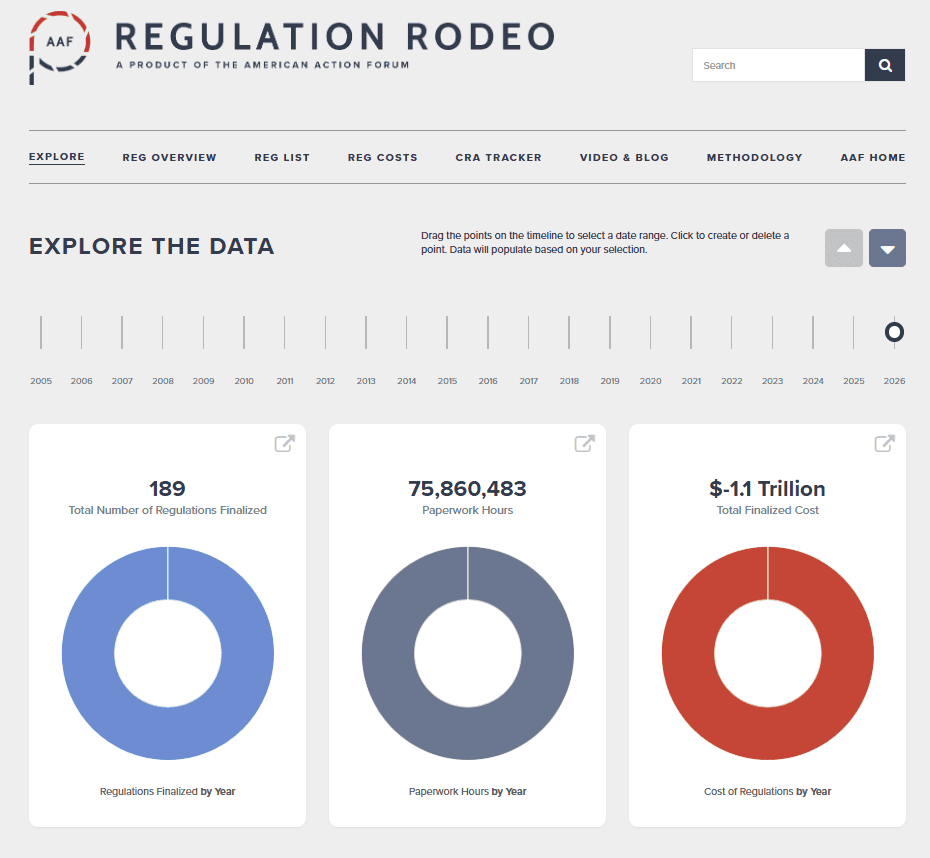
- 2026 Final Rule Costs: -$1.1 trillion
- 2026 Proposed Rule Costs: $49.3 billion
NOTABLE REGULATORY ACTIONS
The most consequential cost-cutting rulemaking of the week was the STATE proposed rule on “Passports: Expanding Online Passport Renewal Overseas.” Specifically:
This proposed change includes expanding online passport application availability to qualified applicants located in foreign countries. In addition, the Department is proposing to remove the requirement that an applicant’s most recently issued passport must have a year or less of remaining validity to qualify to submit an online passport application.
The agency expects this more streamlined process to reduce the postage and travel costs of some six million applicants. Based upon fiscal year 2027 projections, STATE estimates that such savings will add up to nearly $149 million in a given year, or roughly $1.1 billion total when projected across a 10-year horizon using a 7-percent discount rate.
The agency action carrying perhaps the deepest economic impact comes from the DHS proposal, “to establish a $103,265 fee, payable at the time of filing, for all H-1B cap-subject petitions.” The proposed rule represents the Trump Administration’s second attempt to levy exponentially higher H-1B visa fees after an effort to do so via president proclamation was struck down in court. This rulemaking emanates from DHS claimed authority “to recover a portion of the full costs of providing immigration adjudication and naturalization services incurred by multiple Federal agencies in processing, adjudicating, and supporting the lawful immigration system.” As such, throughout the rule, the agency makes clear that the fee increase is primarily supposed to provide increased revenue to fund the activity of relevant DHS sub-agencies.
This presents an interesting conundrum when one arrives at the rulemaking’s cost-benefit analysis section. There, DHS categorizes the proposal’s impact as $8.8 billion in annualized regulatory costs and does not include any transfer effects. Given the essentially fiscal nature of this fee increase, however, this $8.8 billion calculation should fall in the transfer section. Per the standing direction to agencies on cost-benefit analysis (that DHS itself cites):
Transfers occur when wealth or income is redistributed without any direct change in aggregate social welfare. To the extent that regulatory outputs reflect transfers rather than net welfare gains to society, you should identify them as transfers rather than benefits or costs.
Thus, the American Action Forum (AAF) will not be including the estimate for the purposes of RegRodeo (see “Methodology” section here).
Nevertheless, it is still worth remarking on the magnitude of the rulemaking’s impact. The increase in fees – currently in the hundreds or thousands of dollars per application – into the realm of hundreds of thousands of dollars represents an exponential shift that will likely have a substantial impact on the program. Per DHS’ more technical analysis documentation: “Following implementation of the $100,000 Proclamation payment in September 2025, USCIS observed a short-term shock decline of more than 90% in consular H-1B receipts.” This will remain a rulemaking worth following.
TRACKING TRUMP 2.0
In assessing 2026 rulemakings that include an Executive Order (EO) 14192 determination, there have been 71 “deregulatory” rules with combined total savings of $1.1 trillion against 13 “regulatory” rules that involve roughly $45.9 billion in costs. Adding that to the total agencies produced during 2025 (at least from rules that had a clear “regulatory” or “deregulatory” designation), the Trump Administration has enacted $1.2 trillion in total cost reductions thus far under EO 14192. Rules for which agencies have claimed one of the EO’s exemptions have accounted for an additional $7.1 billion in costs so far in 2026.
CONGRESSIONAL REVIEW ACT (CRA)
The AAF CRA tracker provides a full survey of activity under the law thus far into this term. As of today, members of the 119th Congress have introduced CRA resolutions of disapproval addressing 147 “rules” that collectively involve $172 billion in estimated compliance costs. Of these, 23 have been passed into law, repealing a series of Biden Administration rules that had a combined $3 billion in associated compliance costs. The Trump Administration estimates that the repeal of a Biden-era rule on air pollutants yields an additional $936 million in savings. While the main window of CRA action has largely passed, there are still outstanding resolutions that could move legislatively. AAF will continue to monitor and update such developments as appropriate.
TOTAL BURDENS
Since the start of 2026, the federal government has published $1 trillion in total regulatory net cost savings (with $1.1 trillion in reductions from finalized rules) and 107.3 million hours of net annual paperwork increases (with 75.9 million hours coming from final rules).