Week in Regulation
September 21, 2026
Major EPA Rollback Drops
Last week saw some reasonably lively action in the pages of the Federal Register. All told, there were 11 rulemakings containing some kind of quantifiable economic impact. The headliners, however, emanated from a single source: the Environmental Protection Agency (EPA). EPA published a pair of significant deregulatory rulemakings – one final, the other proposed – that seek to dramatically roll back greenhouse gas (GHG) emissions standards for power plants. Overall, federal agencies published roughly $95.3 billion in total cost savings and cut 750,578 paperwork burden hours.
REGULATORY TOPLINES
- Proposed Rules This Week: 31
- Final Rules This Week: 44
- 2026 Total Pages: 59,590
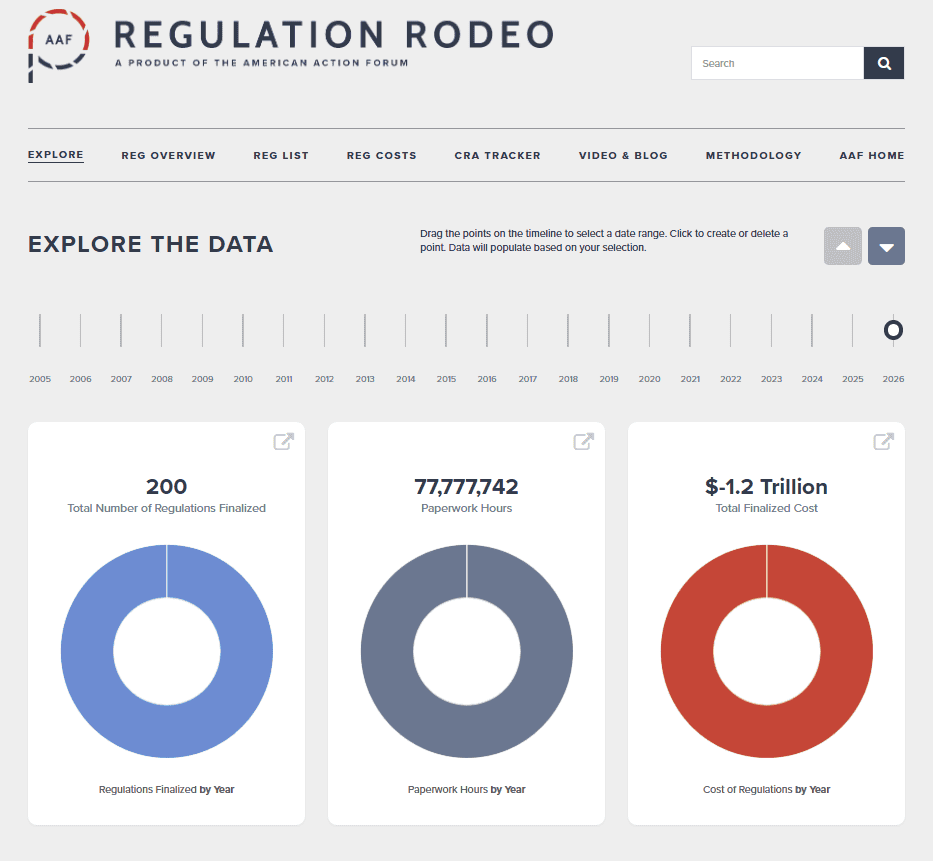
- 2026 Final Rule Costs: -$1.2 trillion
- 2026 Proposed Rule Costs: $46.3 billion
NOTABLE REGULATORY ACTIONS
The most consequential rulemaking of the week was the final rule from EPA regarding “Partial Repeal of the Carbon Pollution Standards for Fossil Fuel-Fired Electric Generating Units.” Per the rule’s summary:
Specifically, the EPA is repealing the emission guidelines for existing fossil fuel-fired steam generating units, the carbon capture and sequestration/storage (CCS)-based standards for coal-fired steam generating units undertaking a large modification, and the CCS-based standards for new base load stationary combustion turbines ( i.e., Phase 2 standards). In a separate action published concurrently with this final rule, the EPA is issuing a supplemental proposal soliciting comment on additional reasons to rescind all GHG emission requirements for fossil fuel-fired EGUs to effectuate the best reading of Clean Air Act (CAA) section 111 and ensure consistency with applicable principles of administrative law beyond those reasons on which the EPA solicited comment in the June 2025 notice of proposed rulemaking.
EPA estimates that this final rule could yield $95 billion in total compliance cost savings for affected facilities. The agency also employs a novel cost analysis that projects a more expansive “savings” total of roughly $310 billion when accounting for certain macroeconomic shifts. For RegRodeo purposes, the American Action Forum (AAF) will record the (still sizable) $95 billion total to provide a more consistent comparison to the estimate produced in the rule’s proposed version. As for the accompanying proposed rule mentioned in the above excerpt, EPA projects such changes to result in another $230 million in cost savings. Click here for broader AAF analysis of these rulemakings.
TRACKING TRUMP 2.0
In assessing 2026 rulemakings that include an Executive Order (EO) 14192 determination, there have been 74 “deregulatory” rules with combined total savings of $1.2 trillion against 14 “regulatory” rules that involve roughly $45.9 billion in costs. Adding that to the total agencies produced during 2025 (at least from rules that had a clear “regulatory” or “deregulatory” designation), the Trump Administration has enacted $1.3 trillion in total cost reductions thus far under EO 14192. Rules for which agencies have claimed one of the EO’s exemptions have accounted for an additional $7.1 billion in costs so far in 2026.
CONGRESSIONAL REVIEW ACT (CRA)
There was some CRA news over on Capitol Hill this week – although it was fairly ephemeral. Congressional Democrats in both chambers introduced respective resolutions of disapproval targeting a Trump Administration immigration rule. Meanwhile, House Republicans passed a rule that would have, among other items, brought a couple of CRA resolutions up for consideration on the House floor. That consideration will now need to wait until at least after the mid-term elections, however, as the House left town earlier than expected.
The AAF CRA tracker provides a full survey of activity under the law thus far into this term. As of today, members of the 119th Congress have introduced CRA resolutions of disapproval addressing 148 “rules” that collectively involve $175.5 billion in estimated compliance costs. Of these, 23 have been passed into law, repealing a series of Biden Administration rules that had a combined $3 billion in associated compliance costs. The Trump Administration estimates that the repeal of a Biden-era rule on air pollutants yields an additional $936 million in savings. While the main window of CRA action has largely passed, there are still outstanding resolutions that could move legislatively. AAF will continue to monitor and update such developments as appropriate.
TOTAL BURDENS
Since the start of 2026, the federal government has published $1.1 trillion in total regulatory net cost savings (with $1.2 trillion in reductions from finalized rules) and 108.7 million hours of net annual paperwork increases (with 77.8 million hours coming from final rules).