Week in Regulation
September 14, 2026
Another Big SEC Proposal Drives the Week
This past week in regulation saw a modest uptick in rulemaking activity compared to the week prior. All told, there were 10 agency actions that carried some kind of measurable economic impact. Most of these, however, were not terribly significant. As with the week before, the most sizable rulemaking came from the Securities and Exchange Commission (SEC), in the form of a deregulatory proposed rule that would roll back the “political contribution rule.” Overall, federal agencies published roughly $2.5 billion in total cost savings but added two million paperwork burden hours.
REGULATORY TOPLINES
- Proposed Rules This Week: 27
- Final Rules This Week: 46
- 2026 Total Pages: 57,905
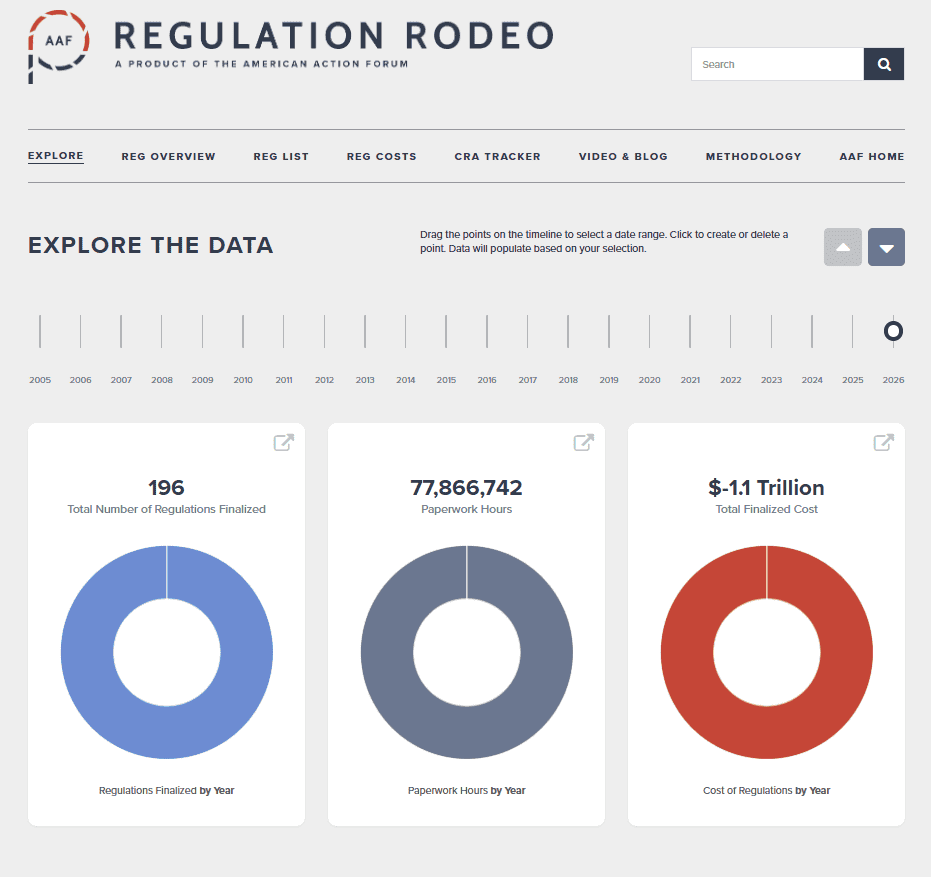
- 2026 Final Rule Costs: -$1.1 trillion
- 2026 Proposed Rule Costs: $46.6 billion
NOTABLE REGULATORY ACTIONS
The most consequential rulemaking of the week was the SEC proposed rule on “Political Contributions by Certain Investment Advisers.” More precisely, the proposal is seeking:
To rescind the political contribution rule under the Investment Advisers Act of 1940 (the “Advisers Act”), which prohibits investment advisers from providing investment advisory services for compensation to a government client for two years after an adviser or any covered associate of the adviser makes a contribution to certain categories of elected officials or candidates, among other prohibitions.
The underlying rule was originally intended to create a more substantial buffer between relevant investment advisers and elected officials to prevent corrupt relationships between the two groups. The commission now finds, however, that “prohibitions on fraud, fiduciary duty requirements, the compliance rule, and the code of ethics rule (defined below), are likely sufficient to address pay-to-play practices while allowing an adviser the flexibility to implement an approach that is more appropriately tailored to its particular risks, rendering the political contribution rule unnecessary.” The proposed rule’s economic analysis estimates that repealing the political contribution rule will yield nearly $3 billion in net total compliance cost savings over a 10-year horizon.
TRACKING TRUMP 2.0
In assessing 2026 rulemakings that include an Executive Order (EO) 14192 determination, there have been 73 “deregulatory” rules with combined total savings of $1.1 trillion against 14 “regulatory” rules that involve roughly $45.9 billion in costs. Adding that to the total agencies produced during 2025 (at least from rules that had a clear “regulatory” or “deregulatory” designation), the Trump Administration has enacted $1.2 trillion in total cost reductions thus far under EO 14192. Rules for which agencies have claimed one of the EO’s exemptions have accounted for an additional $7.1 billion in costs so far in 2026.
CONGRESSIONAL REVIEW ACT (CRA)
The AAF CRA tracker provides a full survey of activity under the law thus far into this term. As of today, members of the 119th Congress have introduced CRA resolutions of disapproval addressing 147 “rules” that collectively involve $172 billion in estimated compliance costs. Of these, 23 have been passed into law, repealing a series of Biden Administration rules that had a combined $3 billion in associated compliance costs. The Trump Administration estimates that the repeal of a Biden-era rule on air pollutants yields an additional $936 million in savings. While the main window of CRA action has largely passed, there are still outstanding resolutions that could move legislatively. AAF will continue to monitor and update such developments as appropriate.
TOTAL BURDENS
Since the start of 2026, the federal government has published $1 trillion in total regulatory net cost savings (with $1.1 trillion in reductions from finalized rules) and 109.4 million hours of net annual paperwork increases (with 77.9 million hours coming from final rules).