Week in Regulation
September 8, 2026
A Dull End to Summer
As the summer season (unofficially) concluded with the arrival of the long Labor Day weekend, the level of regulatory activity suggests that federal agencies were also in a vacationing mindset. There was a grand total of seven rulemakings that contained some kind of measurable economic impact. Of these, only one – a Securities and Exchange Commission (SEC) proposed rule – really left a mark. Overall, federal agencies published roughly $236 million in total costs and added 113,298 paperwork burden hours.
REGULATORY TOPLINES
- Proposed Rules This Week: 24
- Final Rules This Week: 58
- 2026 Total Pages: 56,961
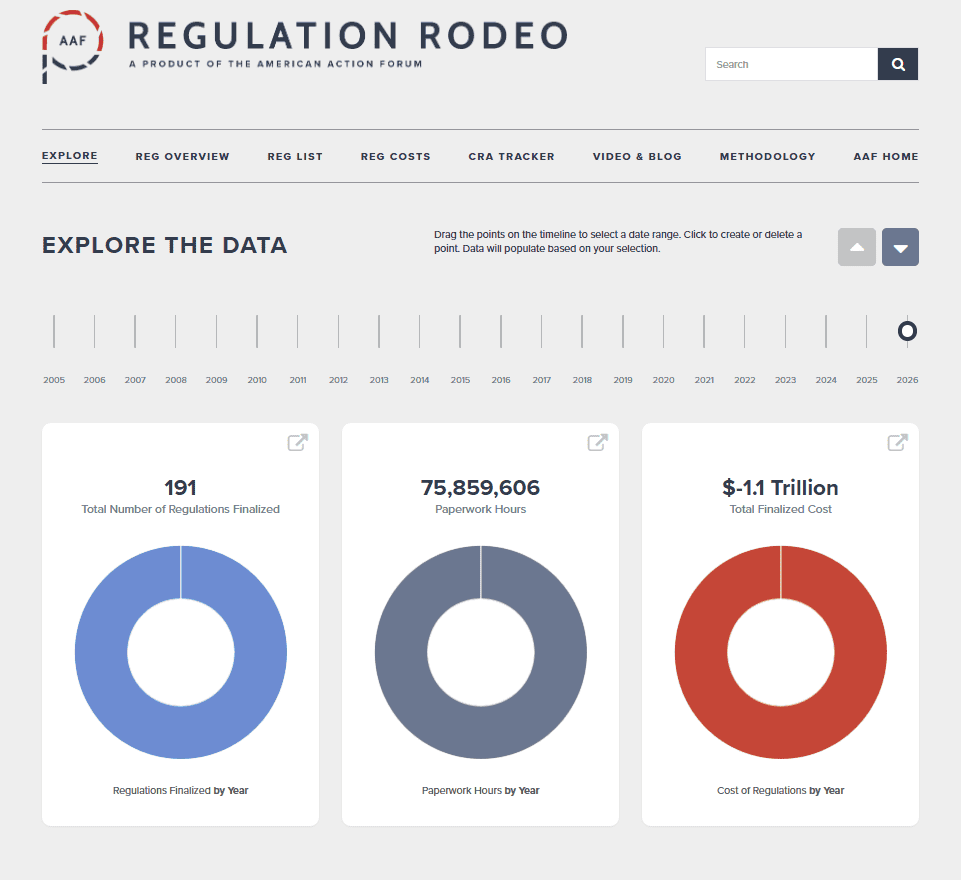
- 2026 Final Rule Costs: -$1.1 trillion
- 2026 Proposed Rule Costs: $49.6 billion
NOTABLE REGULATORY ACTIONS
The most significant rulemaking of the week was the proposed rule from SEC regarding “Transfer Agent Rules.” Transfer agents are the parties charged with “countersigning securities upon issuance, monitoring for overissuance, registering the transfer of securities, exchanging or converting securities, and transferring record ownership of securities by bookkeeping entry.” The relevant regulatory provisions for them “have not been substantively updated since the first rules were adopted in the late 1970s and early 1980s.” As such, SEC is seeking to provide an updated regulatory framework that takes into account the technological and business practice changes developed over the ensuing decades. While the commission alludes to certain aspects that will provide qualitative cost savings to transfer agents (due to “greater flexibility” in certain circumstances), the rulemaking’s quantitative analysis estimates that these updated requirements will involve nearly $280 million in total costs and roughly 115,000 hours of additional paperwork annually.
TRACKING TRUMP 2.0
In assessing 2026 rulemakings that include an Executive Order (EO) 14192 determination, there have been 72 “deregulatory” rules with combined total savings of $1.1 trillion against 13 “regulatory” rules that involve roughly $45.9 billion in costs. Adding that to the total agencies produced during 2025 (at least from rules that had a clear “regulatory” or “deregulatory” designation), the Trump Administration has enacted $1.2 trillion in total cost reductions thus far under EO 14192. Rules for which agencies have claimed one of the EO’s exemptions have accounted for an additional $7.1 billion in costs so far in 2026.
CONGRESSIONAL REVIEW ACT (CRA)
The AAF CRA tracker provides a full survey of activity under the law thus far into this term. As of today, members of the 119th Congress have introduced CRA resolutions of disapproval addressing 147 “rules” that collectively involve $172 billion in estimated compliance costs. Of these, 23 have been passed into law, repealing a series of Biden Administration rules that had a combined $3 billion in associated compliance costs. The Trump Administration estimates that the repeal of a Biden-era rule on air pollutants yields an additional $936 million in savings. While the main window of CRA action has largely passed, there are still outstanding resolutions that could move legislatively. AAF will continue to monitor and update such developments as appropriate.
TOTAL BURDENS
Since the start of 2026, the federal government has published $1 trillion in total regulatory net cost savings (with $1.1 trillion in reductions from finalized rules) and 107.4 million hours of net annual paperwork increases (with 75.9 million hours coming from final rules).