Week in Regulation
June 2, 2025
Administrative Housekeeping Over at Transportation
As is perhaps to be expected these days, there was not much in the way of significant regulatory activity gracing the pages of the Federal Register this past week. Only three rulemakings contained some kind of measurable economic impact. There was, however, a sizeable wave of actions seeking to make (largely) mundane updates to the nation’s regulatory code. Following on the heels of the Department of Energy from a couple of weeks ago, the Department of Transportation (DOT) took its turn in clearing out an array of obsolete regulatory provisions. Across all rulemakings, agencies published $20.3 million in total cost savings and had no change in paperwork burden hours.
REGULATORY TOPLINES
- Proposed Rules: 54
- Final Rules: 50
- 2025 Total Pages: 23,211
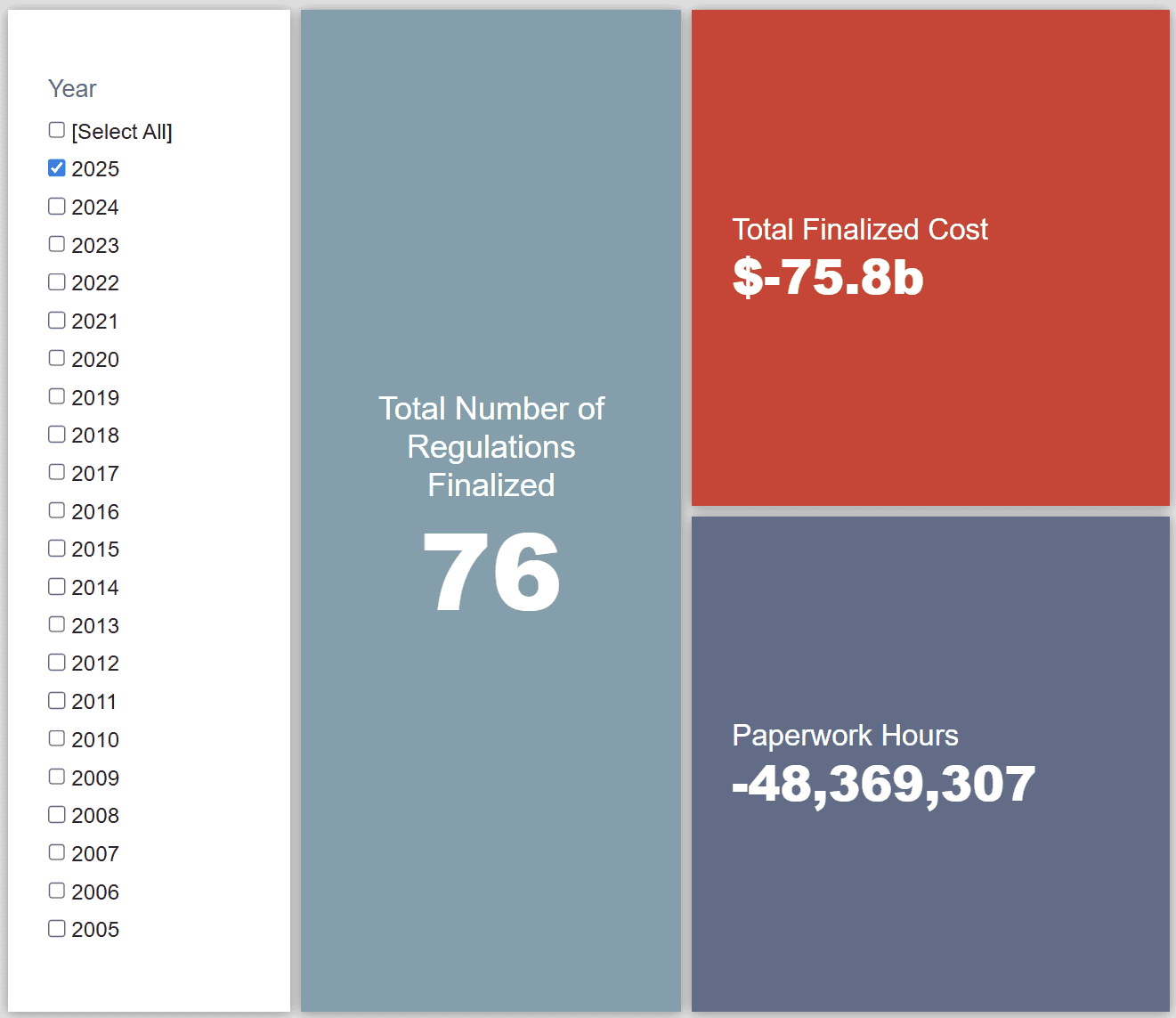
- 2025 Final Rule Costs: -$75.8 billion
- 2025 Proposed Rule Costs: $181.3 billion
NOTABLE REGULATORY ACTIONS
Last Friday, DOT published a whopping 57 rulemakings in the Federal Register. Most of these were proposed rules that, under the auspices of Executive Order (EO) 14192, primarily seek to excise long-outdated passages in the Code of Federal Regulation (CFR) and thus do not involve some quantifiable economic impact. These proposals touched on such topics as:
- Rescinding Requirements Regarding Geodetic Markers (“proposing to rescind the rule and regulations issued on July 19, 1974”)
- Rescinding Requirements Regarding Bridges on Federal Dams (“proposing to rescind the rule and regulations issued on October 10, 1974”)
- Parts and Accessories Necessary for Safe Operation; Retroreflective Sheeting on Semitrailers and Trailers (“the obsolete regulatory text concerning trailers and semitrailers manufactured before December 1993 would be eliminated given that it is unlikely these vehicles are still in operation.”)
- Parts and Accessories Necessary for Safe Operation; Spare Fuses (updating CFR language “established by the Interstate Commerce Commission’s (ICC) Bureau of Motor Carrier Safety, circa 1941.”)
While most of these rulemakings focused on clearing out the regulatory clutter, there were some that DOT finds could have a measurable effect on regulatory costs – and thus potential “savings” for the purposes of the EO 14192 regulatory budget. A final rule (that follows up on a proposed rule left over from November 2020) on “State Highway Agency Equal Employment Opportunity Programs” brings an estimated $8.8 million in cost savings. Additionally, the agency proposes delaying the implementation of a series of Biden-era safety restraint standards, providing nearly $12 million in estimated cost savings.
TRACKING TRUMP 2.0
There were no significant announcements coming from the White House regarding broader regulatory policy initiatives this past week. Furthermore, with Congress out on recess this past week, there were no new developments on the Congressional Review Act (CRA) front.
Be sure to follow the AAF CRA tracker. As of today, members of the 119th Congress have introduced CRA resolutions of disapproval addressing 44 Biden-era rules that collectively involve $137.5 billion in compliance costs. Out of these, 11 such resolutions have been passed into law, repealing a series of Biden Administration rules that had a combined $3 billion in associated compliance costs. It is highly unlikely any more resolutions of disapproval with a realistic chance of passage will be introduced this term. Since there are still outstanding resolutions that could move legislatively, however, AAF will continue to monitor and update such developments as appropriate.
TOTAL BURDENS
Since January 1, the federal government has published $105.5 billion in total net costs (with $75.8 billion in cost savings from finalized rules) and 69.5 million hours of net annual paperwork cuts (with 48.4 million hours coming from final rules).