Week in Regulation
April 28, 2025
Another (Relatively) Quiet One
This past week saw a return to relatively subdued activity in the pages of the Federal Register after the nominal spike seen the week before. There was only one rulemaking with recordable economic effects that was not a routine airworthiness directive. Additionally, between a relatively quiet week in White House policy pronouncements and Congress remaining on recess, there was a limited amount of consequential regulatory policy actions. Across all rulemakings, agencies published $7.6 million in total costs and added 4,741 paperwork burden hours.
REGULATORY TOPLINES
- Proposed Rules: 23
- Final Rules: 25
- 2025 Total Pages: 17,469
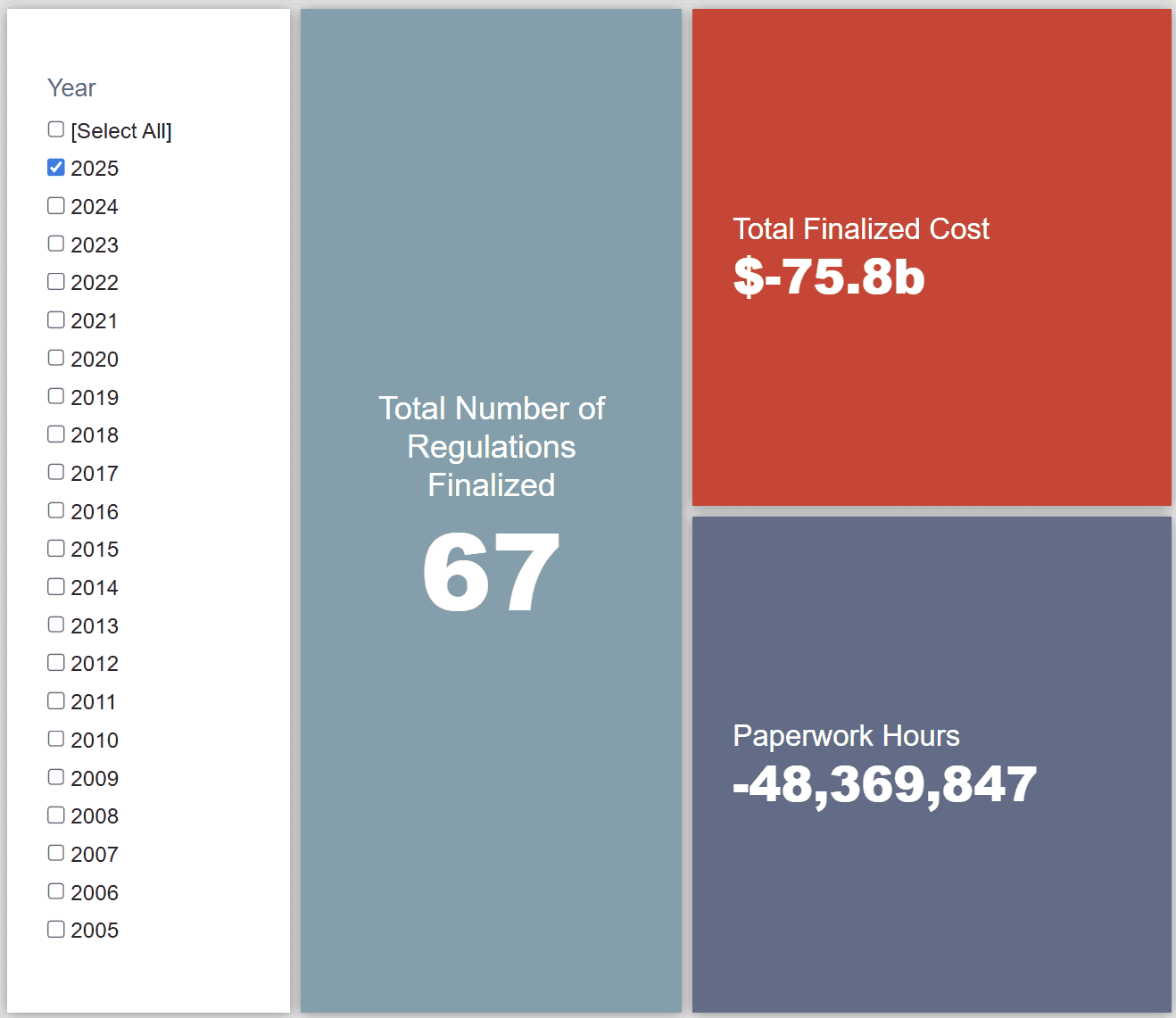
- 2025 Final Rule Costs: -$75.8 billion
- 2025 Proposed Rule Costs: $181.3 billion
NOTABLE REGULATORY ACTIONS
The only rulemaking with measurable economic cost effects that was not an airworthiness directive this past week was the Federal Trade Commission’s (FTC) “Children’s Online Privacy Protection Rule.” FTC estimates that the rule’s administrative burdens will involve 4,741 hours of additional paperwork, with roughly $2.4 million in associated costs, annually.
The Office of Personnel Management also published its proposed rule regarding “Improving Performance, Accountability and Responsiveness in the Civil Service.” The proposal seeks to implement the administration’s planned reclassification of numerous federal employees into “Schedule F.” The rulemaking’s cost-benefit analysis is primarily confined to the internal effects across federal agencies. Thus, while it is not necessarily a significant rule in terms of broader economic impacts, one can nevertheless expect it to be a political lightning rod going forward.
TRACKING TRUMP 2.0
There were no significant policy announcements from the White House that primarily addressed regulatory policy writ large. There were, however, a couple of orders that directed assorted agencies to collectively evaluate options for updating regulatory provisions regarding apprenticeships and offshore critical mineral extraction, respectively.
This coming week, Congress returns from its two-week recess. The House is set to take up a set of Congressional Review Act (CRA) resolutions of disapproval addressing a rules from the Department of Interior as well as the series of Clean Air Act waivers from the Environmental Protection Agency (EPA) for California’s vehicle emissions standards. There remains a live debate over whether the CRA applies to these waiver determinations, but congressional Republicans appear ready to press the issue.
Beyond the procedural novelty involved, there is also an interesting wrinkle in terms of timing. The Senate will have roughly two more weeks to sidestep the filibuster for voting on Biden-era rules that fell into the CRA’s “look-back” window. Since EPA technically transmitted these waiver actions to Congress for CRA purposes in late February 2025, however, the window for expedited consideration extends further into the future – likely by about an additional month. As such, prioritizing these above other potential resolutions of disapproval represents a somewhat curious decision.
Be sure to follow the AAF updated CRA tracker. As of today, members of the 119th Congress have introduced CRA resolutions of disapproval addressing 43 Biden-era rules that collectively involve $137.5 billion in compliance costs. AAF will continue to update this tracker as additional resolutions are introduced and receive votes on the floors of each chamber.
TOTAL BURDENS
Since January 1, the federal government has published $105.6 billion in total net costs (with $75.8 billion in cost savings from finalized rules) and 68.8 million hours of net annual paperwork cuts (with 48.4 million hours coming from final rules).