Week in Regulation
May 26, 2026
Major Swings in Cost Savings and Added Paperwork
The past week in regulation was a hectic one in terms of both the quantity and magnitude of actions published in the Federal Register. There were 18 rulemakings containing some kind of measurable economic impact – with five of those having effects in the billions of dollars. It was a generally deregulatory week with significant cost-cutting actions from the Securities and Exchange Commission (SEC) and Environmental Protection Agency (EPA). A rule from the Department of Health & Human Services (HHS), however, swung in the opposite direction – adding millions of hours of new paperwork. Overall, federal agencies published roughly $26.8 billion in total cost savings but added 18.5 million paperwork burden hours.
REGULATORY TOPLINES
- Proposed Rules This Week: 30
- Final Rules This Week: 50
- 2026 Total Pages: 30,427
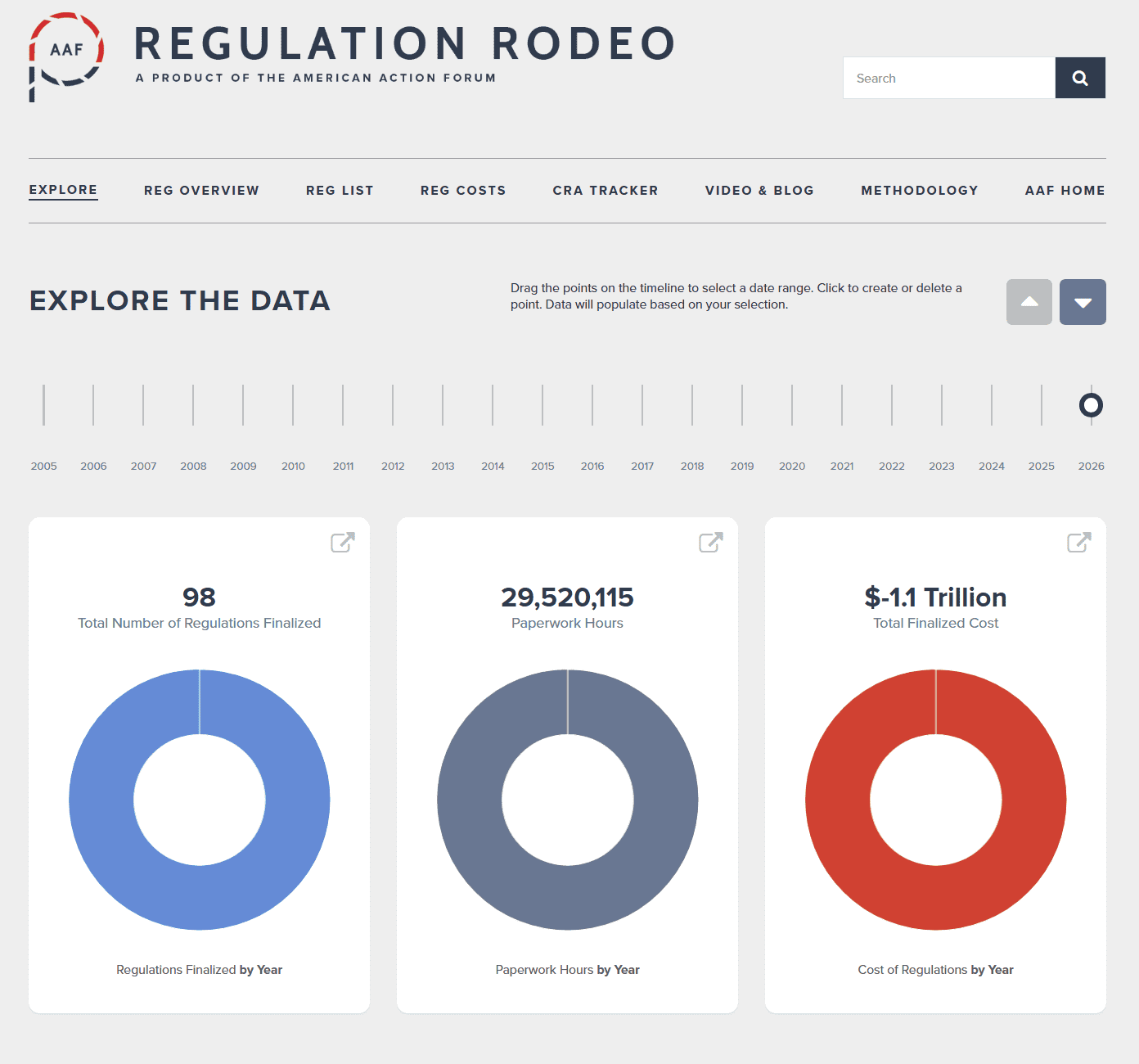
- 2026 Final Rule Costs: -$1.1 trillion
- 2026 Proposed Rule Costs: $89.6 billion
NOTABLE REGULATORY ACTIONS
The most consequential rulemaking of the week from a costs/savings perspective was the SEC proposed rule on “Enhancement of Emerging Growth Company Accommodations and Simplification of Filer Status for Reporting Companies.” A couple of weeks prior, SEC proposed changes to its requirement reporting schedule. This rulemaking goes even further and seeks “to streamline filer statuses for Securities Exchange Act of 1934 (“Exchange Act”) reporting companies.” In particular, “an expanded subset of filers would be afforded various disclosure and other regulatory relief accommodations that currently are applicable to the more narrowly defined subset of filers.” The commission estimates that the monetized impacts of these shifts would be substantial, with total savings exceeding $13.6 billion over a 10-year horizon.
The other major deregulatory rulemaking of the week came in the proposal from EPA on “Effluent Limitations Guidelines and Standards for the Steam Electric Power Generating Point Source Category-Unmanaged Combustion Residual Leachate.” The proposed rule would roll back a 2024 Biden-era rule on the matter. The current EPA expects this action to result in annualized cost savings for affected facilities of “$532 million to $1,286 million using a seven percent discount rate,” with $909 million as the mid-point estimate. Extrapolated across the 28-year window the agency utilizes in its regulatory analysis, this would mean $11 billion in total cost reductions. EPA also promulgated two other proposed rules this week with estimated savings in the billions of dollars.
The most substantial burden-adding rulemaking of the week was the HHS rule on “Patient Protection and Affordable Care Act, HHS Notice of Benefit and Payment Parameters for 2027; and Basic Health Program.” Primarily, the agency is “finalizing changes related to some of the Affordable Care Act provisions and parameters we previously implemented under the authority granted to the Secretary by Public Law (Pub. L.) 119-21, which CMS refers to as the Working Families Tax Cut (WFTC) legislation.” The provisions affected number in the dozens. For the purposes of RegRodeo recording though, the main issue is the rule’s new administrative burdens. HHS expects the rule to involve almost 18.6 million hours of new paperwork each year. The annualized costs of these requirements (and other aspects of the rule) come out to $588 million. Across the rule’s five-year analytical window, this amounts to roughly $2.4 billion in total new regulatory costs.
TRACKING TRUMP 2.0
The most interesting wrinkle of the week on the regulatory budget side of things came from the HHS rule discussed above. With roughly 18.6 million hours of new paperwork and billions of dollars in costs, one might expect the rule to clearly be a “regulatory” action under Executive Order (EO) 14192. The agency, however, states that: “This rule is exempt from otherwise-applicable requirements under E.O. 14192, per footnote 1 of OMB’s Accounting Methods.” As said footnote explains: “A regulatory action that generates substantial federal budget savings may be exempt from EO 14192’s requirements.” This rule and another proposed rule from HHS this week are the only rulemakings thus far to explicitly claim this apparent exemption.
In assessing 2026 rulemakings that include an EO 14192 determination, there have been 38 “deregulatory” rules with combined total savings of $1.1 trillion against six “regulatory” rules that involve roughly $41.8 billion in costs. Adding that to the total agencies produced during 2025 (at least from rules that had a clear “regulatory” or “deregulatory” designation), the Trump Administration has enacted $1.2 trillion in total cost reductions thus far under EO 14192. Rules for which agencies have claimed one of the EO’s exemptions have accounted for an additional $2.9 billion in costs so far in 2026.
CONGRESSIONAL REVIEW ACT (CRA)
The American Action Forum (AAF) CRA tracker provides a full survey of activity under the law thus far into this term. As of today, members of the 119th Congress have introduced CRA resolutions of disapproval addressing 136 “rules” across the Biden and Trump Administrations that collectively involve $173.6 billion in estimated compliance costs. Of these, 23 have been passed into law, repealing a series of Biden Administration rules that had a combined $3 billion in associated compliance costs. The Trump Administration estimates that the repeal of this rule yields an additional $936 million in savings. While the main window of CRA action has largely passed, there are still outstanding resolutions that could move legislatively. AAF will continue to monitor and update such developments as appropriate.
TOTAL BURDENS
Since the start of 2026, the federal government has published $972.2 billion in total regulatory net cost savings (with $1.1 trillion in reductions from finalized rules) and 56.4 million hours of net annual paperwork increases (with 29.5 million hours coming from final rules).