Week in Regulation
May 11, 2026
ATF Stands Out in Busy Cost-Cutting Week
This past week was a rather lively one in terms of rulemaking activity in the pages of the Federal Register. There were 23 agency actions that carried some kind of quantifiable economic effect. While a Securities and Exchange Commission (SEC) proposal laid claim to being the single most significant item, the most active agency of the week was the Bureau of Alcohol, Tobacco, Firearms, and Explosives (ATF) producing a majority (12 such actions) of the week’s recordable rulemaking haul. Overall, federal agencies published roughly $3.9 billion in total cost savings and cut 4.2 million paperwork burden hours.
REGULATORY TOPLINES
- Proposed Rules This Week: 73
- Final Rules This Week: 75
- 2026 Total Pages: 25,428
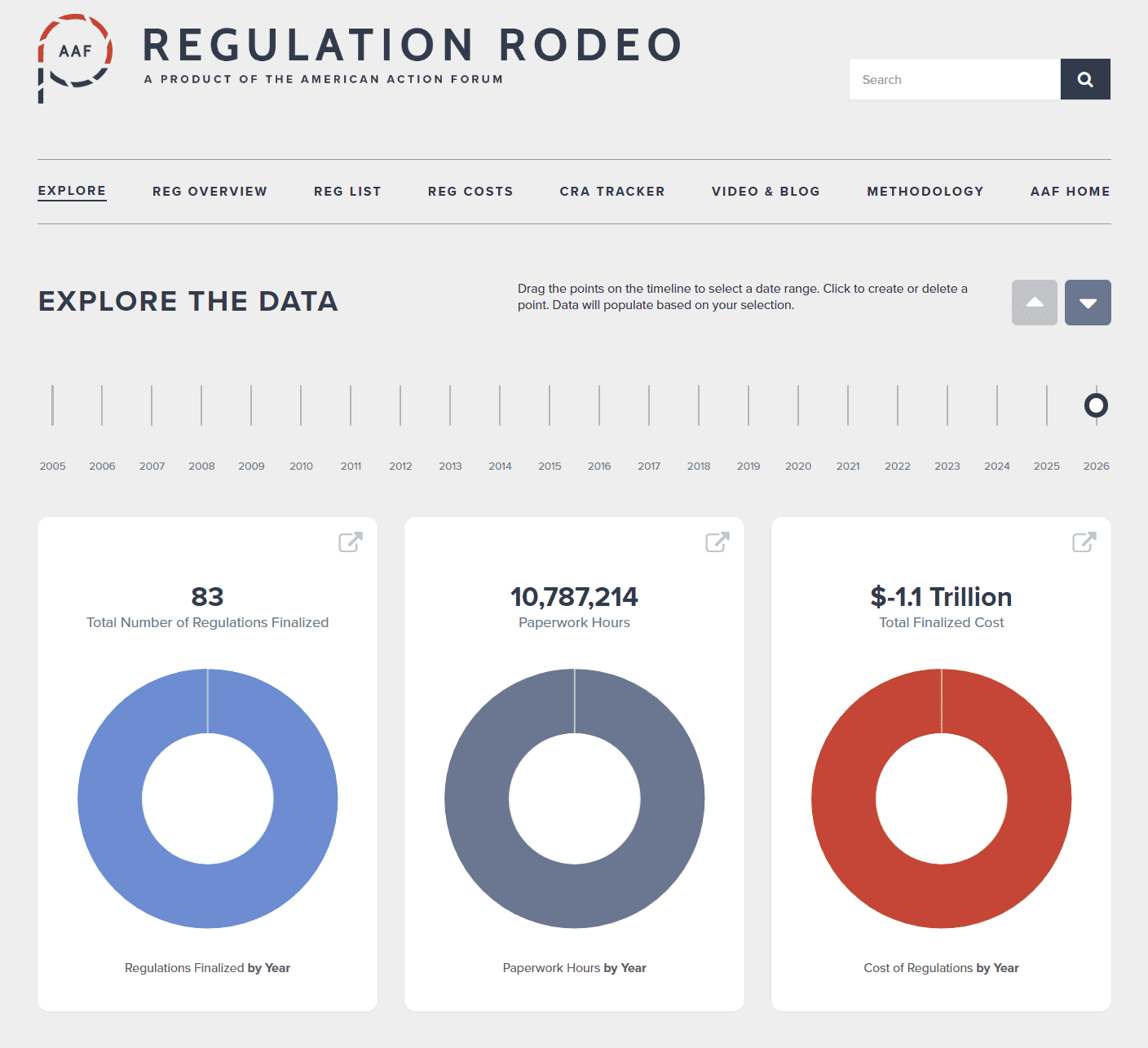
- 2026 Final Rule Costs: -$1.1 trillion
- 2026 Proposed Rule Costs: $118.8 billion
NOTABLE REGULATORY ACTIONS
The most consequential rulemaking of the week in terms of potential economic impact was the SEC proposed rule on “Semiannual Reporting.” The proposal seeks to significantly adjust the schedule of reports produced by publicly traded companies. Specifically:
Under the proposal, an Exchange Act reporting company that elects semiannual reporting would be required to file one semiannual report and one annual report for each fiscal year. Semiannual filers would file their interim report on new Form 10-S. This form would require the same narrative disclosures and financial information as existing Form 10-Q but would cover a six-month period (rather than a fiscal quarter). The deadline for filing Form 10-S would be 40 or 45 days (depending on the company’s filer status) after the fiscal year’s first semiannual period end—the same as with current Form 10-Q’s fiscal quarter end deadline, which would not change—while the second semiannual period would be subsumed in the annual period presented in the annual report on Form 10-K.
SEC expects that eliminating the requirement for quarterly reports and replacing it with this “semiannual” schedule will yield sizable net cost savings to covered companies. The commission estimates the total net savings to reach roughly $1.7 billion over a 10-year horizon.
As discussed earlier, ATF was the week’s most active agency in terms of overall volume – which is atypical for the agency. For instance, prior to last week, the last time it published a significant regulatory document was more than two years ago. Most of the agency’s rulemakings this past week focused on the “firearms” portion of its titular portfolio. One can expect the various rulemaking dockets to be quite contentious regarding each action’s implications for federal gun control policy. Setting those substantive issues aside, however, there were two proposed rules that stood out in terms of their purported economic analyses.
The two proposals worth highlighting focus on “Removing Factoring Criteria for Firearms With Attached ‘Stabilizing Braces’” and “Revising Non-Over-the-Counter Firearms Transaction Requirements.” The former, spurred in part by court decisions in intervening years, seeks “to remove from the regulatory definitions of ‘rifle’ the two paragraphs added by the 2023 final rule that defined the term ‘designed or redesigned, made or remade, and intended to be fired from the shoulder.’” ATF expects this to yield savings due to “persons who purchase a firearm with attached stabilizing brace no longer incurring the time and cost needed to apply to transfer and register such items as [National Firearms Act] NFA firearms.” The agency calculates such savings to be $144.4 million annually, or roughly $1 billion total over a 10-year window. The other main savings proposal would make various changes to loosen the requirements for federal firearms licensees “to transfer firearms to a person residing in the same state but who does not appear in person.” The agency expects these more flexible standards to mean nearly four million “hours saved” each year, amounting to $103 million in monetized savings (or $728 million in net present value over a decade).
TRACKING TRUMP 2.0
In assessing 2026 rulemakings that include an Executive Order (EO) 14192 determination, there have been 31 “deregulatory” rules with combined total savings of $1.1 trillion against five “regulatory” rules that involve roughly $41.7 billion in costs. Adding that to the total agencies produced during 2025 (at least from rules that had a clear “regulatory” or “deregulatory” designation), the Trump Administration has enacted $1.2 trillion in total cost reductions thus far under EO 14192. Rules for which agencies have claimed one of the EO’s explicit exemptions have accounted for an additional $508 million in costs so far in 2026.
CONGRESSIONAL REVIEW ACT (CRA)
The AAF CRA tracker provides a full survey of activity under the law thus far into this term. As of today, members of the 119th Congress have introduced CRA resolutions of disapproval addressing 134 “rules” across the Biden and Trump Administrations that collectively involve $173.3 billion in estimated compliance costs. Of these, 23 have been passed into law, repealing a series of Biden Administration rules that had a combined $3 billion in associated compliance costs. The Trump Administration estimates that the repeal of this rule yields an additional $936 million in savings. While the main window of CRA action has largely passed, there are still outstanding resolutions that could move legislatively. AAF will continue to monitor and update such developments as appropriate.
TOTAL BURDENS
Since the start of 2026, the federal government has published $944.5 billion in total regulatory net cost savings (with $1.1 trillion in reductions from finalized rules) and 37.9 million hours of net annual paperwork increases (with 10.8 million hours coming from final rules).