Week in Regulation
May 18, 2026
A Deregulatory Downshift
Last week had a modestly active haul of rulemakings that graced the pages of the Federal Register. There were 14 items that had some kind of measurable economic effect. After a few weeks of cost reductions in the billions of dollars, however, the magnitude of deregulatory action dipped a bit. The most significant rulemaking of the week came from the Department of Health & Human Services (HHS) delaying the compliance date of a Biden-era rule. Overall, federal agencies published roughly $828.6 million in total cost savings and cut 29,593 paperwork burden hours.
REGULATORY TOPLINES
- Proposed Rules This Week: 29
- Final Rules This Week: 54
- 2026 Total Pages: 28,354
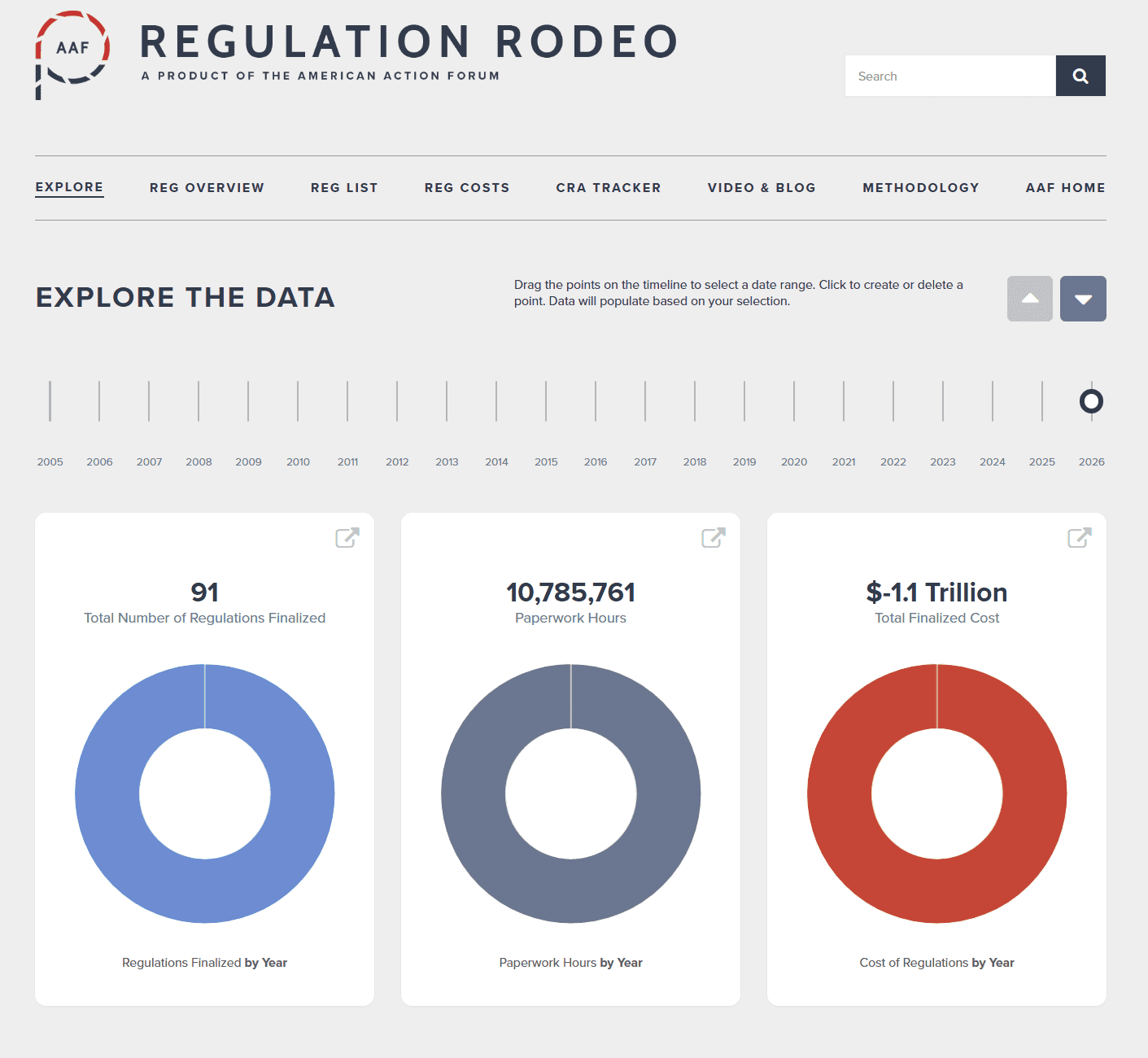
- 2026 Final Rule Costs: -$1.1 trillion
- 2026 Proposed Rule Costs: $118.8 billion
NOTABLE REGULATORY ACTIONS
The most consequential action of the week was the HHS rule on “Extension of Compliance Dates for Nondiscrimination on the Basis of Disability; Accessibility of Web Content and Mobile Applications of Recipients of Departmental Financial Assistance.” As the title suggests, the rule will “extend the compliance dates for the requirements for web content and mobile application (“app”) accessibility that were adopted on May 9, 2024. The compliance date for recipients with fifteen (15) or more employees is extended from May 11, 2026, to May 11, 2027.” The move comes on the heels of a similar recent compliance date extension promulgated by the Department of Justice. HHS estimates that its one-year push-back will yield roughly $803 million in total savings for affected entities.
TRACKING TRUMP 2.0
In assessing 2026 rulemakings that include an Executive Order (EO) 14192 determination, there have been 36 “deregulatory” rules with combined total savings of $1.1 trillion against five “regulatory” rules that involve roughly $41.7 billion in costs. Adding that to the total agencies produced during 2025 (at least from rules that had a clear “regulatory” or “deregulatory” designation), the Trump Administration has enacted $1.2 trillion in total cost reductions thus far under EO 14192. Rules for which agencies have claimed one of the EO’s explicit exemptions have accounted for an additional $508 million in costs so far in 2026.
CONGRESSIONAL REVIEW ACT (CRA)
The only real news on the CRA front was a series of (ultimately doomed) votes in the Senate on resolutions of disapproval introduced by Democratic Senators regarding various aspects of a Trump Administration Consumer Financial Protection Bureau rule that repealed agency guidance documents en masse. As the American Action Forum (AAF) has previously noted, these votes were primarily exercises in political messaging that inherently had no realistic shot at ever becoming law – even if they somehow advanced through the upper chamber.
The AAF CRA tracker provides a full survey of activity under the law thus far into this term. As of today, members of the 119th Congress have introduced CRA resolutions of disapproval addressing 134 “rules” across the Biden and Trump Administrations that collectively involve $173.3 billion in estimated compliance costs. Of these, 23 have been passed into law, repealing a series of Biden Administration rules that had a combined $3 billion in associated compliance costs. The Trump Administration estimates that the repeal of this rule yields an additional $936 million in savings. While the main window of CRA action has largely passed, there are still outstanding resolutions that could move legislatively. AAF will continue to monitor and update such developments as appropriate.
TOTAL BURDENS
Since the start of 2026, the federal government has published $945.3 billion in total regulatory net cost savings (with $1.1 trillion in reductions from finalized rules) and 37.9 million hours of net annual paperwork increases (with 10.8 million hours coming from final rules).