Week in Regulation
April 27, 2026
The Deregulatory Flow Continues Apace
Last week was a busy one in the pages of the Federal Register, with 42 final rules published last Friday alone. Throughout the entire week there were 16 rulemakings containing some kind of measurable economic impact. Moreover – and continuing a now weeks-long trend – these actions largely trended in the cost-cutting direction. Rulemakings from the Department of Justice (DOJ) and Securities & Exchange Commission (SEC) (with an assist from the Commodity Futures Trading Commission (CFTC)) were the week’s main standouts. There was also a proposed rule from the Department of Education (ED) that had some intriguing regulatory accounting issues. Overall, federal agencies published roughly $4.3 billion in total cost savings but added 1.9 million paperwork burden hours.
REGULATORY TOPLINES
- Proposed Rules This Week: 44
- Final Rules This Week: 75
- 2026 Total Pages: 22,385
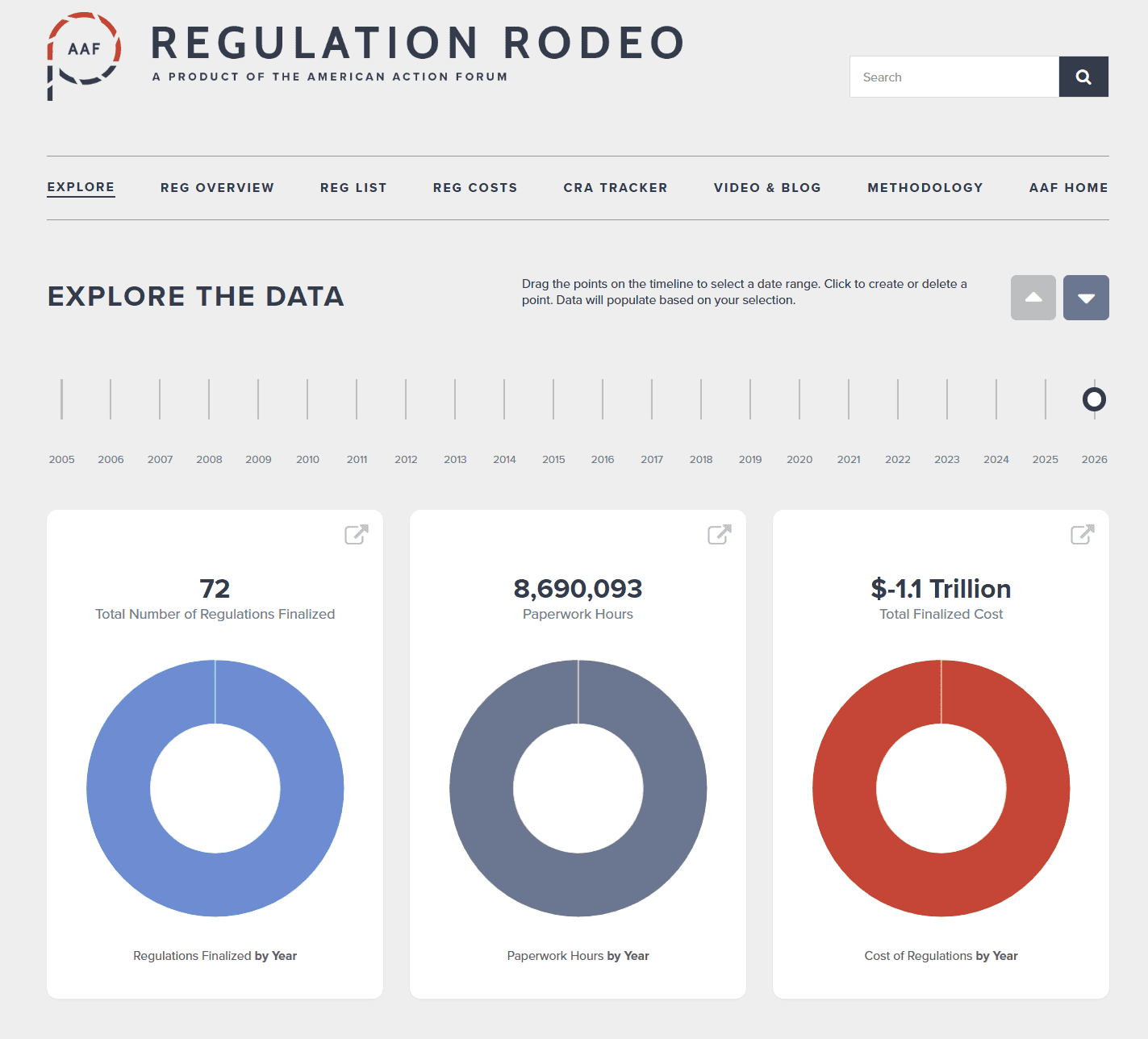
- 2026 Final Rule Costs: -$1.1 trillion
- 2026 Proposed Rule Costs: $126.2 billion
NOTABLE REGULATORY ACTIONS
The most significant rulemaking of the week was the DOJ interim final rule on “Extension of Compliance Dates for Nondiscrimination on the Basis of Disability; Accessibility of Web Information and Services of State and Local Government Entities.” Specifically:
By this Interim Final Rule (“IFR”), the Department of Justice (“Department”) is revising the regulations implementing title II of the Americans with Disabilities Act (“ADA”) to extend the compliance dates for the requirements for web content and mobile application (“app”) accessibility that were adopted on April 24, 2024. The compliance date for State and local government entities with a total population of 50,000 or more is extended from April 24, 2026, to April 26, 2027. The compliance date for public entities with a total population of less than 50,000, or any special district government, is extended from April 26, 2027, to April 26, 2028.
The agency estimates that this compliance date push-back will save relevant jurisdictions roughly $2.8 billion in total compliance costs.
The week’s runner-up was the proposed rule jointly promulgated by SEC and CFTC regarding “Form PF; Reporting Requirements for All Filers.” As the title suggests, the proposal seeks:
To amend Form PF, the confidential reporting form for certain SEC-registered investment advisers to private funds, including those that also are registered with the CFTC as a commodity pool operator (a “CPO”) or a commodity trading advisor (a “CTA”). The proposed amendments would eliminate certain filing and reporting obligations, streamline certain requirements, and make corrections and other revisions.
The Commissions involved estimate that such changes will yield nearly $1.2 billion in total net savings to affected entities.
Finally, there was the proposed rule from ED titled “Accountability in Higher Education and Access Through Demand-Driven Workforce Pell: Student Tuition and Transparency System (STATS) and Earnings Accountability,” which looks “to amend the regulations governing institutional eligibility, general provisions regulations, and the William D. Ford Direct Loan (Direct Loan) Program under title IV of the Higher Education Act (HEA) of 1965, as amended (the title IV, HEA programs).” On one hand, the agency expects $99.1 million in annualized compliance cost savings, but on the other, posits 2.2 million additional paperwork burden hours. The ED-provided explanation for this discrepancy is the following:
As noted in the Paperwork Reduction Act section, some items are reductions in burden and others are increases, with a combination of one-time adjustments and recurring items. The net effect of this is a reduction in burden that is displayed as a benefit in the accounting statement. This is a contrast to the presentation in the Paperwork Reduction Act summary table that presents the annual burden without the subsequent net reductions in future years.
Essentially, some of the major burden-adding aspects of the paperwork requirements come in the initial, upfront compliance period while the burden-cutting aspects come into play in future years. Unfortunately, the agency does not provide a clear year-by-year accounting of this dynamic in the rulemaking’s text. For now, the American Action Forum (AAF) will record the relevant figures as presented for RegRodeo purposes.
TRACKING TRUMP 2.0
In assessing 2026 rulemakings that include an Executive Order (EO) 14192 determination, there have been 27 “deregulatory” rules with combined total savings of $1.1 trillion against four “regulatory” rules that involve roughly $41.6 billion in costs. Adding that to the total agencies produced during 2025 (at least from rules that had a clear “regulatory” or “deregulatory” designation), the Trump Administration has enacted $1.2 trillion in total cost reductions thus far under EO 14192. Rules for which agencies have claimed one of the EO’s explicit exemptions have accounted for an additional $508 million in costs so far in 2026.
CONGRESSIONAL REVIEW ACT (CRA)
There was a bit of CRA news this past weekend that had an interesting wrinkle to it. Republican House members introduced H.J. Res 157 that seeks to repeal the latest Renewable Fuel Standards (RFS) rule. Mind you, this latest RFS rule comes from the Trump Administration and represents the current administration’s costliest rule thus far. This marks the first CRA resolution of disapproval introduced during this term where members of the president’s own party are challenging a rule promulgated by agencies under his watch. Suffice it to say, the politics of such legislation will be fascinating to track going forward. AAF had some further commentary on the rule in question here.
The AAF CRA tracker provides a full survey of activity under the law thus far into this term. As of today, members of the 119th Congress have introduced CRA resolutions of disapproval addressing 131 “rules” across the Biden and Trump Administrations that collectively involve $173.8 billion in estimated compliance costs. Of these, 22 have been passed into law, repealing a series of Biden Administration rules that had a combined $3 billion in associated compliance costs. The Trump Administration estimates that the repeal of this rule yields an additional $936 million in savings. While the main window of CRA action has largely passed, there are still outstanding resolutions that could move legislatively. AAF will continue to monitor and update such developments as appropriate.
TOTAL BURDENS
Since the start of 2026, the federal government has published $936.1 billion in total regulatory net cost savings (with $1.1 trillion in reductions from finalized rules) and 39.5 million hours of net annual paperwork increases (with 8.7 million hours coming from final rules).