Week in Regulation
February 3, 2025
Mostly Quiet on the Regulatory Front as Freeze Continues
The opening week of President Trump’s second term may have seen some substantial action slip past the “regulatory freeze” order, but this week really saw the heart of regulatory winter take hold. Reminiscent of similar periods during the beginning of Trump’s first term and the beginning of the Biden Administration, this past week’s rulemaking activity slowed to less than a trickle. The only regulatory actions with some kind of quantifiable economic impact came in the form of a handful of mundane “airworthiness directives” hitting the books. Across all rulemakings, agencies published $10.8 million in total costs and no new paperwork burden hours.
REGULATORY TOPLINES
- Proposed Rules: 11
- Final Rules: 28
- 2025 Total Pages: 8,740
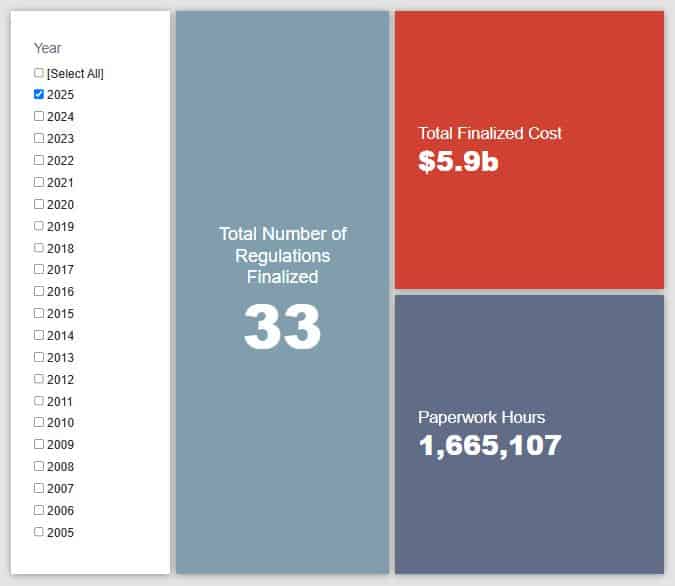
- 2025 Final Rule Costs: $5.9 billion
- 2025 Proposed Rule Costs: $180.1 billion
NOTABLE REGULATORY ACTIONS
As mentioned above, there was virtually no regulatory activity of any real significance. The Federal Aviation Administration (FAA) posted a series of “airworthiness directives” – routine rules that seek to address internal mechanical issues in various aircraft as they become apparent. To give a sense of the scale of these rulemakings, the costliest one posted this week was one regarding certain Boeing aircraft that would involve just under $6 million in inspection costs.
In light of the tragic crash over the Potomac River this past week, aeronautical safety will likely become a major focus of regulatory scrutiny in the near future. Given the recency of the incident, however, further investigation is needed to identify what additional safety measures agencies such as FAA ought to take. As of this publication, the most concrete action FAA has taken thus far is closing off that section of airspace to helicopter traffic.
TRACKING TRUMP 2.0
For the better part of the week, it was looking like there would continue to be radio silence on the returning Trump Administration’s broader regulatory agenda. That changed somewhat on Friday night with the announcement – via a fact sheet – that the president had signed an executive order directing agencies to implement his campaign pledge to require that agencies produce at least 10 deregulatory actions for each new regulatory one. Some initial thoughts can be found in the latest edition of the American Action Forum’s (AAF) Daily Dish.
The full executive order became publicly available sometime over the weekend – albeit not via the White House’s website [at least as of today]. Per AAF’s expectations, the order represents a more expansive version of the first Trump term’s regulatory budget under Executive Order 13,771. The topline 10-to-1 ratio is seemingly the most jarring aspect, but per the order’s text: “any new incremental costs associated with new regulations shall, to the extent permitted by law, be offset by the elimination of existing costs associated with at least 10 prior regulations.” As such, it merely tasks agencies with finding at least 10 actions that can collectively “pay for” a new regulatory action’s costs.
The more consequential aspect of the order is expanding the definition of “regulation” or “rule” to mean:
An agency statement of general or particular applicability and future effect designed to implement, interpret, or prescribe law or policy or to describe the procedure or practice requirements of an agency, including, without limitation, regulations, rules, memoranda, administrative orders, guidance documents, policy statements, and interagency agreements, regardless of whether the same were enacted through the processes in the Administrative Procedure Act
Whereas the regulatory budget under Executive Order 13,771 was primarily focused on notice-and-comment rulemakings, this version will cast a much wider net in terms of the items involved. There are many more implementation details to figure out – such as how to calculate the costs/savings for actions that did not carry an estimate originally. As those aspects become apparent, AAF will be sure to examine their implications.
Members of Congress have begun to introduce resolutions of disapproval under the Congressional Review Act addressing some Biden-era rules, but these all remain merely in the “introduced” stage. As the most high-profile Trump appointee confirmation hearings begin to subside in coming weeks, however, one can expect those resolutions to start moving through the respective chambers in earnest.
TOTAL BURDENS
Since January 1, the federal government has published $186 billion in total net costs (with $5.9 billion in new costs from finalized rules) and 25 million hours of net annual paperwork cuts (with 1.7 million hours in increases from final rules).