Week in Regulation
January 27, 2025
Trade Proposal Stands Out During Otherwise Frosty Week
Between the historic winter storms across the Southeast and chilly temperatures elsewhere in the country, it was a fitting week to have a “regulatory freeze” as the Trump Administration reassumed power. Despite the putative pause on rulemaking activity – standard practice across incoming administrations recently – some items hit the Federal Register that were either already in the hopper during the waning days of the Biden Administration or came from independent agencies that are not under the White House’s direct control. And while most outstanding proposed rules left over from the Biden era are now going on ice for the foreseeable future, last week did see a sizeable proposal – promulgated jointly by the Departments of Homeland Security and Treasury (“the Agencies”) – regarding the treatment of certain trade shipments that may yet continue in some form under the new administration. Across all rulemakings, agencies published $72.5 billion in total costs and added 237,287 annual paperwork burden hours.
REGULATORY TOPLINES
- Proposed Rules: 30
- Final Rules: 21
- 2025 Total Pages: 8,163
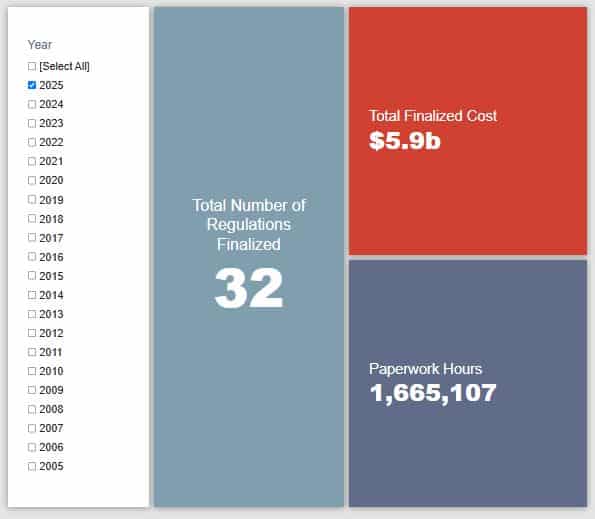
- 2025 Final Rule Costs: $5.9 billion
- 2025 Proposed Rule Costs: $180.1 billion
NOTABLE REGULATORY ACTIONS
The most consequential action of the week was the proposed rule from the Agencies regarding “Trade and National Security Actions and Low-Value Shipments.” The proposal seeks to amend “the U.S. Customs and Border Protection (CBP) regulations pertaining to the administrative exemption for certain low-value shipments not exceeding $800,” also known as “de minimis shipments.” Specifically, the proposed rule lifts the “administrative exemption” that allows such shipments to avoid being subject to a tariff. The American Action Forum (AAF) examined the economic impact of legislative proposals to change the rules regarding de minimis shipments last fall.
According to the rulemaking’s cost-benefit analysis, the effective imposition of tariffs on these shipments would lead to consumer surplus losses due to “higher import prices faced by consumers” in the range of $99.9 billion to $180.8 billion over a decade. Granted, a significant portion of this would then be revenue that redounds to the federal Treasury but calculating that out of the equation would still lead to total net welfare losses (or “costs”) to the economy of $21.9 billion to $121.9 billion – or an average of $71.9 billion – over that 10-year window. Yet given President Trump’s well-documented affinity for tariffs, it is not difficult to see this being a rulemaking that survives across the administrations.
It will, however, be interesting to monitor whether the rule undergoes any major changes in substance upon potential finalization. For one, the proposal seems fundamentally un-aligned with President Trump’s Day One directive to agencies “to deliver emergency price relief…to the American people.” Additionally, the Agencies include the following assumptions in their analysis:
-
Consistent with recent economic evidence on tariff pass-through, we assume full tariff pass-through to U.S. consumers in our main estimates.
-
Because tariff revenues depend on the value of imported goods, the high scenario generates less revenue as consumer demand falls in response to the additional fees on many shipments.
Such assumptions run contrary to recent rhetorical claims from President Trump on the issue of tariffs.
TRACKING TRUMP 2.0
In light of the president’s election last fall, AAF looked at what the country could broadly expect from a now-second Trump term on the regulatory front. As expected, the Trump Administration has implemented the aforementioned “regulatory freeze” and rescinded a host of Biden executive orders. The much-ballyhooed “Department of Government Efficiency” (or DOGE) found a home – and a much more restrained mission – as essentially a renamed United States Digital Service. Furthermore, the new administration has clearly made re-implementing the “Schedule F” order a priority. There have been some initial rumblings regarding the Congressional Review Act (CRA), but it will take some time for those efforts to wind their way through Capitol Hill. AAF plans to have an updated version of its CRA Tracker monitoring such developments soon.
As for broader policy items addressing regulatory policy writ large, the initial wave of executive orders and presidential memos has not been as robust as previously expected. The main focus of early, regulation-related orders appears to mostly concern energy and the environment with a series of actions covering various topics on that front. The price relief order mentioned above represents the only order thus far that covers a more generalized set of rulemakings. Currently, there has yet to be a new version of the first Trump Administration’s regulatory budget framework. It is worth noting, however, that it took that program 10 days to officially hit the books, so it may still be forthcoming. If it, or some similar program, becomes apparent in coming weeks, AAF will be sure to keep an eye on its implementation.
TOTAL BURDENS
Since January 1, the federal government has published $186 billion in total net costs (with $5.9 billion in new costs from finalized rules) and 25 million hours of net annual paperwork cuts (with 1.7 million hours in increases from final rules).