Week in Regulation
July 13, 2026
A Cost-cutting Week for Guns and Pipes
This past week was a moderately busy one in the pages of the Federal Register, punctuated by a couple of significant actions. All told, there were 14 rulemakings that contained some kind of quantified economic impact. The most notable items of the week were a pair of proposed rules from the Bureau of Alcohol, Tobacco, Firearms, and Explosives (ATF) and the Department of Transportation (DOT), that each brought purported cost savings well into the billions of dollars. Overall, federal agencies published roughly $12.5 billion in total cost savings but added 724,757 paperwork burden hours.
REGULATORY TOPLINES
- Proposed Rules This Week: 39
- Final Rules This Week: 55
- 2026 Total Pages: 42,765
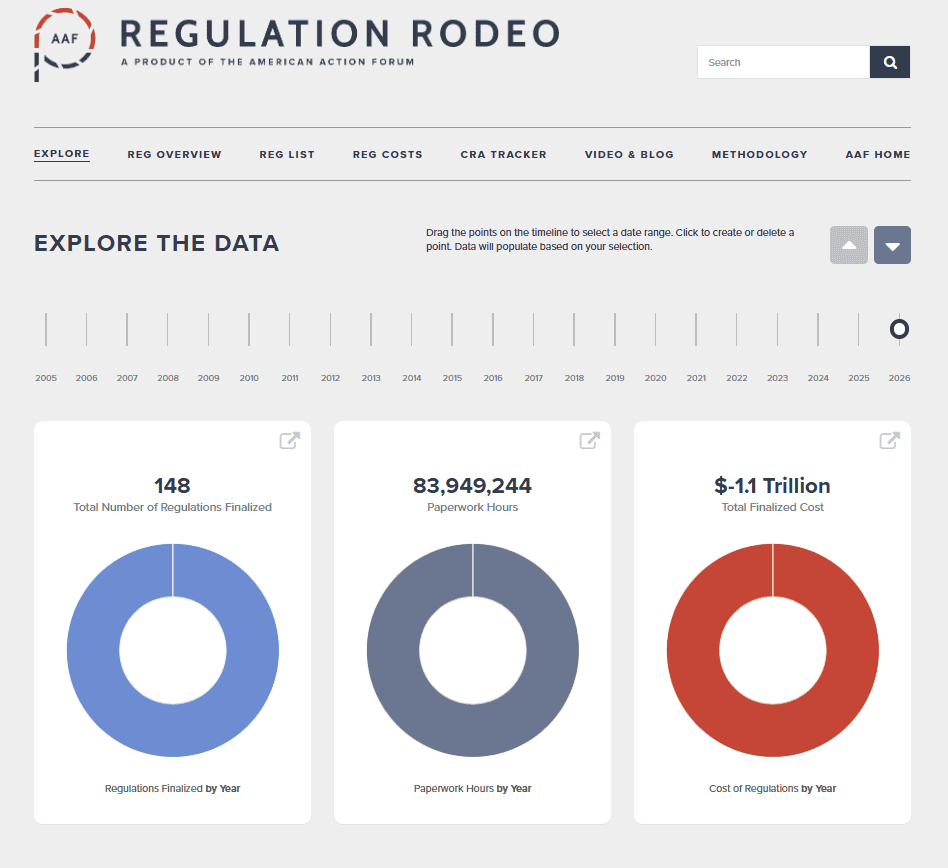
- 2026 Final Rule Costs: -$1.1 trillion
- 2026 Proposed Rule Costs: $66.5 billion
NOTABLE REGULATORY ACTIONS
The most sizable rulemaking of the week was the ATF proposed rule on “Registering NFA [National Firearms Act] Firearms That Fall Out of Government Contract.” Currently, certain NFA registration requirements do not apply to firearms in the possession or control of the United State Government (USG). According to the agency, however: “There is no regulatory mechanism to register NFA firearms manufactured for the USG that have fallen out of USG contract, so manufacturers must destroy or export such items, which can be extremely costly and burdensome.” This proposal “would permit such manufacturers to register, after the standard registration window, rejected, residual, or repurposed (collectively, ‘rejected’) USG firearms not previously registered when they were part of a contract with the USG ( e.g., a contract with the Department of Defense).” ATF estimates that this new process would yield roughly $830 million in annual regulatory savings for affected firearms manufacturers (or $8.3 billion total across a 10-year horizon).
The other proposed rule of consequence this past week was the DOT measure regarding “Pipeline Safety: Repair Criteria for Hazardous Liquid and Gas Transmission Pipelines.” As the title suggests, the proposed rule seeks “to modernize and to clarify the anomaly response criteria in the Federal pipeline safety regulations for gas transmission and hazardous liquid pipelines.” Specifically, the agency notes:
Technology has dramatically advanced in the quarter of a century since the adoption of the [integrity management] IM program. In-line inspection (ILI) tools can now detect more pipeline anomalies with a higher degree of certainty, even interacting threats and previously unreliably detected threats. Models can depict an entire pipeline with the impact of the anomaly and calculate the critical strain. All of this can be used to determine a pipeline’s predicted failure pressure or fatigue life.
DOT expects that updating the relevant regulatory provisions to account for these technological developments will “generate substantial cost savings for gas transmission, hazardous liquid, and carbon dioxide pipelines operators.” Per figures provided in the Regulatory Impact Analysis, these savings add up to nearly $4 billion across the analytic window.
TRACKING TRUMP 2.0
In assessing 2026 rulemakings that include an Executive Order (EO) 14192 determination, there have been 53 “deregulatory” rules with combined total savings of $1.1 trillion against 10 “regulatory” rules that involve roughly $45.7 billion in costs. Adding that to the total agencies produced during 2025 (at least from rules that had a clear “regulatory” or “deregulatory” designation), the Trump Administration has enacted $1.2 trillion in total cost reductions thus far under EO 14192. Rules for which agencies have claimed one of the EO’s exemptions have accounted for an additional $7.6 billion in costs so far in 2026.
As mentioned last week, the Trump Administration finally released its “2026 Regulatory Plan and the Unified Agenda [UA] of Federal Regulatory and Deregulatory Actions.” The main item from the UA regarding EO 14192 is that the Office of Information and Regulatory Affairs projects agencies to achieve $1.5 trillion in net cost reductions by the end of fiscal year 2026. This American Action Forum (AAF) analysis identifies and examines certain trends within the document that may point to how the administration expects to reach that goal.
CONGRESSIONAL REVIEW ACT (CRA)
The AAF CRA tracker provides a full survey of activity under the law thus far into this term. As of today, members of the 119th Congress have introduced CRA resolutions of disapproval addressing 138 “rules” across the Biden and Trump Administrations that collectively involve $176 billion in estimated compliance costs. Of these, 23 have been passed into law, repealing a series of Biden Administration rules that had a combined $3 billion in associated compliance costs. The Trump Administration estimates that the repeal of this rule yields an additional $936 million in savings. While the main window of CRA action has largely passed, there are still outstanding resolutions that could move legislatively. AAF will continue to monitor and update such developments as appropriate.
TOTAL BURDENS
Since the start of 2026, the federal government has published $985.5 billion in total regulatory net cost savings (with $1.1 trillion in reductions from finalized rules) and 102.6 million hours of net annual paperwork increases (with 83.9 million hours coming from final rules).