Week in Regulation
July 6, 2026
Some Deregulatory Bangs and Pops
Despite it being a holiday-shortened week, the opening week of July 2026 saw plenty of action in terms of regulatory developments. There were 20 rulemakings containing some kind of measurable economic impact. The week’s haul trended decidedly in the cost-cutting direction with proposed rules from the Commodity Futures Trading Commission (CFTC) and Federal Deposit Insurance Corporation (FDIC), respectively, providing the most significant reductions in compliance costs. Additionally, at the very end of the week, the Trump Administration finally produced its report on forthcoming regulatory and deregulatory plans. Overall, federal agencies published roughly $3.4 billion in total cost savings and cut 3.6 million paperwork burden hours.
REGULATORY TOPLINES
- Proposed Rules This Week: 37
- Final Rules This Week: 87
- 2026 Total Pages: 40,783
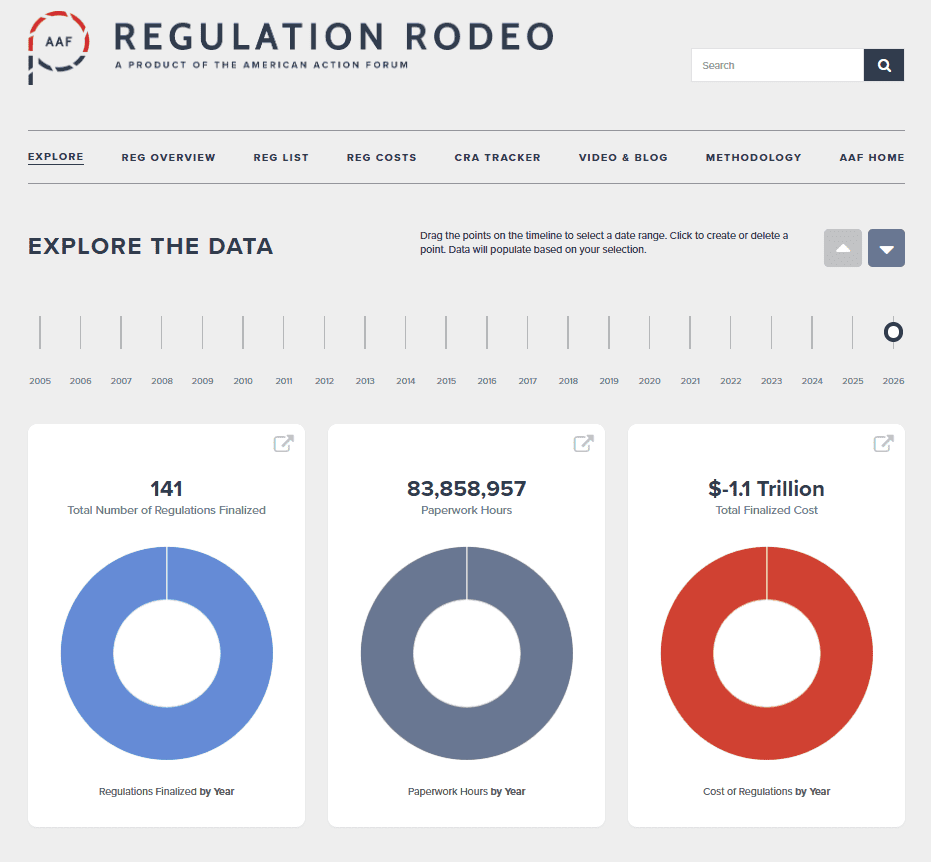
- 2026 Final Rule Costs: -$1.1 trillion
- 2026 Proposed Rule Costs: $79.5 billion
NOTABLE REGULATORY ACTIONS
The most consequential rulemaking of the week in terms of quantified costs and/or savings was the CFTC proposed rule regarding “Data Reporting Requirements for Certain Event Contracts.” In particular, the proposal makes:
Revisions to the Commission’s regulations that would set forth an alternate framework for reporting of data for certain fully collateralized event contracts (the “Proposal”). These revisions would require certain reporting markets, futures commission merchants, clearing members, and foreign brokers to report certain event contracts pursuant to the regulations in parts 15 through 18 rather than the reporting regulations contained in certain sections of parts 38, 39, 43 and 45.
The commission expects such changes to result in “a decreased burden relative to baseline due to the significantly higher reporting level and reportable volume threshold level the Proposal would establish, which would result in a corresponding lower level of large traders.” Teasing out the net estimates of compliance costs and savings – largely included in a series of footnotes – the rulemaking’s amendments would result in annual reductions in paperwork of 5.5 million hours and $669 million in associated costs (or roughly $2 billion total when extended over the 3-year window for which official paperwork requirements apply).
The other main cost-cutting measure of the week – also in the financial services realm – was the FDIC proposed rule on “Resolution Submissions Required for Covered Insured Depository Institutions.” This proposal:
Would modify the current rule by raising and automatically updating the dollar threshold that determines the scope of applicability; reducing the requirements regarding the content of resolution submissions provided to the FDIC, with a focus on information that most directly supports the FDIC’s resolution readiness in the event of material distress and failure of a covered IDI [insured depository institutions]; and standardizing content requirements for covered IDIs. The proposed rule would also eliminate the FDIC’s credibility assessment of submissions provided by IDIs, as well as expectations for capabilities testing under the current rule.
FDIC expects such changes to result in “an aggregate cost reduction of approximately $68 million across all affected IDIs when averaged over the 12-year period of analysis.” Extending that $68 million across that 12-year analytical window means roughly $814 million in total cost savings.
TRACKING TRUMP 2.0
In assessing 2026 rulemakings that include an Executive Order (EO) 14192 determination, there have been 52 “deregulatory” rules with combined total savings of $1.1 trillion against 10 “regulatory” rules that involve roughly $45.7 billion in costs. Adding that to the total agencies produced during 2025 (at least from rules that had a clear “regulatory” or “deregulatory” designation), the Trump Administration has enacted $1.2 trillion in total cost reductions thus far under EO 14192. Rules for which agencies have claimed one of the EO’s exemptions have accounted for an additional $7.6 billion in costs so far in 2026.
As for the broader scope of regulatory policy under the second Trump term, there was a late-breaking development this past week. Last Friday – which was, of course, technically a federal holiday – the Office of Information and Regulatory Affairs (OIRA) posted the “2026 Regulatory Plan and the Unified Agenda [UA] of Federal Regulatory and Deregulatory Actions.” This represents the most recent version of the UA since the administration published “Spring 2025” edition last September. This most recent version, through both its timing and title, appears to be a combined version of what would have been the Fall 2025 and Spring 2026 editions of the typically biennial report.[1]
An administration publishing merely one UA per year is not without precedent though. The only UA published by the Obama Administration for 2012 did not come until late December of that year. There were concerns at the time – and speculation long since – that the Obama Administration forgoing a Spring 2012 UA was a political consideration heading into that year’s presidential election. With this 2026 UA now coming right in the throes of this year’s mid-term election season, outside of the holiday-weekend publication, the peculiar timing and framing of this edition is more likely the result of more mundane operational issues[2] than some larger political motivation.
Stay tuned for a deeper analysis from the American Action Forum (AAF) on this UA’s contents later this week.
CONGRESSIONAL REVIEW ACT (CRA)
The AAF CRA tracker provides a full survey of activity under the law thus far into this term. As of today, members of the 119th Congress have introduced CRA resolutions of disapproval addressing 138 “rules” across the Biden and Trump Administrations that collectively involve $176 billion in estimated compliance costs. Of these, 23 have been passed into law, repealing a series of Biden Administration rules that had a combined $3 billion in associated compliance costs. The Trump Administration estimates that the repeal of this rule yields an additional $936 million in savings. While the main window of CRA action has largely passed, there are still outstanding resolutions that could move legislatively. AAF will continue to monitor and update such developments as appropriate.
TOTAL BURDENS
Since the start of 2026, the federal government has published $973 billion in total regulatory net cost savings (with $1.1 trillion in reductions from finalized rules) and 101.9 million hours of net annual paperwork increases (with 83.9 million hours coming from final rules).