Week in Regulation
July 20, 2026
July Continues Down Deregulatory Path
Each week of July (so far) has trended toward deregulation. This past week saw a dozen rulemakings containing some kind of measurable economic impact. A handful of these had effects in the billions of dollars. The main deregulatory actions came from the Environmental Protection Agency (EPA) and Department of Interior (DOI). A costly rule from the Department of Homeland Security (DHS) regarding student visas partially blunted the week’s general trend, however. Overall, federal agencies published roughly $10.8 billion in total cost savings but added 2.8 million paperwork burden hours.
REGULATORY TOPLINES
- Proposed Rules This Week: 29
- Final Rules This Week: 48
- 2026 Total Pages: 45,104
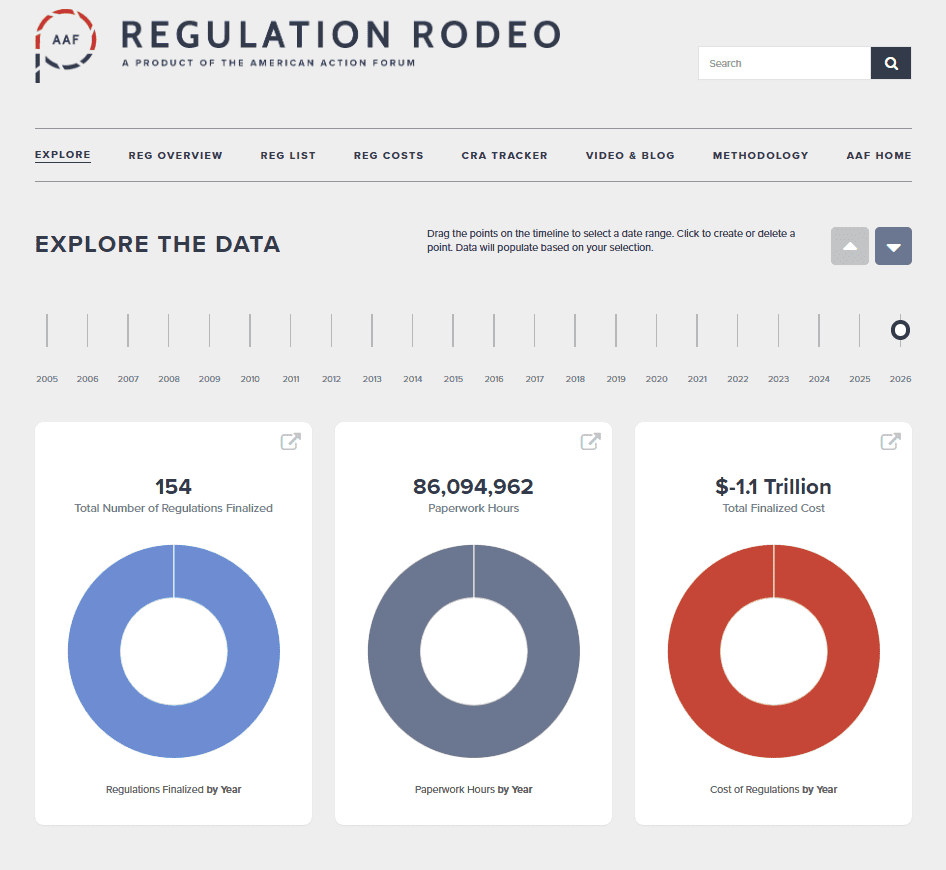
- 2026 Final Rule Costs: -$1.1 trillion
- 2026 Proposed Rule Costs: $56.4 billion
NOTABLE REGULATORY ACTIONS
The most significant rulemaking of the week (in terms of economic impact) was the proposed rule from EPA regarding “Amendments and Nonconformance Penalties for Model Year 2027 and Later Heavy-Duty Highway Engines and Amendments to Inducement Provisions for SCR-Equipped Diesel Engines.” The proposal primarily seeks to make a series of changes to a Biden-era rule on emissions standards for heavy duty vehicles. The most substantial change involves shortening:
The period over which CAA [Clear Air Act] section 207 requires an engine manufacturer to warrant to a purchaser that: (1) the engine is designed, built, and equipped so as to conform with applicable regulations under CAA section 202 and (2) is free from defects in materials or workmanship which would cause the engine not to conform with applicable regulations for the warranty period.
EPA expects such a shift to result in total cost reductions for manufacturers of roughly $24 billion against approximately $15 billion in increased operating costs for consumers, yielding $9.4 billion in total net cost savings.
The other substantial deregulatory measure of the week was the DOI rule on “Rescinding the Definition of ‘Harm’ Under the Endangered Species Act (ESA).” As the title plainly suggests, DOI is undoing the long-standing regulatory definition of the term “harm” due to the agency now finding that the definition does “not accord with the single, best meaning of the statutory text.” The agency does not include a particularly robust economic analysis in the rule itself, but does note that it expects this changes to result in “annualized quantified cost savings of … $521.0 million at a 7 percent discount rate.” If one extrapolates that over a 10-year period, that would mean nearly $3.7 billion in total cost savings.
The most consequential cost-adding rulemaking of the week was the DHS rule titled “Establishing a Fixed Time Period of Admission and an Extension of Stay Procedure for Nonimmigrant Academic Students, Exchange Visitors, and Representatives of Foreign Information Media.” With this rule, the agency is “amending its regulations to change the admission period in the F, J, and I classifications from duration of status to an admission for a fixed time period, and additional changes to admission and extension requirements.” DHS estimates that such changes will result in nearly $450 million in increased compliance costs for affected applicants annually (or roughly $3.2 billion total over a 10-year period). Despite this sizable cost estimate, the rule is another high-profile example of an agency action that claims the “immigration-related function” exemption from official consideration in the administration’s regulatory budget program.
TRACKING TRUMP 2.0
In assessing 2026 rulemakings that include an Executive Order (EO) 14192 determination, there have been 56 “deregulatory” rules with combined total savings of $1.1 trillion against 10 “regulatory” rules that involve roughly $45.7 billion in costs. Adding that to the total agencies produced during 2025 (at least from rules that had a clear “regulatory” or “deregulatory” designation), the Trump Administration has enacted $1.2 trillion in total cost reductions thus far under EO 14192. Rules for which agencies have claimed one of the EO’s exemptions have accounted for an additional $10.7 billion in costs so far in 2026.
CONGRESSIONAL REVIEW ACT (CRA)
The AAF CRA tracker provides a full survey of activity under the law thus far into this term. As of today, members of the 119th Congress have introduced CRA resolutions of disapproval addressing 138 “rules” across the Biden and Trump Administrations that collectively involve $176 billion in estimated compliance costs. Of these, 23 have been passed into law, repealing a series of Biden Administration rules that had a combined $3 billion in associated compliance costs. The Trump Administration estimates that the repeal of this rule yields an additional $936 million in savings. While the main window of CRA action has largely passed, there are still outstanding resolutions that could move legislatively. AAF will continue to monitor and update such developments as appropriate.
TOTAL BURDENS
Since the start of 2026, the federal government has published $996.3 billion in total regulatory net cost savings (with $1.1 trillion in reductions from finalized rules) and 105.4 million hours of net annual paperwork increases (with 86.1 million hours coming from final rules).