Insight
June 30, 2026
ERISA’s Important but Limited Role in Health Care Cost Containment
Executive Summary
- Rising health care costs have brought renewed attention to the Employee Retirement Income Security Act of 1974 (ERISA) as policymakers and advocates look for new ways to address increasingly expensive employer-sponsored coverage.
- Leveraging requirements under ERISA appears attractive because other cost-containment efforts have had limited success, making the statute seem like a potential avenue for influencing a large share of private health coverage.
- ERISA is a benefit-plan governance statute, however, not a price-control law; pursuing broader cost-containment agendas using ERISA authority would not address hospital prices, physician payment, prescription drug prices, or the broader structural forces that drive health care spending.
Introduction
Employer-sponsored insurance sits at the center of the American health care system. It is the most common form of health insurance in the United States, covering 53.8 percent of the total population for at least part of the year. KFF estimates that employer-sponsored insurance covers 154 million people under age 65, while average annual premiums in 2025 reached $9,325 for single coverage and $26,993 for family coverage. Those figures help explain why employer coverage has become a natural target for policymakers concerned about affordability: It is large, expensive, and directly connected to workers’ wages, household budgets, and employer compensation decisions.
These pressures have led to renewed interest in the Employee Retirement Income Security Act of 1974 (ERISA). Because ERISA governs much of the legal framework for private-employer benefit plans, it can appear to offer an existing federal pathway for addressing problems in a market that has proven difficult to discipline through other reforms. Policymakers have struggled for years to slow spending growth through transparency initiatives, insurance regulation, payment reforms, competition policy, and targeted interventions in the pharmaceutical and provider markets. Against that backdrop, some have argued that ERISA should be updated, interpreted more aggressively, or used more directly to address the rising cost of employer-sponsored health coverage.
There may be reason to examine whether ERISA is functioning as effectively as it should in today’s health care market. ERISA plans are either self-funded or fully insured. A self-funded plan is defined as an arrangement where the employer collects premiums from employees (the covered population) and is directly responsible for paying the resulting medical claims. Employers that self-fund coverage usually establish relationships with third-party administrators (TPAs), independent intermediary organizations that manage self-funded health plans by processing medical, dental, and vision claims, and managing provider networks. In turn, TPAs establish contractual networks to provide this coverage. Approximately 60 percent of ERISA plans are self-funded. Fully insured ERISA plans are those where an employer purchases insurance coverage for employees directly from an insurer. Around 40 percent of ERISA plans are fully insured.
As evidenced by the differentiation above, employers now depend on complex contractual relationships with insurers, TPAs, pharmacy benefit managers (PBMS), brokers, consultants, and other vendors. Employers or plan sponsors, fiduciaries, and other contractual actors may not always have sufficient visibility into compensation arrangements, claims data, rebate flows, network pricing, or other information necessary to evaluate whether a plan is being administered prudently. Reforms that improve disclosure, restrict gag clauses, and clarify vendor compensation can therefore serve a legitimate purpose within ERISA’s existing framework.
Yet there is a difference between improving ERISA’s operation in the health plan context and transforming ERISA into a general health care cost-containment statute. The statute is fundamentally concerned with benefit-plan governance: disclosure, fiduciary conduct, claims administration, plan oversight, and federal uniformity. It was not designed to regulate hospital prices, physician payment, prescription drug prices, or the broader structural forces that drive health care spending. Policymakers can strengthen ERISA where it naturally applies, particularly around transparency and fiduciary oversight, but using it as a substitute for broader health care cost strategy risks pushing the statute beyond its proper role while leaving the underlying cost drivers largely untouched.
What Is ERISA?
ERISA is one of the foundational statutes governing private employee benefits in the United States. Its name can be misleading in the health policy context. While ERISA is often discussed today in association with employer-sponsored health plans, the statute was born primarily out of a retirement-security crisis. Congress enacted ERISA after years of concern that workers could spend decades earning promised pension benefits only to find, at retirement, that the money was unavailable, inadequately funded, or poorly protected.
The most cited historical catalyst was the 1963 collapse of the Studebaker pension plan in South Bend, Indiana. When Studebaker terminated its employee pension plan, more than 8,500 workers lost some or all of their expected pension benefits, an episode that came to symbolize the vulnerability of private pensions before federal reform. The broader problem was not simply one failed company, however. It was that private benefit plans had grown into a central part of workers’ economic security without a sufficiently comprehensive federal framework to ensure disclosure, prudent management, funding discipline, and enforceable rights.
ERISA was the culmination of earlier federal efforts to oversee employee benefit plans, including the Welfare and Pension Plans Disclosure Act of 1958, which required employers to disclose information about pension plans, and which gave the Department of Labor a role in overseeing those benefits. But ERISA was designed to go further.
At its core, ERISA sets minimum federal standards for most voluntarily established private sector retirement and health plans. It requires plans to provide participants with information about plan features and funding; imposes fiduciary obligations on those who manage plans and plan assets; establishes claims and appeals procedures; gives participants a right to sue for benefits and fiduciary breaches; and, for defined-benefit pension plans, created federal protections through the Pension Benefit Guaranty Corporation. Since its enactment, ERISA has been amended repeatedly to reflect changing retirement and health benefit needs, but its basic architecture remains rooted in benefit-plan governance.
ERISA does not require employers to offer benefits, nor does it prescribe the precise terms of every benefit package. Instead, it regulates the administration of benefit plans once employers choose to offer them. An employer may decide whether to sponsor a plan, what type of plan to offer, how generous that plan should be, and whether to amend or terminate it, subject to other applicable legal constraints. ERISA then governs how the plan is administered, how participants are informed, how assets are handled, and how fiduciaries discharge their duties.
Those fiduciary duties are among ERISA’s most important features. Fiduciaries must act solely in the interest of plan participants and beneficiaries, for the exclusive purpose of providing benefits and paying reasonable plan expenses. They must act prudently, follow plan documents that are consistent with ERISA, avoid conflicts of interest, and ensure that plan assets are not misused. In the retirement context, these duties naturally focus on investment selection, fees, diversification, and the protection of plan assets. In the health plan context, they apply to plan administration, service-provider oversight, claims processes, and the handling of plan resources.
How Health Care Fits In
Although ERISA is widely associated with pensions and retirement security, the statute’s treatment of employer-sponsored health coverage as an “employee welfare benefit plan” extends its scope to private-sector plans that provide medical, surgical, hospital, prescription drug, disability, and other welfare benefits. This means that when an employer chooses to sponsor a health plan, that plan is generally subject to ERISA’s federal rules governing reporting, disclosure, fiduciary responsibilities, claims procedures, and enforcement rights. ERISA therefore supplies much of the legal architecture for employer-sponsored health coverage, even though it was not enacted primarily as a health care statute.
This understanding is important because ERISA regulates the administration of the plan, not the health care system surrounding it. The statute does not generally require an employer to offer health benefits, dictate every covered service, regulate provider prices, or set the price of prescription drugs. Instead, it establishes standards for how a plan must be operated once it exists. Participants must receive certain information about their coverage; fiduciaries must act prudently and in the interest of participants and beneficiaries when managing the plan; and beneficiaries must have access to claims and appeals processes when coverage is denied. In this sense, ERISA’s health care role is procedural and fiduciary rather than directly regulatory of prices or delivery.
Over time, Congress has used ERISA as one vehicle for applying broader health coverage protections to employer plans. Requirements related to Consolidated Omnibus Budget Reconciliation Act (COBRA) continuation of health coverage, Health Insurance Portability and Accountability Act of 1996 (HIPAA) portability, mental health parity, Affordable Care Act market plans, surprise billing protections, and more recent transparency obligations have all been layered onto ERISA-covered group health plans. Those additions demonstrate that ERISA is not irrelevant to health policy. But they also reinforce the statute’s proper role: ERISA is a framework for plan governance, participant protections, and uniform administration of employer-sponsored benefits. It can help ensure that health plans are administered fairly and transparently, but it is not, by design, a mechanism for controlling the underlying cost of health care.
ERISA Preemption and State Actions
ERISA preemption is one of the statute’s most important features for employer-sponsored health coverage. In broad terms, ERISA preempts state laws that “relate to” employee benefit plans, while preserving state authority to regulate insurance. That balance has always been especially important for self-insured employer health plans, which as noted above are the primary type of ERISA plan: States may regulate insurers and insurance products, but they generally may not treat self-funded ERISA plans as insurers to impose state insurance regulation on them. The result is a federal floor and a federal framework for plan administration, designed to allow multistate employers to operate benefit plans without navigating a separate set of state rules in every jurisdiction. As the map illustrates, however, the status of federal ERISA preemption is at risk of fragmenting across the country.
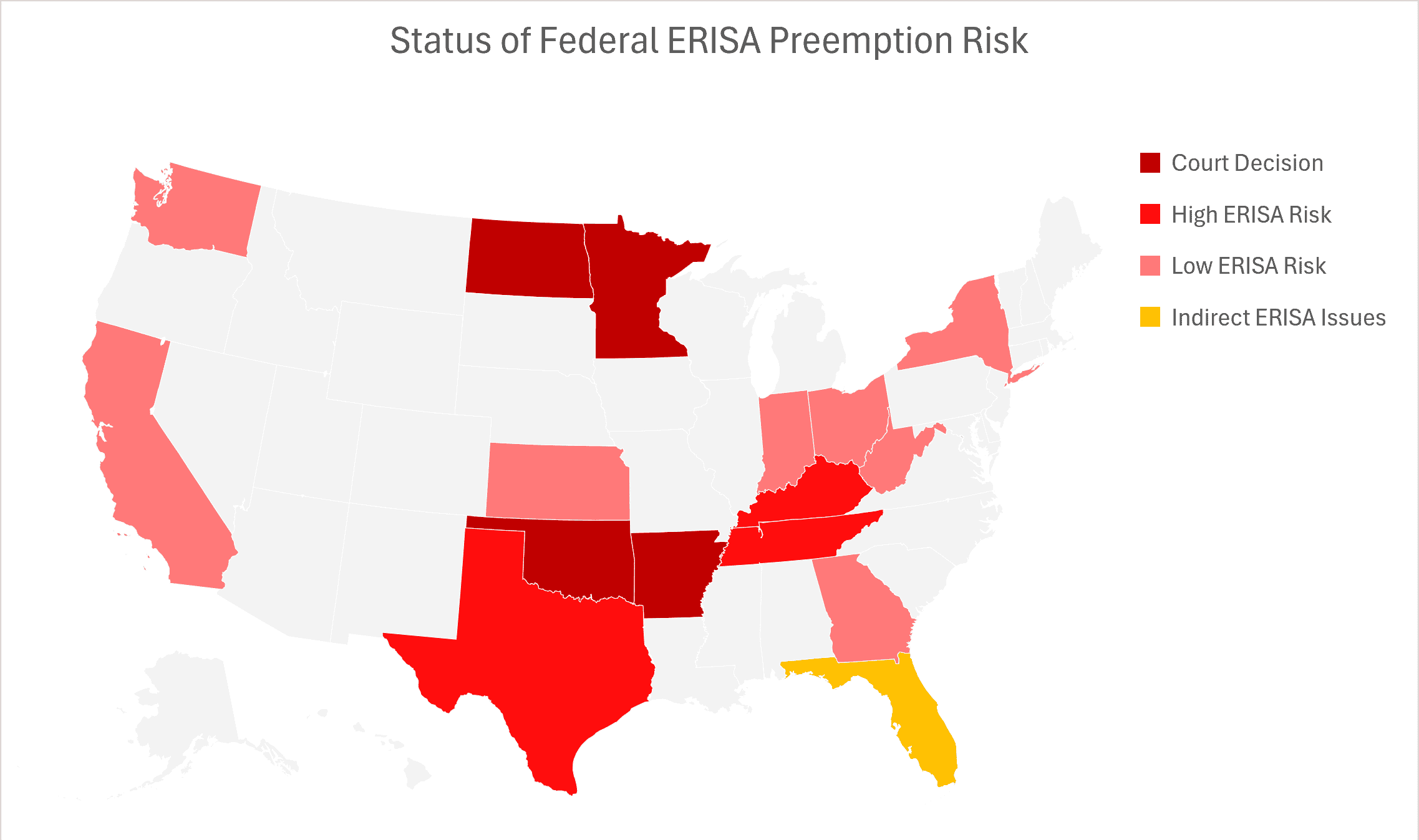
Source: Author research and interpretations
States have increasingly pursued laws that may weaken this federal preemption, particularly affecting pharmacy benefit managers, claims-data reporting, reimbursement rules, network requirements, and other policies intended to affect health care costs. Some of these laws may be framed as general health care or insurance regulation, while others more directly affect how ERISA plans are administered. Consider a large employer with employees in 30 or 40 states that sponsors a single self-funded health plan. Without ERISA’s preemption framework, that employer could be required to administer different versions of the same plan depending on where each employee lives or receives care. One state might require specific claims-data reporting, another might impose unique pharmacy reimbursement rules, another might mandate different appeal procedures, and another might restrict how the plan contracts with third-party administrators or pharmacy benefit managers. Even if each state policy is well-intentioned, the cumulative effect could be a fragmented compliance regime layered on top of an already complex national health plan.
Realistic Future State
There are some things ERISA can do to support employers providing health care coverage, though. ERISA can support better information, better governance, and better accountability. For example, it is reasonable to ask whether plan fiduciaries have sufficient information to evaluate the compensation paid to third-party administrators, PBMs, brokers, consultants, and other service providers. It is reasonable to prohibit contractual gag clauses that prevent plan sponsors from accessing claims data, provider-specific cost information, or quality information. It is reasonable to require service providers to disclose direct and indirect compensation so that plan fiduciaries can evaluate whether arrangements are reasonable and whether conflicts of interest exist.
Those kinds of reforms fit comfortably within ERISA’s design. They strengthen the ability of employers and fiduciaries to manage plans prudently and may create pressure for better contracting and more informed purchasing. They are also consistent with the idea that fiduciaries should have enough information to assess the reasonableness of plan expenses and the quality of services provided to the plan.
But that is different from asking ERISA to solve health care affordability directly. The major drivers of health care costs often sit outside ERISA’s core institutional reach. Hospital operations, provider market power, physician employment trends, site-of-care incentives, drug development costs, insurance benefit mandates, tax implications of employer coverage, utilization patterns, public program payment rules, and state insurance regulation all influence what employers and workers ultimately pay. ERISA touches some of these dynamics only indirectly. It may shape how a plan contracts services, but it does not determine the underlying structure of the health care market.
Given these realities, stretching ERISA beyond its statutory design could create unintended consequences. If ERISA fiduciary duty is interpreted as a broad obligation to secure the lowest possible health care prices, employers could face open-ended litigation risk for complex benefit design and contracting decisions. Courts would be asked to second-guess plan design choices, network arrangements, formularies, cost-sharing structures, and vendor contracts in markets where there may be no single clearly correct answer. That could encourage more defensive plan administration, greater reliance on outside vendors, narrower benefits, increased cost-shifting to workers, or reduced employer willingness to offer generous coverage.
The distinction between fiduciary administration and employer plan design is therefore essential. Under ERISA, fiduciaries must act prudently, loyally, and in the interest of participants and beneficiaries when administering a plan or managing plan assets. But employers also act as plan sponsors. In that capacity, they make business decisions about whether to offer benefits, what kind of benefits to offer, how generous those benefits should be, and whether to amend or terminate a plan. Those decisions may have enormous consequences for workers, but they are not automatically fiduciary decisions. Treating every cost-related choice as a fiduciary matter would blur a line that ERISA itself has long recognized.
The recent attention to PBMs and prescription drug benefit management illustrates both the promise and the limits of ERISA-based reform. PBM contracts can be opaque, and employer plan sponsors may not always have a clear view of rebate arrangements, spread pricing, pharmacy reimbursement, administrative fees, formulary incentives, or the true net cost of prescription drugs. Better disclosure in this area could be valuable. It could help fiduciaries understand whether vendor compensation is reasonable, whether incentives are aligned, and whether the plan is receiving the value it expects. At the same time, PBM transparency is not the same thing as prescription drug cost containment. Disclosure can improve oversight, but does not by itself determine drug prices, accelerate generic or biosimilar competition, or restructure the pharmacy supply chain.
ERISA may be one relevant statute for employer-sponsored plans, but it should not become a substitute for more targeted policy. A balanced approach would recognize ERISA’s value without overstating its capacity. Policymakers should ensure that plan fiduciaries can access the information they need, evaluate service-provider compensation, review plan performance, and fulfill their obligations to participants. They should also be cautious about using ERISA as a backdoor mechanism for broader health policy goals that the statute was not designed to achieve.
Conclusion
Improving health care affordability is a significant challenge for policymakers. Employers are frustrated, workers are paying more, and the health care system rarely produces prices that are transparent, predictable, or disciplined by normal market forces. But the seriousness of the problem does not mean every available statute is equally suited to solve it. ERISA is a governance statute for employee benefit plans. It can help improve the process by which plans are administered and overseen, help ensure that participants receive information, rights, and remedies, and help fiduciaries ask better questions of the vendors they hire.
But ERISA cannot easily substitute for a coherent health care cost-containment strategy. It was not written to regulate provider markets, set prices, restructure incentives, or redesign the health care delivery system. Policymakers and advocates should therefore be careful not to ask ERISA to carry more than it can bear. The better course is to strengthen ERISA where it naturally applies – transparency, fiduciary process, disclosure, and plan governance – while addressing the underlying drivers of health care costs through other statutes and policies designed for that purpose.