Research
September 10, 2026
Lowering the Medicare Eligibility Age to 62: Cost and Coverage Outcomes

Executive Summary
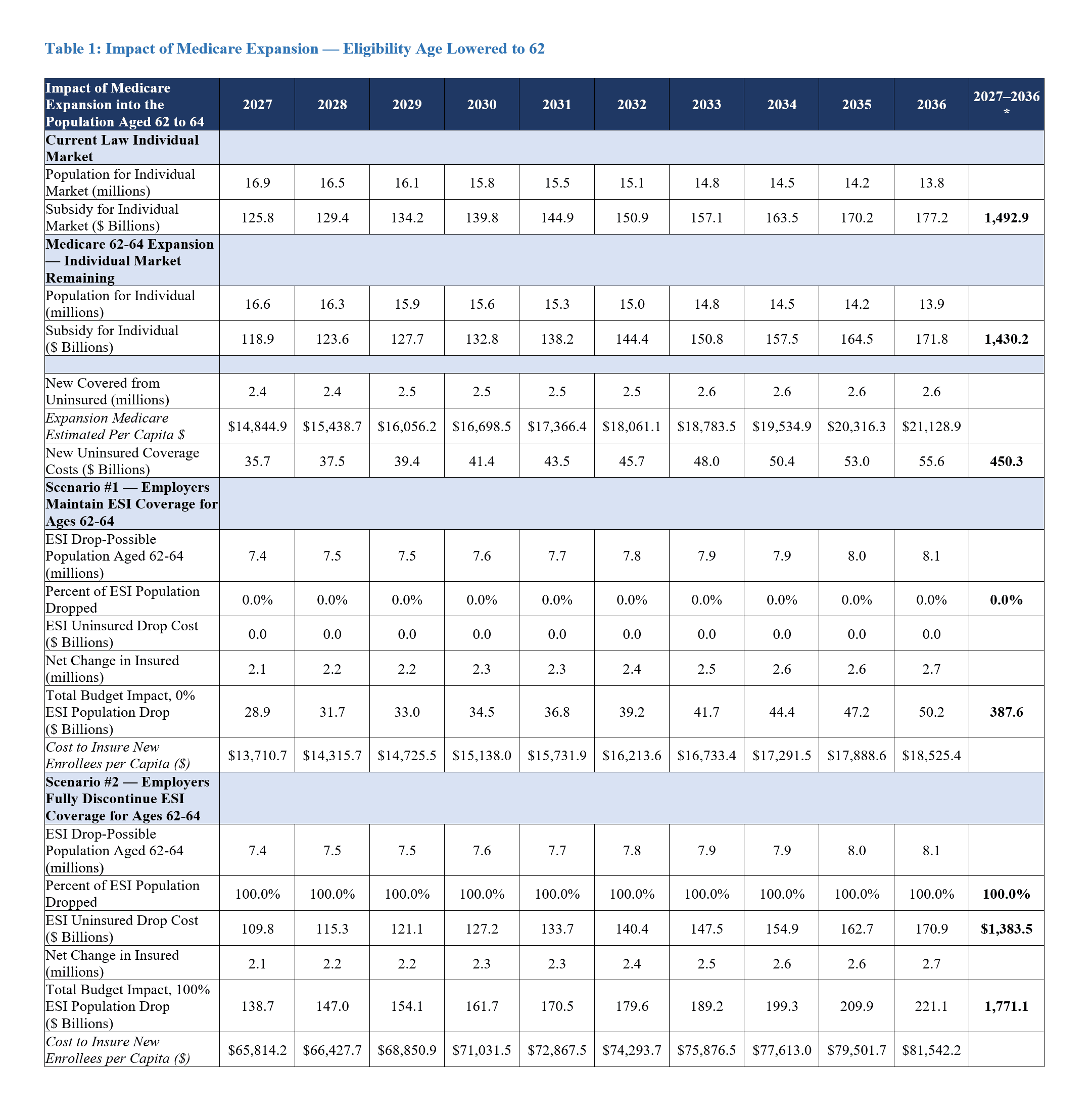
- Lowering the Medicare eligibility age to 62 would cost $387.6 billion over the 10-year period from 2027–2036 after accounting for savings that would accrue to the Affordable Care Act’s (ACA) marketplace from lower spending on subsidies and assuming employers continue to offer health insurance to those newly eligible for Medicare.
- If employers were to drop health coverage for employees age 62-64 in response to the Medicare eligibility age being lowered, the total cost of the policy would climb to as high as $1,771.1 billion (about $1.8 trillion).
- Both scenarios would result in a net increase in the total number of insured Americans of approximately 2.1 million in 2027, growing to approximately 2.7 million by 2036.
Introduction
Lowering the Medicare eligibility age is a proposal that resurfaces in Congress. The American Action Forum’s September 2021 estimate modeled a reduction to age 60 the last time it was discussed. This update is published modeling a more modest reduction to age 62, using the same framework applied to the narrower 62-64 age band and projected over 2027–2036. This update also reflects a larger individual insurance market than the original 2021 estimate, with the individual market’s 2027 population revised up to 16.9 million, and an updated Medicare per-capita cost basis of $14,844.90 in 2027, estimated from actual Medicare plan bid data rather than the original ACA-premium proxy.
This update shows that if Medicare eligibility were extended to those age 62-64, the cost to the federal government would be between $387.6 billion and $1.8 trillion over the 10-year window—depending on employer behavior in response to the change.
Scenarios and Assumptions
This update models two scenarios (as shown in Table 1) for lowering the Medicare eligibility age to 62, resulting in a lower and upper bound for cost to the federal government.
Scenario 1 assumes that all employers continue to offer employer-sponsored insurance (ESI) to the newly Medicare-eligible population and that those age 62-64 are able to choose between ESI and Medicare, resulting in new federal spending as shown in Table 1.
Scenario 2 assumes that 100 percent of employers stop ESI coverage for those age 62-64, leading to a complete migration of that age cohort into Medicare and resulting in the higher new federal spending shown in Table 1.
Both scenarios assume that those age 62-64 who are currently covered by Medicaid would remain in Medicaid coverage, and that all currently uninsured individuals age 62-64 enroll in Medicare. Cost estimates for both scenarios are net of savings derived from lower federal spending on premium tax credits through the ACA marketplace. The per capita cost of expanded Medicare is estimated using actual Medicare plan bid data: $14,138.00 in 2026, up 7.6 percent from $13,141.00 in 2025. This is then set 5 percent above the 2026 bid for 2027 ($14,844.90) and escalated 4 percent per year thereafter. The individual market itself is sized at 16.9 million people in 2027, evolving at the same year-over-year growth rate as the original model.
This model projects that both scenarios result in a net increase in the total number of insured Americans of approximately 2.1 million in the first projected year, growing to approximately 2.7 million by the final year, relative to this model’s current-law baseline.
Conclusion
Policymakers could structure a Medicare expansion in a number of ways to attempt to minimize the scorable cost of the policy; based on this model’s estimates however, a straightforward expansion of Medicare down to age 62 would cost between $13,710.70 and $81,542.20 per newly covered beneficiary, depending on year and share of the ESI population enrolled in the expansion. Medicare expansion has become an ideological litmus test for many policymakers, but from a purely dollars-and-cents perspective, extending Medicare coverage to those age 62-64 remains a case where the fiscal cost is substantial relative to the coverage gained.
Sources
AAF: Lowering the Medicare Age to 60: Cost and Coverage Outcomes
Center for Health & Economy: Lowering the Medicare Age to 60
KFF: Federal default age curve / ACA age rating factors
45 CFR 147.102 — Fair health insurance premiums (age rating)