The Shipment
April 16, 2026
Global Growth Revisions
(Not So) Fun Fact: As of today, the U.S. national average gas price sits at $4.09 which is roughly 10 percent higher than one month ago but a slight decline of 2 percent since last week.
The Strait of Hormuz Weighs on Global Growth
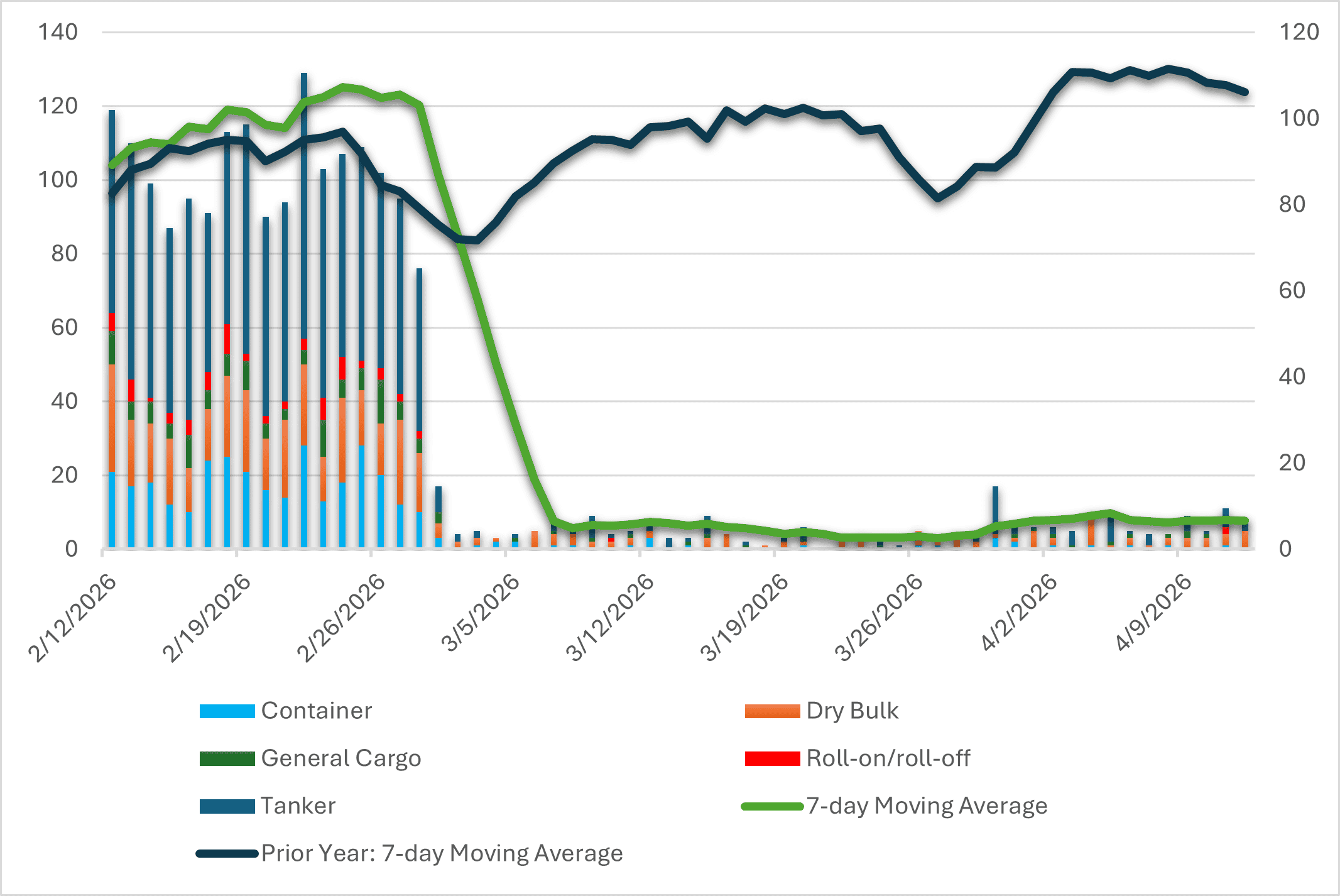
What’s Happening: This week, financial leaders, central bank governors, and economists from around the world are coming to Washington, D.C. to discuss the state of the global economy during meetings at the International Monetary Fund (IMF) and World Bank. The IMF released a new edition of its “World Economic Outlook” with updated projections for inflation and economic growth, as well as general expectations for macroeconomic trends, policies, and spending over the next few years across countries. At the top of mind is the current conflict in the Middle East which threatens to curb global growth, raise headline inflation, and further fragment economies across geopolitical lines. Treasury Secretary Bessent stated that the IMF and World Bank have overreacted given their more pessimistic outlooks for 2026, emphasizing that the United States is far better positioned to overcome a period of higher prices than Europe or Asia. Meanwhile, traffic through the Strait of Hormuz remains static despite the recent ceasefire announcement due in part to the newly imposed U.S. blockade of all ships entering or exiting Iranian ports. Global shipping companies also remain cautious and await greater clarity on the conflict being resolved more permanently.
Why It Matters: The IMF and World Bank discussions this week highlight how interconnected the global economy truly is as a result of international trade, with disruptions to shipping causing noticeable and lasting impacts. Since the IMF’s January projections, global real gross domestic product (GDP) growth projections have been lowered from 3.3–3.1 percent for 2026. In fact, the IMF noted that it would have raised its global growth forecast to 3.4 percent were it not for the current Iran conflict. Projected U.S. real GDP growth has also been lowered from 2.4–2.3 percent this year, a notable consequence of the global energy shock, lack of fertilizer, and other downstream effects from the Middle East conflict. This slight growth downgrade is, however, less drastic than those of other advanced economies as Secretary Bessent rightfully pointed out. Growth in the European Union – which is far more dependent than the United States on energy flowing from the Strait of Hormuz – has been lowered by 0.2 percentage points for both 2026 and 2027, while the United Kingdom is expected to take a 0.5 percentage point hit to growth this year alone compared to January estimates. The Middle East and Asian economies have also seen rather substantial downward revisions to growth in 2026 as they have been hard hit by a plummet in exports and energy shortages, respectively (see Figure 1). Furthermore, world consumer prices are expected to increase by 4.4 percent this year compared to the previous estimate of 3.8 percent. The IMF also lays out two additional scenarios where the Iran conflict and resulting supply shocks are more protracted. These scenarios suggest global growth could dip to between 2–2.5 percent, with inflation hitting 5.4–5.8 percent, warning that the most severe scenario brings the world near recession territory.
Looking Ahead: Talks between the United States and Iran may have stalled, but it appears both sides continue to engage in dialogue through intermediaries. At the moment, it appears highly unlikely that a long-term solution can be found as the gap between the two parties remains unbridgeable. Beyond the list of national security differences, a key point of contention is that the United States seeks to re-open the Strait of Hormuz while Iran plans to push for control over the strait by establishing a new toll for transiting ships. The United States and other countries highly impacted by the conflict will only be able to mitigate risks to growth and inflation by returning Strait of Hormuz tanker traffic to normal levels. This task has yet to be achieved and seems unlikely in the short term.
Figure 1: IMF 2026 Real GDP Growth Revisions by Country (January vs April Projections)
| Country | Percentage Point Change | Before Iran Conflict | After Iran Conflict |
|
Iran |
-7.2% | 1.1% |
-6.1% |
| Philippines |
-1.5% |
5.6% |
4.1% |
| Saudi Arabia |
-1.4% |
4.5% |
3.1% |
| Türkiye |
-0.8% |
4.2% |
3.4% |
| United Kingdom |
-0.5% |
1.3% |
0.8% |
| Argentina |
-0.5% |
4.0% |
3.5% |
| Egypt |
-0.5% |
4.7% |
4.2% |
| Germany |
-0.3% |
1.1% |
0.8% |
| Spain |
-0.2% |
2.3% |
2.1% |
| Italy |
-0.2% |
0.7% |
0.5% |
| Indonesia |
-0.1% |
5.1% |
5.0% |
| France |
-0.1% |
1.0% |
0.9% |
| Canada |
-0.1% |
1.6% |
1.5% |
| Thailand |
-0.1% |
1.6% |
1.5% |
| United States |
-0.1% |
2.4% |
2.3% |
| China |
-0.1% |
4.5% |
4.4% |
| Australia |
-0.1% |
2.1% |
2.0% |
| Korea |
0.0% |
1.9% |
1.9% |
| Japan |
0.0% |
0.7% |
0.7% |
| India |
0.1% |
6.4% |
6.5% |
| Mexico |
0.1% |
1.5% |
1.6% |
| Russia |
0.3% |
0.8% |
1.1% |
| Brazil |
0.3% |
1.6% |
1.9% |
| Malaysia |
0.4% |
4.3% |
4.7% |
| Pakistan |
0.4% |
3.2% |
3.6% |
|
Regional Breakdown |
|||
| Middle East and Central Asia |
-2.0% |
3.9% |
1.9% |
| Emerging Market and Developing Economies |
-0.3% |
4.2% |
3.9% |
| Sub-Saharan Africa |
-0.3% |
4.6% |
4.3% |
| Euro Area |
-0.2% |
1.3% |
1.1% |
| World Output |
-0.2% |
3.3% |
3.1% |
| Advanced Economies |
0.0% |
1.8% |
1.8% |
| Latin America and the Caribbean |
0.1% |
2.2% |
2.3% |
Source: International Monetary Fund
Figure 2: Strait of Hormuz Transit Calls by Number of Ships (Through April 12, 2026)