The Shipment
May 8, 2025
Movie Tariffs and the First Trade Deal
Fun Fact: The average effective tariff rate of the United States is at roughly 28 percent, a higher rate than during the Smoot-Hawley tariff and slowly approaching Venezuela’s 36.5 percent simple average final bound.
The Reel Cost of Tariffs
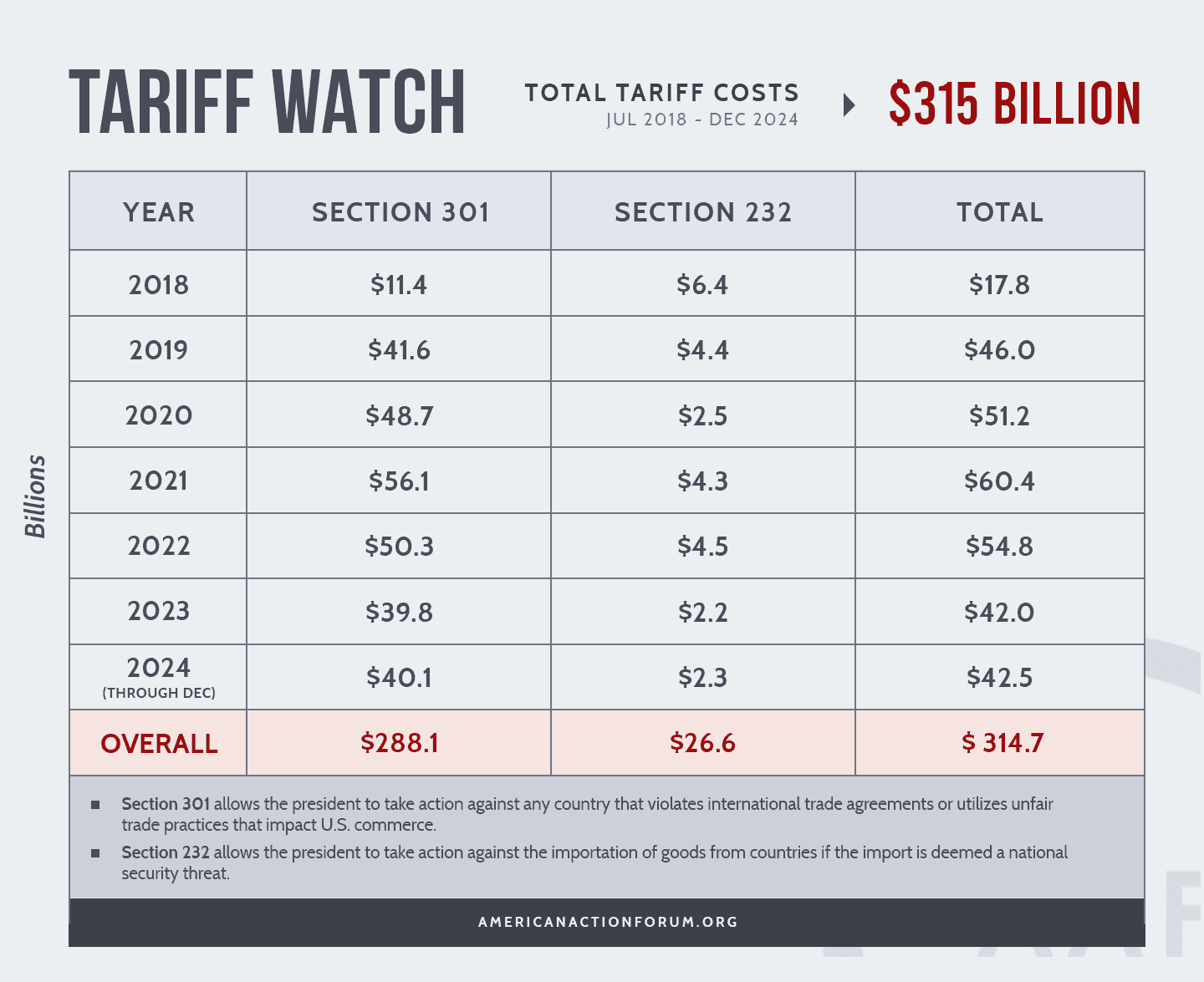
What’s Happening: While some celebrated May the Fourth by watching a Star Wars movie, President Trump cautioned that the U.S. film industry is “DYING a very fast death.” This prompted the president to announce that his administration will look into instituting a 100-percent tariff on movies produced abroad. The rationale behind this move, as with nearly every tariff implemented by the Trump Administration, is that other countries’ efforts to draw film production away from the United States pose a national security risk. Trump is expected to meet with Hollywood executives to gauge their reaction to a foreign film tariff, which helps explain why details on how this tariff would be implemented remain scarce. The process for implementing such a tariff would likely begin via a Section 232 investigation by the United States Trade Representative alongside a report on how foreign films are a national security threat.
Why It Matters: If enacted, this proposed tariff would be the first in U.S. history placed on an imported service rather than a good, although this is not the first time the administration has entered unchartered trade waters. What makes the move to tariff services interesting, setting aside the unknown implementation process, is the fact that the United States has a net surplus in service exports. Indeed, the U.S. film industry had over $22 billion in exports in 2023, with a trade surplus between $14.9 billion and $15.3 billion. Without question, Hollywood is the world’s most dominant film industry. Out of the top 10 largest film studios since 1995, all are considered U.S. studios. Widening the view to the top 50, only one can be considered entirely foreign and it eventually merged with Universal Pictures, a U.S. firm. If this were not enough to ease “national security” concerns, the film industry is extremely consolidated. The top 10 movie studios accounted for slightly over 85 percent of the domestic box office between 1995 and 2025, meaning Americans overwhelmingly watch American-made movies from American movie studios on American screens. Widening the scope to the top 200 studios, the picture does not get any clearer for the Trump Administration’s movie tariff, as 99.6 percent of the domestic box office went to U.S. film studios. Even on the world stage, U.S. consumers make up an outsized portion of global moviegoers, accounting for just under one-third of the worldwide box office in 2024. The global reach and influence of the U.S. film industry means that it will be susceptible to retaliatory measures, particularly from China, which accounts for almost 20 percent of the global box office and has already displayed willingness to limit imports of U.S. films. Furthermore, if a movie tariff targets any studio that films outside the United States, the entirety of Hollywood will be at risk of facing whatever convoluted service-tariff system is developed. Streaming services such as Disney+, Max, and especially Netflix have begun diversifying their content for global audiences by filming in exotic locations or partnering with foreign studios, making any tariff calculation based on a subscription service much more complex.
Looking Ahead: As AAF President Douglas Holtz-Eakin noted, it is far from clear how such a tariff would be implemented. Whether film studios would have to pay according to their production budget, movie ticket price, or some other calculation remains to be seen. Given the unprecedented nature of putting a tariff on entertainment, the process of figuring out how the 100-percent tax would work likely buys time for the film industry to speak with the administration. A dialogue with the film industry might show the administration that the problem is not that movies are being filmed in London rather than Los Angeles. The concern that foreign studios are stealing market share is also not terribly convincing. The real issue lies in the fact that the film industry has not recovered since the COVID-19 pandemic. Adjusting for inflation, the 2024 domestic box office figures are right around 1983 levels. Any conversation President Trump has with the film industry will almost certainly touch on the fact Americans are not going to theaters in the same numbers and entertainment is shifting from big screen releases to monthly subscription services. Adding costs to movie productions or film consumers is the last thing U.S. studios need right now and could be a death blow to the movie theater experience.

Source: The Numbers
The First Trade Deal: A Mixed Bag
What’s Happening: It was confirmed on May 8 via Truth Social that the first U.S. trade agreement to stave of “Liberation Day” tariffs would be with the United Kingdom (UK). As mentioned last week, the UK was one of a few possible countries that could receive the first announced deal, with President Trump stating that the UK-U.S. relationship has a long history. During the press conference, the Trump trade team announced that the UK would reduce non-tariff barriers, purchase $10 billion worth of Boeing planes, and lower certain tariff rates. The United States, meanwhile, is maintaining the universal 10-percent tariff on the UK, introducing a tariff-rate quota for British automobiles, and reducing steel and aluminum tariffs from 25 percent to 0. Additionally, Trump officials mentioned that the UK would begin fast tracking the import process for U.S. goods and the UK would be part of the U.S. “economic security blanket”. What this might mean is still unclear.
Why It Matters: This first trade deal, while an important steppingstone toward reducing trade barriers with additional trade partners in the near future, does not account for a significant portion of U.S. trade. The UK represented just 2.1 percent of imports in 2024, and the 10-percent “Liberation Day” tariff was formulated despite the U.S. trade surplus with the country. That this tariff will remain in place likely indicates that the 10-percent tariff is non-negotiable for every country, and will not be going away any time soon. Reminder: A flat, universal tariff still raises U.S. household costs by between $1,700 and $2,350 annually. Setting aside the maintenance of the “Liberation Day” tariff rate on the UK (which is not reciprocal), the reduction of sector-specific tariffs is a slight positive. The United States will be lowering automobile tariffs from 25 percent to 10 percent for the first 100,000 car imports and eliminating the steel and aluminum tariffs completely. This does, in effect, bring the United States back to where it began on the steel and aluminum front, as there was a prior tariff-rate quota that UK imports never really hit anyway. Increased market access for U.S. agricultural exports was highlighted as a major success, although the UK made clear that it will not be altering its food standards, meaning that hormone-treated U.S. beef will still not be admitted. Lacking from the discussion was any change to the UK’s digital service tax, which heavily impacts the U.S. technology industry.
Looking Ahead: Both President Trump and British Prime Minister Keir Starmer are touting this trade deal as a historic success that has been in the making for many years, although it has yet to be formalized. The major takeaway from today is that countries seem to be negotiating to avoid tariffs higher than a baseline 10 percent, which on its own represents one of the largest tax increases in U.S. history. Additionally, the precedent has now been set that the Section 232 tariffs for national security are on the table for reductions. If previous speculation holds, the next trade deal may be with India, Vietnam, or Japan. For now, keep an eye on the upcoming meeting in Switzerland between the United States and China that is intended to open the door to a future trade deal.