







Week in Regulation
November 9, 2026
A Deregulatory Start to November
The most politically consequential aspect of this past week was, of course, the midterm elections. Over in the pages of the Federal Register, though, agencies were quite busy churning out new regulatory and deregulatory actions. There were 17 rulemakings that contained some kind of quantified economic analysis. The main actions of the week trended in a decidedly – though not overwhelmingly – deregulatory direction. Cost-cutting rulemakings from the Departments of Transportation (DOT), Labor (DOL), and Agriculture (USDA), respectively, constituted the standout items. Overall, federal agencies published roughly $1.7 billion in total cost savings and cut 1.4 million paperwork burden hours.
REGULATORY TOPLINES
- Proposed Rules This Week: 31
- Final Rules This Week: 46
- 2026 Total Pages: 70,649
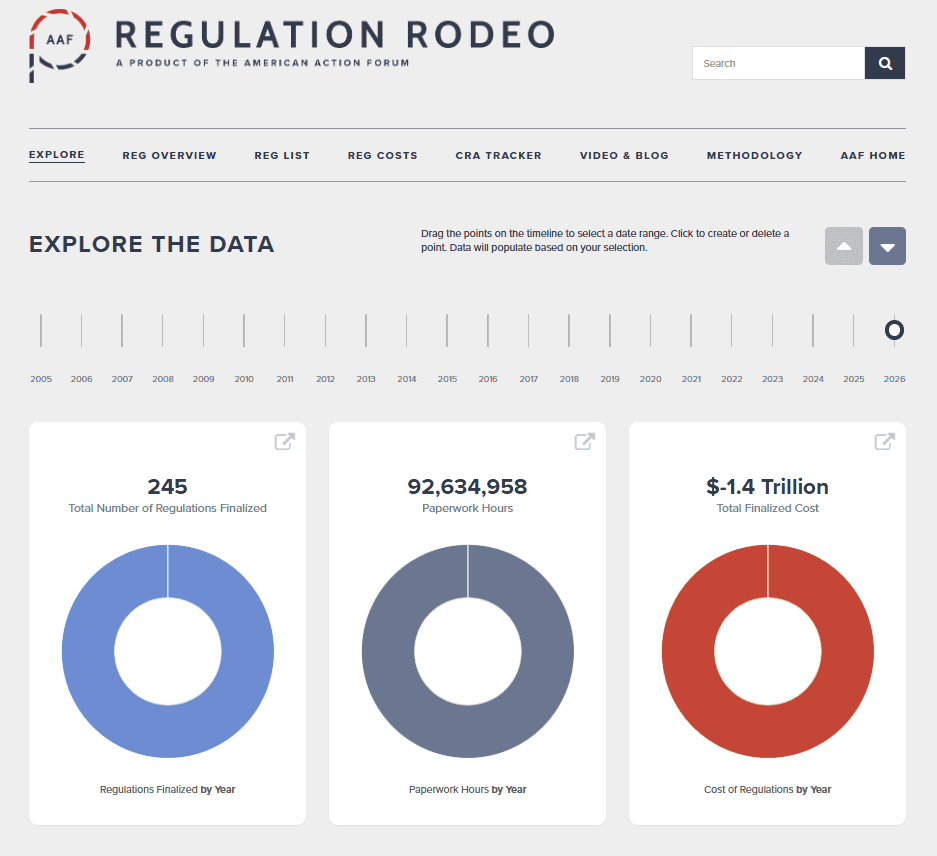
- 2026 Final Rule Costs: -$1.4 trillion
- 2026 Proposed Rule Costs: $52.7 billion
NOTABLE REGULATORY ACTIONS
The most significant rulemaking of the week was the proposed rule from DOT regarding “Pipeline Safety: Amendments to Liquefied Natural Gas Facilities.” As the succinct title suggests, the agency is “updating its regulations for liquefied natural gas (LNG) facilities to incorporate by reference the most recent industry safety standards and to make other changes to account for more than two decades of improvements and technological advancements.” Per the rulemaking’s “Background” section, the current “regulations are largely based on the 2001 edition of an industry standard, NFPA 59A, Standard for the Production, Storage, and Handling of Liquefied Natural Gas (LNG), and have not been updated since 2006.” DOT estimates that these changes will yield just over $1 billion in total compliance cost savings for affected facilities.
The second-biggest cost-cutter of the week was the DOL rule entitled “Prohibiting Illegal Discrimination in Registered Apprenticeship Programs.” The rule rescinds a series of “affirmative action requirements that were previously imposed by the Department on Registered Apprenticeship program sponsors.” The agency anticipates that eliminating the covered training and reporting requirements will result in roughly $694 million in total net cost reductions for affected entities. The estimated shifts in paperwork burdens, however, are unclear and rather puzzling. Just as in the proposed version of the rule, the final version does not include quantified estimates. Curiously, an associated notice includes an estimated 1.1 million hours – a sum that is roughly double the currently estimated amount for the paperwork requirements in question.
The last major deregulatory action of the week was the USDA rule on “Special Supplemental Nutrition Program for Women, Infants, and Children (WIC): Online Ordering and Transactions and Food Delivery Revisions To Meet the Needs of a Modern, Data-Driven Program.” Per the rule’s introduction:
This rule sets forth regulatory flexibilities, encourages innovation, and modernizes WIC food delivery regulations. The rule ensures WIC participants have the same shopping options as non-WIC shoppers to transact their WIC benefits as the retail marketplace innovates and evolves. This rule also clarifies requirements so that State agencies can effectively carry out a modern, data-driven program that uses current technologies for food delivery.
USDA expects such changes to result in significant time savings, both from streamlining certain administrative burdens and allowing covered beneficiaries the convenience afforded by online ordering options. Per the rule’s analysis, total monetized savings add up to nearly $246 million with a roughly two-million-hour reduction in relevant paperwork requirements.
TRACKING TRUMP 2.0
In assessing (calendar year) 2026 rulemakings that include an Executive Order (EO) 14192 determination, there have been 87 “deregulatory” rules with combined total savings of $1.5 trillion against 17 “regulatory” rules that involve roughly $46.3 billion in costs. Adding that to the total agencies produced during 2025 (at least from rules that had a clear “regulatory” or “deregulatory” designation), the Trump Administration has enacted $1.6 trillion in total cost reductions thus far under EO 14192. Rules for which agencies have claimed one of the EO’s exemptions have accounted for an additional $7.6 billion in costs so far in 2026.
CONGRESSIONAL REVIEW ACT (CRA)
The AAF CRA tracker provides a full survey of activity under the law thus far into this term. As of today, members of the 119th Congress have introduced CRA resolutions of disapproval addressing 148 “rules” that collectively involve $175.5 billion in estimated compliance costs. Of these, 23 have been passed into law, repealing a series of Biden Administration rules that had a combined $3 billion in associated compliance costs. The Trump Administration estimates that the repeal of a Biden-era rule on air pollutants yields an additional $936 million in savings. While the main window of CRA action has largely passed, there are still outstanding resolutions that could move legislatively. AAF will continue to monitor and update such developments as appropriate.
TOTAL BURDENS
Since the start of 2026, the federal government has published $1.4 trillion in total regulatory net cost savings (with $1.4 trillion in reductions from finalized rules) and 159.2 million hours of net annual paperwork increases (with 92.6 million hours coming from final rules).