







Week in Regulation
October 26, 2026
An “Interpretive Rule” Leaves a Surprising Impact
Last week represented a modestly active one in terms of federal agencies’ regulatory developments. There were 11 rulemakings that contained some kind of measurable economic effect. Chief among these was a somewhat unusual rule from the Consumer Product Safety Commission (CPSC) updating the agency’s official interpretation of what substances constitute “flammable liquid fuels.” This “interpretive rule” – a sub-category of rule that often involves more qualitative than quantitative impact – could apparently result in billions of dollars of cost savings over the ensuing decades. Overall, federal agencies published roughly $10.5 billion in total cost savings but added 3.3 million paperwork burden hours.
REGULATORY TOPLINES
- Proposed Rules This Week: 32
- Final Rules This Week: 46
- 2026 Total Pages: 67,079
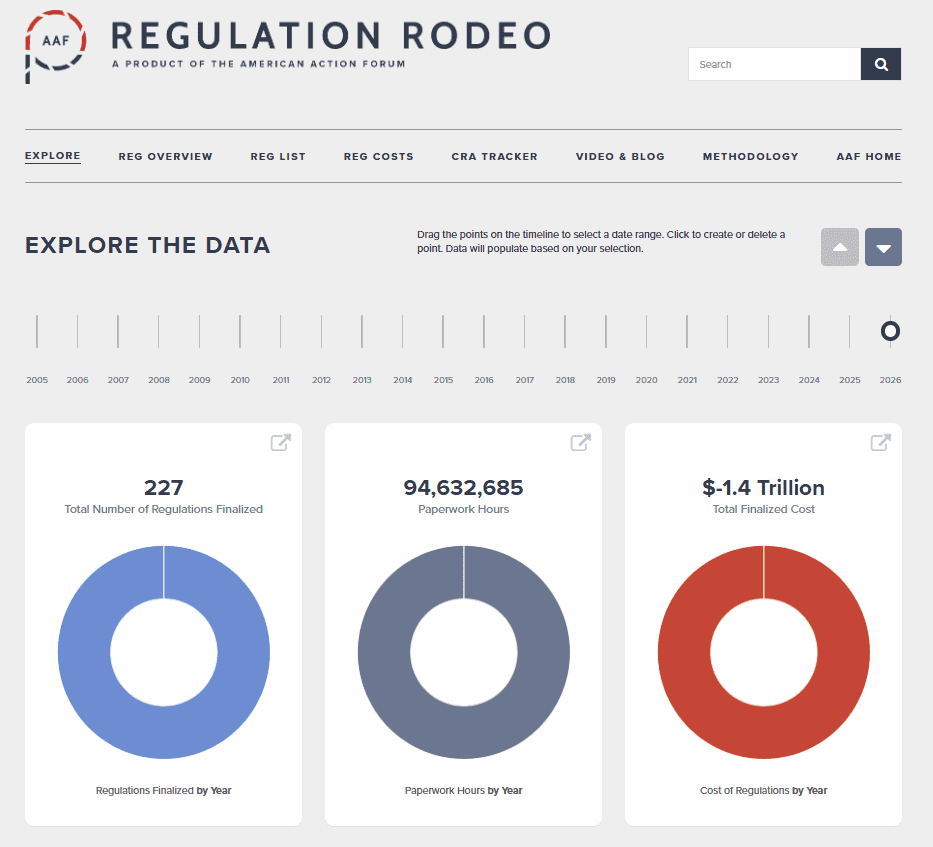
- 2026 Final Rule Costs: -$1.4 trillion
- 2026 Proposed Rule Costs: $84.9 billion
NOTABLE REGULATORY ACTIONS
The most consequential rulemaking of the week was the rule from CPSC regarding the “Interpretation of ‘Flammable Liquid Fuels’ With Respect to Fuel Additives.” Specifically:
The Commission interprets this phrase not to include fuel additives that are intended to be added to flammable liquid fuels for the sole purpose of improving engine performance, cleaning engine components, extending engine life, stabilizing fuel, preventing weather effects from fuel, or some similar purpose unrelated to creating heat or power.
This updated set of parameters comes from the commission acceding to a district court’s finding that the previous interpretation was overly broad and covered substances that did not meet the plain definition of “fuel.” As the commission further notes, this represents an example of the shift in executive-judicial deference under the Loper Bright decision. Perhaps the most remarkable aspect, however, comes in the potential economic effects. The commission’s staff estimate that “this clarification avoids approximately $545.7 million in annual compliance costs that otherwise would be incurred by manufacturers of fuel additive products,” or upward of $10.7 billion in total cost savings across a 30-year horizon.
TRACKING TRUMP 2.0
In assessing (calendar year) 2026 rulemakings that include an Executive Order (EO) 14192 determination, there have been 82 “deregulatory” rules with combined total savings of $1.5 trillion against 15 “regulatory” rules that involve roughly $45.9 billion in costs. Adding that to the total agencies produced during 2025 (at least from rules that had a clear “regulatory” or “deregulatory” designation), the Trump Administration has enacted $1.6 trillion in total cost reductions thus far under EO 14192. Rules for which agencies have claimed one of the EO’s exemptions have accounted for an additional $7.5 billion in costs so far in 2026.
CONGRESSIONAL REVIEW ACT (CRA)
The AAF CRA tracker provides a full survey of activity under the law thus far into this term. As of today, members of the 119th Congress have introduced CRA resolutions of disapproval addressing 148 “rules” that collectively involve $175.5 billion in estimated compliance costs. Of these, 23 have been passed into law, repealing a series of Biden Administration rules that had a combined $3 billion in associated compliance costs. The Trump Administration estimates that the repeal of a Biden-era rule on air pollutants yields an additional $936 million in savings. While the main window of CRA action has largely passed, there are still outstanding resolutions that could move legislatively. AAF will continue to monitor and update such developments as appropriate.
TOTAL BURDENS
Since the start of 2026, the federal government has published $1.36 trillion in total regulatory net cost savings (with $1.4 trillion in reductions from finalized rules) and 153.1 million hours of net annual paperwork increases (with 94.6 million hours coming from final rules).