







Week in Regulation
November 16, 2026
Cost-Cutting Week Marred by Major Paperwork Surge
Despite being holiday-shortened, federal rulemaking continued at a brisk pace last week. There were 15 federal actions that had some kind of measurable economic impact. The main items were deregulatory proposals from the Departments of Health & Human Services (HHS) and Labor (DOL). Another proposed rule from the Department of Agriculture (USDA) seeking to implement stricter eligibility requirements for Supplemental Nutrition Assistance Program (SNAP) benefits, however, countered the week’s generally cost-reducing trend with substantial administrative burdens. Overall, federal agencies published roughly $3 billion in total cost savings but added million 17.1 paperwork burden hours.
REGULATORY TOPLINES
- Proposed Rules This Week: 36
- Final Rules This Week: 54
- 2026 Total Pages: 73,305
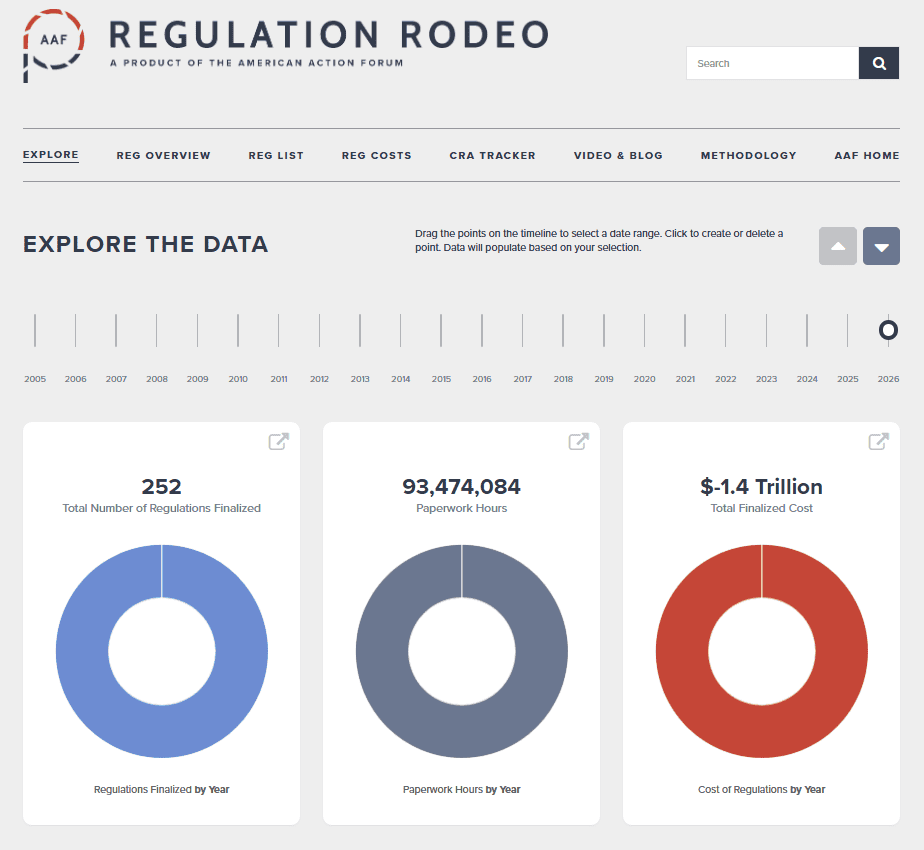
- 2026 Final Rule Costs: -$1.4 trillion
- 2026 Proposed Rule Costs: $49.9 billion
NOTABLE REGULATORY ACTIONS
The most significant rulemaking from a regulatory costs or savings perspective was the proposed rule from HHS entitled “Medicare and Medicaid Programs; Cutting Administrative Requirements for Excellence in Patient Care.” As the succinct title suggests, the proposal seeks to “reform Medicare and Medicaid regulations deemed obsolete or excessively burdensome on healthcare providers and suppliers, with the objective of reducing costs, enhancing flexibility in delivering innovative care, and streamlining existing regulations.” The proposed changes cut across a wide swath of the health care industry. HHS estimates that such changes will yield cost and paperwork reductions of nearly $320 million and 885,000 hours annually. Over the proposal’s 10-year analytical window, total cost savings amount to roughly $2.2 billion.
The other major deregulatory action of the week was the latest proposed rule from DOL regarding “Respirable Crystalline Silica and Respiratory Protection.” Specifically, the proposal “includes clarifications and improvements to requirements for methods of compliance, exposure monitoring, respiratory protection, medical surveillance, and recordkeeping” from a 2024 Biden Administration rule on the matter. This now Trump-era DOL estimates that the various updates it proposes here will add up to $1.3 billion in total cost savings for affected mining operations across a 60-year window.
Last, the most consequential burden-adding rulemaking of the week was the USDA proposal on “Supplemental Nutrition Assistance Program: Reforming Categorical Eligibility.” As the rulemaking’s summary states:
Under section 5(a) of the Food and Nutrition Act of 2008, households in which each member receives benefits under a State program funded by Temporary Assistance for Needy Families (TANF) are categorically eligible for the Supplemental Nutrition Assistance Program (SNAP). Current SNAP regulations consider TANF benefits to include both cash assistance and non-cash or in-kind benefits or services from TANF-funded programs. This proposal would limit categorical eligibility to only households that receive TANF assistance.
The main economic effect of this proposed rule would be on the fiscal side with “the total reduction in Federal SNAP transfers (SNAP benefit spending) associated with the provisions of this proposed rule to be approximately $44.649 billion over the five-year period FY 2027-FY 2031.” From a regulatory costs or savings perspective, however, the changes in eligibility verification requirements for affected state agencies and households represent sizable administrative burdens. USDA estimates that these changes will involve roughly 14.3 million hours of additional paperwork with nearly $161 million in commensurate costs annually (or just over $800 million total across the five-year window included above).
TRACKING TRUMP 2.0
In assessing (calendar year) 2026 rulemakings that include an Executive Order (EO) 14192 determination, there have been 88 “deregulatory” rules with combined total savings of $1.5 trillion against 18 “regulatory” rules that involve roughly $46.4 billion in costs. Adding that to the total agencies produced during 2025 (at least from rules that had a clear “regulatory” or “deregulatory” designation), the Trump Administration has enacted $1.6 trillion in total cost reductions thus far under EO 14192. Rules for which agencies have claimed one of the EO’s exemptions have accounted for an additional $7.7 billion in costs so far in 2026.
CONGRESSIONAL REVIEW ACT (CRA)
The AAF CRA tracker provides a full survey of activity under the law thus far into this term. As of today, members of the 119th Congress have introduced CRA resolutions of disapproval addressing 148 “rules” that collectively involve $175.5 billion in estimated compliance costs. Of these, 23 have been passed into law, repealing a series of Biden Administration rules that had a combined $3 billion in associated compliance costs. The Trump Administration estimates that the repeal of a Biden-era rule on air pollutants yields an additional $936 million in savings. While the main window of CRA action has largely passed, there are still outstanding resolutions that could move legislatively. AAF will continue to monitor and update such developments as appropriate.
TOTAL BURDENS
Since the start of 2026, the federal government has published $1.4 trillion in total regulatory net cost savings (with $1.4 trillion in reductions from finalized rules) and 176.3 million hours of net annual paperwork increases (with 93.5 million hours coming from final rules).