







Week in Regulation
November 2, 2026
A Major Methane Proposal and a Couple of Offsetting HHS Rulemakings
Federal agency regulatory activity was fairly animated this past week. All told, there were 14 rulemakings that carried some kind of measurable economic effect. Among these, there were three stand-out items. The Environmental Protection Agency (EPA) unveiled its proposed rescission of Biden-era methane emissions standards for power plants. Meanwhile, the Department of Health & Human Services (HHS) had a deregulatory rule and a regulatory proposal where the respective costs and savings essentially canceled each other out. Overall, federal agencies published roughly $32 billion in total cost savings but added 7.5 million paperwork burden hours.
REGULATORY TOPLINES
- Proposed Rules This Week: 21
- Final Rules This Week: 55
- 2026 Total Pages: 68,753
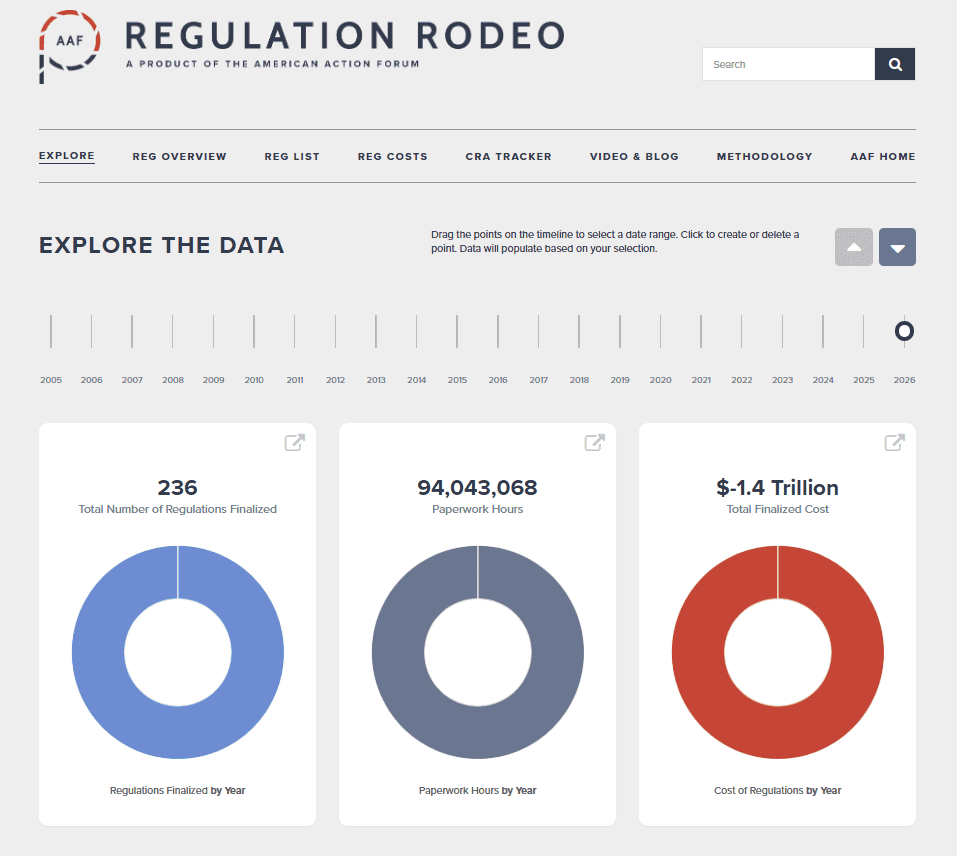
- 2026 Final Rule Costs: -$1.4 trillion
- 2026 Proposed Rule Costs: $53.9 billion
NOTABLE REGULATORY ACTIONS
The most consequential rulemaking of the week was the EPA proposed rule on “Additional Reconsideration Standards of Performance for New, Reconstructed, and Modified Sources and Emissions Guidelines for Existing Sources: Oil and Natural Gas Sector Climate Review.” The proposal seeks to make a series of changes that would significantly roll back a March 2024 Biden Administration rule on the matter. This current EPA estimates that its proposal will result in $32 billion in total cost savings for affected facilities. The cost reductions calculated in the proposal’s analysis are significantly higher than the corresponding cost increase estimates in the original Biden-era rule – due primarily to the former utilizing a longer analytical window than the latter.
The other substantial actions of the week emanated from HHS in a burden-adding proposed rule and cost-cutting final rule. The proposal implements provisions of Public Law 119-21 (the legislation formerly known as the “One Big Beautiful Bill Act,” but now referred to here as the “Working Families Tax Cut”) that establish more stringent criteria for Affordable Care Act exchange eligibility. The agency anticipates that the administrative burdens for consumers and exchange operators from these new requirements could amount to roughly $240 million and 8.3 million hours of annual costs and paperwork, respectively (or approximately $984 million in total costs across the five-year analytic window included). The other significant action from HHS was its final rule on “Health Data, Technology, and Interoperability: ONC Deregulatory Actions To Unleash Prosperity.” As the title suggests, the rule “reduces burden, offers flexibility to both developers and providers, and supports innovation through the removal and revision of certain certification criteria and regulatory provisions.” The agency expects such changes to result in $944 in total cost savings – but only reduces annual paperwork burdens by about 570,000 hours.
TRACKING TRUMP 2.0
In assessing (calendar year) 2026 rulemakings that include an Executive Order (EO) 14192 determination, there have been 84 “deregulatory” rules with combined total savings of $1.5 trillion against 15 “regulatory” rules that involve roughly $45.9 billion in costs. Adding that to the total agencies produced during 2025 (at least from rules that had a clear “regulatory” or “deregulatory” designation), the Trump Administration has enacted $1.6 trillion in total cost reductions thus far under EO 14192. Rules for which agencies have claimed one of the EO’s exemptions have accounted for an additional $7.5 billion in costs so far in 2026.
CONGRESSIONAL REVIEW ACT (CRA)
The AAF CRA tracker provides a full survey of activity under the law thus far into this term. As of today, members of the 119th Congress have introduced CRA resolutions of disapproval addressing 148 “rules” that collectively involve $175.5 billion in estimated compliance costs. Of these, 23 have been passed into law, repealing a series of Biden Administration rules that had a combined $3 billion in associated compliance costs. The Trump Administration estimates that the repeal of a Biden-era rule on air pollutants yields an additional $936 million in savings. While the main window of CRA action has largely passed, there are still outstanding resolutions that could move legislatively. AAF will continue to monitor and update such developments as appropriate.
TOTAL BURDENS
Since the start of 2026, the federal government has published $1.4 trillion in total regulatory net cost savings (with $1.4 trillion in reductions from finalized rules) and 160.6 million hours of net annual paperwork increases (with 94 million hours coming from final rules).