







Week in Regulation
October 19, 2026
SEC Notches Another Sizable Cost-cutting Proposal
This past holiday-shortened week was relatively unremarkable in terms of regulatory activity. There were nine federal agency rulemakings that contained some kind of measurable economic impact, with only one crossing the billion-dollar threshold. That one stand-out item – a proposed rule from the Securities and Exchange Commission (SEC) – adds to the commission’s ongoing trend in recent months of steadily producing substantial deregulatory measures. Overall, federal agencies published roughly $1 billion in total cost savings but added 25,234 paperwork burden hours.
REGULATORY TOPLINES
- Proposed Rules This Week: 31
- Final Rules This Week: 53
- 2026 Total Pages: 65,772
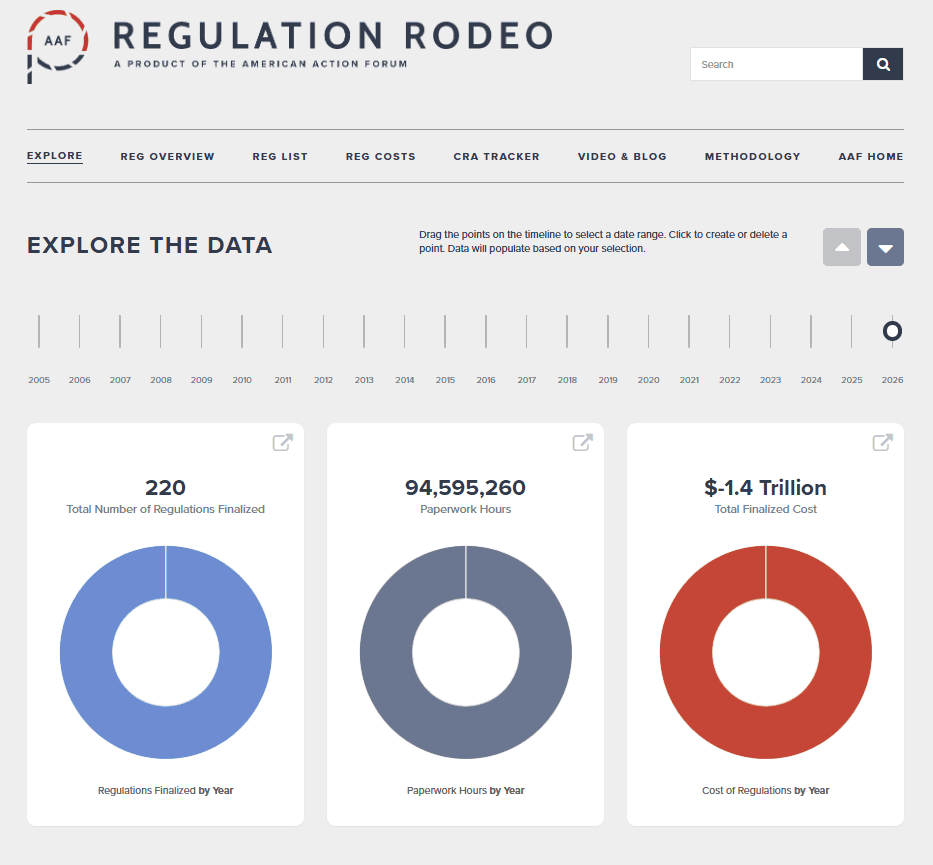
- 2026 Final Rule Costs: -$1.4 trillion
- 2026 Proposed Rule Costs: $84.6 billion
NOTABLE REGULATORY ACTIONS
The most consequential rulemaking of the week was the proposed rule from SEC regarding “Investment Company Cross Trading.” Specifically, the proposal seeks “to amend the rule under the Investment Company Act of 1940 (the “Investment Company Act”) that permits securities transactions between a registered investment company and certain affiliates (referred to as “cross trades”)…to expand the scope of securities that are eligible for cross trading, modernize the rule’s conditions, and enhance investor protection.” While SEC expects some of the proposal’s changes to result in increased costs, they also expect cost savings in the form of “reduced transaction costs and operational efficiencies” to outweigh new costs significantly. According to the commission’s analysis, the proposal could yield roughly $1.1 billion in net cost savings for affected entities. The rulemaking joins a consistent stream of cost-cutting proposals promulgated by SEC over recent months.
TRACKING TRUMP 2.0
In assessing (calendar year) 2026 rulemakings that include an Executive Order (EO) 14192 determination, there have been 80 “deregulatory” rules with combined total savings of $1.5 trillion against 15 “regulatory” rules that involve roughly $45.9 billion in costs. Adding that to the total agencies produced during 2025 (at least from rules that had a clear “regulatory” or “deregulatory” designation), the Trump Administration has enacted $1.6 trillion in total cost reductions thus far under EO 14192. Rules for which agencies have claimed one of the EO’s exemptions have accounted for an additional $7.5 billion in costs so far in 2026.
CONGRESSIONAL REVIEW ACT (CRA)
The AAF CRA tracker provides a full survey of activity under the law thus far into this term. As of today, members of the 119th Congress have introduced CRA resolutions of disapproval addressing 148 “rules” that collectively involve $175.5 billion in estimated compliance costs. Of these, 23 have been passed into law, repealing a series of Biden Administration rules that had a combined $3 billion in associated compliance costs. The Trump Administration estimates that the repeal of a Biden-era rule on air pollutants yields an additional $936 million in savings. While the main window of CRA action has largely passed, there are still outstanding resolutions that could move legislatively. AAF will continue to monitor and update such developments as appropriate.
TOTAL BURDENS
Since the start of 2026, the federal government has published $1.35 trillion in total regulatory net cost savings (with $1.4 trillion in reductions from finalized rules) and 149.8 million hours of net annual paperwork increases (with 94.6 million hours coming from final rules).