Week in Regulation
October 5, 2026
A Very Topsy-Turvy Week
This past week of federal agency regulatory actions saw plenty in terms of both volume and magnitude. There were 19 rulemakings that contained some kind of quantifiable economic impact. From the cost/savings side, the main item was the Department of Transportation’s (DOT) rule on fuel efficiency standards for passenger vehicles. While that rule stood out as one of the more sizable deregulatory actions of late, a couple of rules from the Internal Revenue Service (IRS) setting up compliance requirements for new tax provisions led to a conspicuous spike in paperwork burdens. Overall, federal agencies published roughly $283.2 billion in total cost savings but added 14.6 million paperwork burden hours.
REGULATORY TOPLINES
- Proposed Rules This Week: 34
- Final Rules This Week: 78
- 2026 Total Pages: 63,022
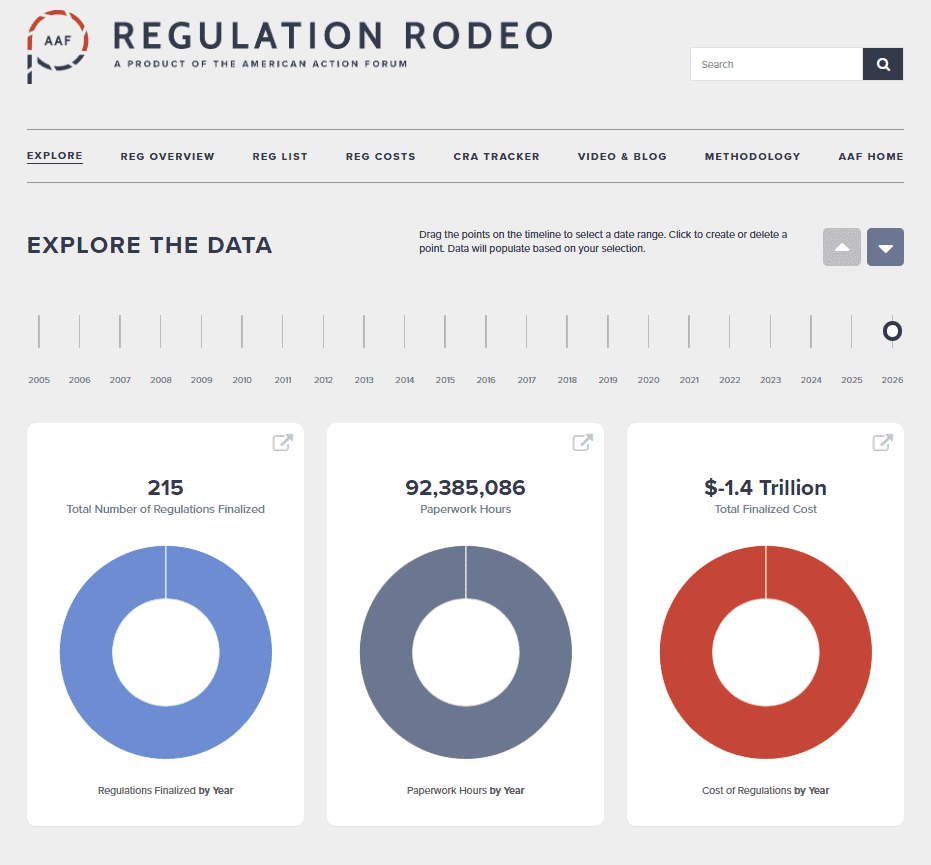
- 2026 Final Rule Costs: -$1.4 trillion
- 2026 Proposed Rule Costs: $45.4 billion
NOTABLE REGULATORY ACTIONS
The most consequential rulemaking of the week was the DOT rule titled “The Safer Affordable Fuel-Efficient (SAFE) Vehicles Rule III for Model Years 2022 to 2031 Passenger Cars and Light Trucks.” Much as with the 2025 proposed version of the rule, DOT is making a series of changes to the relevant regulatory code to significantly reduce the stringency of fuel efficiency standards established under the Biden Administration. The agency estimates that these various updates will provide roughly $283 billion in total savings for affected vehicle manufacturers across a 27-year time horizon. This makes it the second most deregulatory final rule produced during second Trump term thus far, trailing only the related-yet-separate roll-back of greenhouse gas emissions standards from the Environmental Protection Agency.
In spite of such a substantial cost-cutting measure, there were also some burden-adding rules this past week. The main items here were a pair of rules from IRS that establish the compliance framework for: 1) automatic enrollment for “Trump Accounts” and 2) the “Federal Scholarship Tax Credit.” As is often the case with tax-related paperwork, the sheer breadth of affected respondents necessarily yields sizable sums. IRS estimates that the first rule will involve 6.3 million hours of paperwork each year, while the second one will bring nearly 8.3 million hours annually.
TRACKING TRUMP 2.0
The SAFE Vehicles rule mentioned above represented one of the more significant shifts in the regulatory budget math in some time. With its publication coming on September 30, it also happened to fall – just barely – within fiscal year (FY) 2026. It will surely be a major component of any forthcoming Executive Order (EO) 14192 accounting for the fiscal year from the administration. Stay tuned for the American Action Forum’s (AAF) own assessment (similar to past iterations) of agency progress under the EO during FY 2026.
In assessing (calendar year) 2026 rulemakings that include an EO 14192 determination, there have been 78 “deregulatory” rules with combined total savings of $1.5 trillion against 15 “regulatory” rules that involve roughly $45.9 billion in costs. Adding that to the total agencies produced during 2025 (at least from rules that had a clear “regulatory” or “deregulatory” designation), the Trump Administration has enacted $1.6 trillion in total cost reductions thus far under EO 14192. Rules for which agencies have claimed one of the EO’s exemptions have accounted for an additional $7.1 billion in costs so far in 2026.
CONGRESSIONAL REVIEW ACT (CRA)
The AAF CRA tracker provides a full survey of activity under the law thus far into this term. As of today, members of the 119th Congress have introduced CRA resolutions of disapproval addressing 148 “rules” that collectively involve $175.5 billion in estimated compliance costs. Of these, 23 have been passed into law, repealing a series of Biden Administration rules that had a combined $3 billion in associated compliance costs. The Trump Administration estimates that the repeal of a Biden-era rule on air pollutants yields an additional $936 million in savings. While the main window of CRA action has largely passed, there are still outstanding resolutions that could move legislatively. AAF will continue to monitor and update such developments as appropriate.
TOTAL BURDENS
Since the start of 2026, the federal government has published $1.4 trillion in total regulatory net cost savings (with $1.4 trillion in reductions from finalized rules) and 123.1 million hours of net annual paperwork increases (with 92.4 million hours coming from final rules).