Week in Regulation
September 28, 2026
A Steady Week of Cost Cuts
This past week saw a reasonably high volume of Federal Register activity, but nothing on the order of magnitude seen during the preceding week. There were 17 agency rulemakings that carried some kind of quantified economic impact. This week’s cohort of rules generally trended in the deregulatory direction, with proposed rules from the Federal Deposit Insurance Corporation (FDIC) and Nuclear Regulatory Commission (NRC), leading the way. Both proposals brought cost reductions measured in hundreds of millions of dollars. Overall, federal agencies published roughly $953.1 million in total cost savings and cut 169,003 paperwork burden hours.
REGULATORY TOPLINES
- Proposed Rules This Week: 43
- Final Rules This Week: 41
- 2026 Total Pages: 61,005
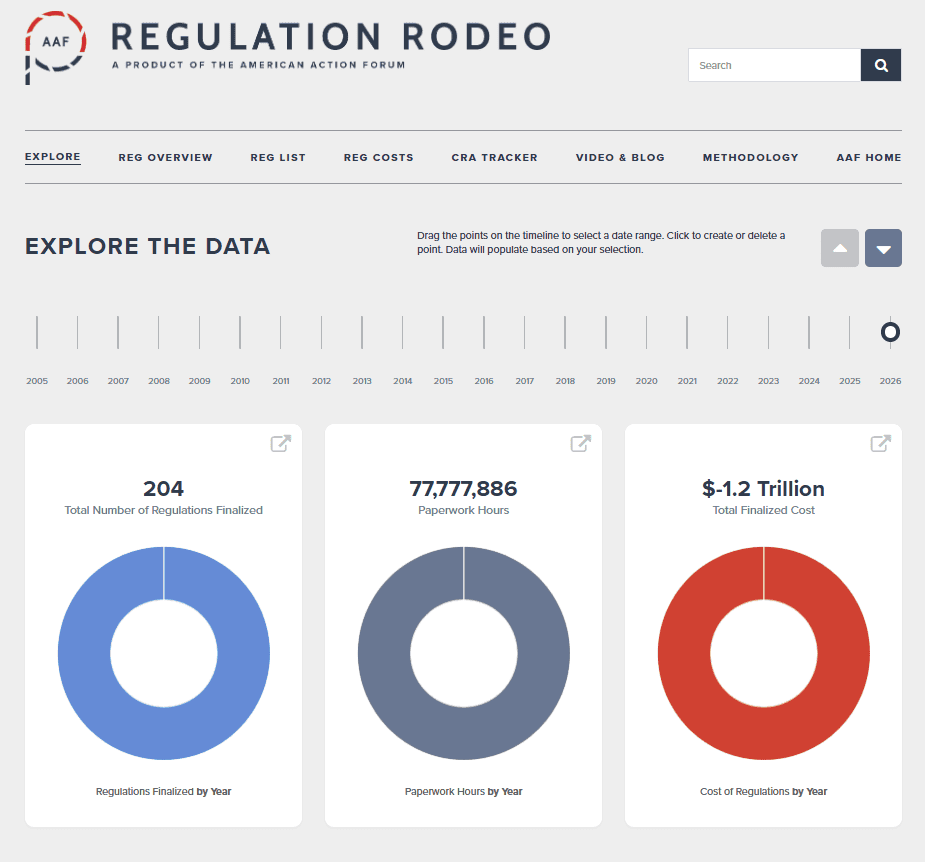
- 2026 Final Rule Costs: -$1.2 trillion
- 2026 Proposed Rule Costs: $45.4 billion
NOTABLE REGULATORY ACTIONS
The most significant rulemaking of the week in terms of economic impact was the proposed rule from FDIC regarding “State Bank Parity.” More specifically, the proposal seeks to update relevant regulatory code “to recognize parity between out-of-State State banks and national banks concerning the application of host State laws when State banks provide services outside of their chartering State.” FDIC estimates that such changes will result in $77 million in “foregone compliance costs” for affected institutions annually (or roughly $316 million in total savings when projected across a 5-year horizon).
The other consequential deregulatory proposal of the week was NRC’s rulemaking on “Regulatory Enhancements for Reactor Licensing, Decommissioning, and Operational Oversight.” The proposed rule seeks to update 15 different policy areas under the commission’s purview, based upon input from relevant stakeholders. NRC estimates that such changes will collectively yield $305 million in total net cost savings for affected facilities.
TRACKING TRUMP 2.0
In assessing 2026 rulemakings that include an Executive Order (EO) 14192 determination, there have been 75 “deregulatory” rules with combined total savings of $1.2 trillion against 14 “regulatory” rules that involve roughly $45.9 billion in costs. Adding that to the total agencies produced during 2025 (at least from rules that had a clear “regulatory” or “deregulatory” designation), the Trump Administration has enacted $1.3 trillion in total cost reductions thus far under EO 14192. Rules for which agencies have claimed one of the EO’s exemptions have accounted for an additional $7.1 billion in costs so far in 2026.
CONGRESSIONAL REVIEW ACT (CRA)
The AAF CRA tracker provides a full survey of activity under the law thus far into this term. As of today, members of the 119th Congress have introduced CRA resolutions of disapproval addressing 148 “rules” that collectively involve $175.5 billion in estimated compliance costs. Of these, 23 have been passed into law, repealing a series of Biden Administration rules that had a combined $3 billion in associated compliance costs. The Trump Administration estimates that the repeal of a Biden-era rule on air pollutants yields an additional $936 million in savings. While the main window of CRA action has largely passed, there are still outstanding resolutions that could move legislatively. AAF will continue to monitor and update such developments as appropriate.
TOTAL BURDENS
Since the start of 2026, the federal government has published $1.1 trillion in total regulatory net cost savings (with $1.2 trillion in reductions from finalized rules) and 108.5 million hours of net annual paperwork increases (with 77.8 million hours coming from final rules).